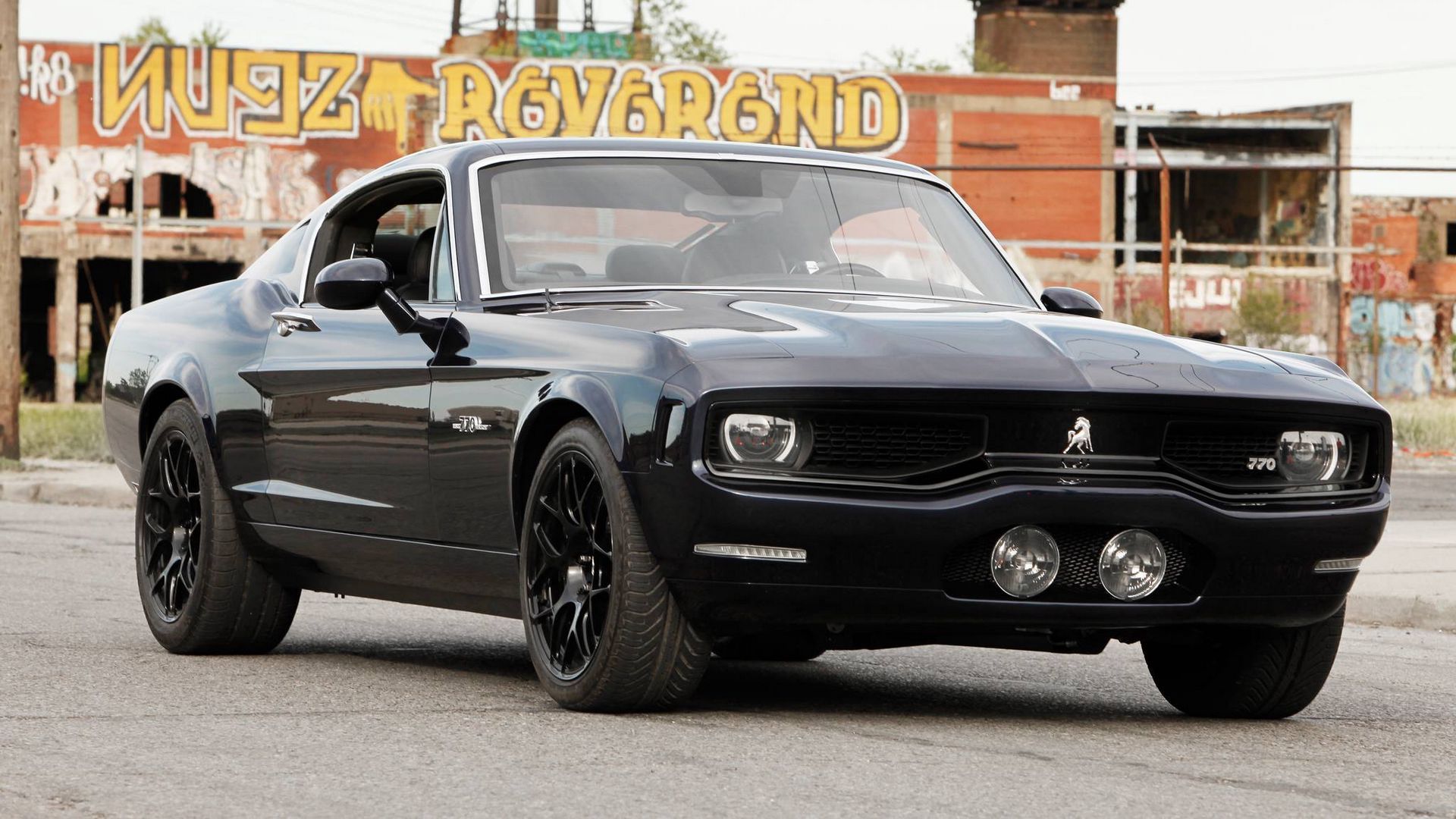
There’s an undeniable magic to classic muscle cars, isn’t there? That roar, that unmistakable silhouette, that feeling of pure, unadulterated power from a bygone era. For many, owning one isn’t just about driving; it’s a special bond between man and machine, a living piece of automotive history that evokes thrilling days of yesteryear. It’s no wonder we’re all so eager to get our hands on them and perhaps, just perhaps, make them even better.
But here’s where the road ahead gets a bit bumpy. The question invariably arises: where do we go from here? Should you keep that magnificent beast as original as possible, as many classic purists would vehemently argue is the only reasonable option? Or, should you dive headfirst into the modification game, striving to create a one-of-a-kind prized possession that has all the features and styling options you’ve always dreamed about? The answer, as it turns out, isn’t always as straightforward as a drag strip on a Saturday night.
While the allure of modern performance and comfort is strong, our tuning gurus have a word of caution, a stark warning borne from countless costly mistakes and dashed dreams. Many popular modifications, those shining promises of improved performance or stunning aesthetics, can lead to unexpected problems, erode value, and frankly, make you wish you’d just left well enough alone. So, before you grab that wrench or swipe that credit card, let’s take a candid look at some common upgrades that might just land you in a ditch of regret.

1. **Aftermarket Carburetors**Ah, the aftermarket carburetor. It whispers promises of better fuel delivery and a significant bump in power, a seemingly irresistible upgrade for anyone looking to squeeze a few more horses out of their classic V8. On paper, it sounds like a no-brainer, a simple bolt-on solution to unlock untapped potential. But let me tell you, what looks good on paper often turns into a genuine headache under the bonnet.
Our experts consistently highlight that many aftermarket carburetors require extensive, painstaking tuning. This isn’t a job for the faint of heart or the impatient; it’s a meticulous dance between air, fuel, and timing that, if not perfectly choreographed, can lead to a symphony of drivability issues. Imagine your pride and joy sputtering and stumbling, refusing to idle smoothly, all because you chased a horsepower phantom.
What often gets overlooked is how these performance parts interact with the car’s original engine setup. Muscle car engines, designed in a specific era with specific tolerances, rely on a delicate balance. Introducing an aftermarket carburetor that isn’t perfectly matched can disrupt this harmony, causing lean or rich running conditions. This isn’t just about minor performance hiccups; it can lead to long-term reliability issues and, in some dire cases, even significant engine damage.
So, while the siren song of increased power is tempting, remember that these upgrades can fundamentally alter air-fuel mixture delivery. Without expert knowledge and endless hours of fine-tuning, you might just find yourself swapping out one problem for a whole host of new ones, leaving you with less driving pleasure and a significantly lighter wallet.
Read more about: Riding That Eight-Year-Old Motorcycle? Here’s What Fellow Bikers *Secretly* Think About You (and Why It Matters).

2. **Oversized Wheels and Tires**There’s no denying the visual impact of a set of aggressively oversized wheels and tires. They give a classic muscle car a meaner, more modern stance, a look that shouts ‘power’ even when standing still. It’s a purely aesthetic choice for many, a way to imprint a personal style on their beloved machine. But as with so many things in life, what looks fantastic in the garage might be a complete disaster on the open road.
Our tuning gurus are quick to point out that these larger wheels can negatively impact a surprisingly wide array of critical driving dynamics. Forget about that smooth, classic ride quality; oversized rubber and heavy rims can make every bump in the road feel like a crater. Your steering feel, that direct connection to the road that makes muscle cars so engaging, can become vague and heavy, robbing you of precision and enjoyment.
And let’s not even start on the speedometer accuracy. With a change in tire diameter, your trusted speedometer can become a liar, throwing off your sense of speed and potentially landing you in hot water with the law. More critically, the video highlights how these seemingly innocent changes can place an immense strain on your car’s original suspension components, accelerating wear and tear and potentially leading to costly repairs down the line. It’s a classic case of form over function, with painful consequences.
Technically speaking, larger wheels significantly increase rotational mass. This isn’t just a minor detail; it directly affects your car’s acceleration, making it feel sluggish off the line. Furthermore, that added weight puts extra stress on crucial parts like suspension bushings and wheel bearings, shortening their lifespan and adding to your maintenance woes. So, think twice before you super-size; your muscle car’s handling and your wallet will thank you.
Read more about: Navigating the Automotive Minefield: Essential Car Accessories That Actually Save Lives (and the Gimmicks to Avoid)

3. **Non-Original Exhaust Systems**Oh, the glorious rumble of a muscle car! It’s an intoxicating symphony, and for many, the quest for an even louder, more aggressive note is irresistible. Upgrading to a non-original, modern exhaust system seems like a straightforward path to an improved auditory experience and perhaps even a performance boost. But before you get lost in the promise of a deeper growl, let’s explore why this can often be a regrettable detour.
While a new exhaust might certainly improve the sound – making your beast roar with more authority – it can profoundly alter something far more crucial: engine backpressure. The video explains that classic muscle car engines are meticulously designed to operate with specific exhaust flow characteristics. This isn’t arbitrary; it’s fundamental to maintaining their intended power and efficiency across the RPM range. Mess with this, and you mess with the heart of the machine.
Altering the backpressure with aftermarket pipes can disrupt what’s known as the ‘scavenging effect’ within the engine. This intricate process helps clear spent exhaust gases from the cylinders, allowing fresh air and fuel to enter more efficiently. When this delicate balance is thrown off, you might find yourself with power loss, rough idling, or a car that simply doesn’t run as smoothly or strongly as it once did. The performance gain you chased could very well turn into a noticeable degradation.
Beyond performance, the impact on fuel economy is another often-overlooked consequence. An improperly designed aftermarket exhaust can lead to less efficient combustion, meaning more trips to the pump and more money drained from your pocket. So, while a thunderous exhaust note is certainly appealing, it’s imperative to understand the intricate relationship between sound, performance, and engine health. Sometimes, the original song is the best one.
4. **Modern Ignition Systems**The march of technology is relentless, and it offers solutions to old problems, even for our beloved classic muscle cars. Modern electronic ignition upgrades, for instance, promise a significant improvement in reliability, doing away with the finicky points and condensers of yesteryear. It sounds like a fantastic proposition: a more dependable start, smoother running, and less maintenance hassle. But as with all things that seem too good to be true, there’s a catch, and it’s a big one.
The video cautions that improper installation of these electronic systems, or the use of incompatible parts, can plunge you into a world of electrical issues. We’re talking about everything from frustrating intermittent failures to complete system breakdowns. What began as a quest for enhanced reliability can quickly devolve into a nightmare of troubleshooting mysterious electrical gremlins, far more complex than adjusting a set of points.
But beyond the technical headaches, there’s a deeper concern for many enthusiasts and purists: the erosion of the car’s classic appeal. A significant part of the charm of owning a muscle car from its original era is its authenticity, its period-correct components. Swapping out the heart of its ignition system for a modern equivalent, while perhaps pragmatic, undeniably detracts from that historical integrity and, for some, the very soul of the vehicle.
This isn’t to say all modernizations are inherently bad, but rather that the balance must be carefully considered. While the allure of ‘set it and forget it’ reliability is strong, you must weigh that against the potential for unforeseen electrical nightmares and the very real possibility of diminishing the car’s cherished classic appeal. Sometimes, preserving the original spirit means embracing the quirks, even if it means adjusting those points every now and then.
Right then, having navigated the treacherous waters of modifications that often lead to nothing but heartache and a lighter wallet, it’s time to widen our lens. We’ve established that some upgrades are simply ill-advised for those cherishing their classic iron. But what about the bigger picture, the grand philosophical debates that rage in garages and online forums? The world of muscle car modification isn’t just about bolting on parts; it’s about identity, aspiration, and sometimes, a hefty dose of ingenious deception.
Our journey continues, exploring the paths less taken, the controversial choices, and the seductive allure of transforming these beasts in ways that go beyond mere bolt-ons. We’ll delve into the fascinating, sometimes contentious, art of creating a convincing ‘clone.’ We’ll then strap in for the adrenaline-fueled ride of extreme performance upgrades, where horsepower reigns supreme. Finally, we’ll consider the irresistible pull of integrating modern comforts into a vintage shell, because let’s face it, sometimes convenience simply wins.
Read more about: Watch Out: The 10 Most Stolen Car Models Dominating US Streets

5. **Building a Convincing Clone**Not everyone is fortunate enough to stumble upon that incredibly rare, factory-spec 1969 Chevrolet Camaro Z/28 lurking in a barn, untouched and pristine. And even if you do, the price tag often demands a king’s ransom, putting such a dream firmly out of reach for many enthusiasts. But fear not, because where scarcity and expense create barriers, human ingenuity, and a thriving aftermarket industry, offer a wonderfully cunning alternative: building a clone.
The premise is brilliantly simple, yet delightfully mischievous. Start with a more common, base model Camaro – or any desirable muscle car for that matter – and then, with the precision of a master forger, begin to piece together the car of your wildest dreams using aftermarket reproduction parts. Companies abound, ready and willing to supply everything from reproduction SS hoods to brand new 427 V-8s and remarkably sturdy 4-speed manual transmissions. It’s a genuine smorgasbord of authenticity, but do be mindful that you generally get what you pay for in terms of quality.
What’s truly astonishing is just how convincing these reproduction clones can become. Experts, seasoned veterans with decades of grease under their fingernails and an uncanny eye for detail, can often be fooled into believing they’re looking at a genuine, factory-born original. This level of craftsmanship, combined with the sheer volume of high-quality reproduction parts available, means that with careful planning and execution, you can build the car you want for significantly less money than acquiring an original in “like-new” condition.
However, a word to the wise for anyone on the hunt for a true classic: always, and we mean always, request all original documentation. Ensure that all the numbers match. If the vehicle truly is completely original, the engine number and transmission number should flawlessly align with the last six digits of the car’s VIN. Without this crucial verification, you might find yourself with a beautiful car, yes, but one whose lineage is a little less… pristine.
The undeniable crowning glory of owning a cloned classic, though, is the sheer, unadulterated freedom it grants you. Since it isn’t an original, high-priced rarity that sheds value with every mile added to the odometer, you can actually drive it around and enjoy it! Take it for spirited cruises, hit the local car shows, or simply revel in the joy of the open road without that nagging worry about depreciating an irreplaceable piece of history. It’s automotive liberation, pure and simple.
Car Model Information: 2018 Chevrolet Camaro 1LS
Name: Chevrolet Camaro
Manufacturer: Chevrolet
Production: 1966–2002,2009–2023
ModelYears: 1967–2002,2010–2024
Class: Pony car
BodyStyle: coupe,convertible
Platform: GM F platform,GM Zeta platform,GM Alpha platform
Layout: Front-engine, rear-wheel-drive layout
Categories: 1970s cars, 1980s cars, 1990s cars, 2+2 coupés, 2000s cars
Summary: The Chevrolet Camaro is a mid-size American automobile manufactured by Chevrolet, classified as a pony car. It first went on sale on September 29, 1966, for the 1967 model year and was designed to compete with the Ford Mustang. The Camaro shared its platform and major components with the Firebird, produced by General Motors’ Pontiac division that was also introduced for the 1967 model year.
Four distinct generations of the Camaro were developed before production ended in 2002. The nameplate was revived on a concept car that evolved into the fifth-generation Camaro; production started on March 16, 2009.
Production of the sixth generation of the Camaro ended in December 2023, for the 2024 model year.
Get more information about: Chevrolet Camaro
Buying a high-performing used car >>>
Brand: Chevrolet Model: Camaro
Price: $18,785 Mileage: 69,196 mi.
Read more about: Paul Newman’s Indelible Legacy: Unpacking the Enduring Impact and Artistry of ‘Cool Hand Luke’

6. **Life in the Fast Lane – The Allure of Extreme Performance Upgrades**Let’s be brutally honest for a moment. As much as we adore the raw, visceral charm of classic muscle cars, the unvarnished truth is that automotive performance technologies of the past simply can’t hold a candle to the astonishing advancements of today. Nostalgia is a powerful drug, but it won’t win a drag race against modern engineering. This undeniable fact paves the way for a truly exhilarating, and often financially crippling, path: extreme performance upgrades.
Even what might seem like “simple” modifications today – things like a new, properly engineered exhaust system, coupled with modern wheels, tires, and vastly superior braking systems – can utterly transform how your classic machine accelerates, stops, and carves through the corners. We’re talking about shedding the gentle lumbering of a vintage beast and awakening a truly agile, road-gripping monster. The difference is night and day, and it’s exhilarating.
But here’s the kicker, the seductive whisper that turns innocent enthusiasm into an expensive obsession: these upgrade “mods” are fiercely addictive. The seemingly endless options available can quickly spiral into a deep, dark rabbit hole of financial commitment. Electronic fuel injection, screaming twin turbos, monstrous superchargers, and sophisticated racing suspensions can dramatically boost your horsepower figures and sharpen your handling to an almost unbelievable degree. Just be warned, it can become a very expensive hobby, very quickly indeed.
And let’s dispel another myth right now: don’t expect a grand return on this particular type of investment. This isn’t like renovating a house with a sleek, modern kitchen and luxurious bathrooms, where you can often recoup a significant portion of your outlay. When it comes to extreme performance upgrades on a classic car, it is highly unlikely that you will ever see your money back if, or when, you decide to sell. These pricey additions should be fueled by a personal, unshakeable desire for pure performance, rather than any misguided notion of financial gain.
Furthermore, before you plunge headfirst into the world of forced induction and race-spec suspension, there are critical considerations that extend beyond the workshop. Always, *always* be aware of your local laws. What might be perfectly street legal in the wide-open spaces of Texas could land you in serious hot water in the more regulated lanes of New York. So, double-check the legality before you purchase any aftermarket parts. It’s also shrewd to consult with your insurance carrier. Ensure you are fully covered for these significant modifications, especially if you plan on unleashing your newly empowered muscle car on the drag strip. After all, you don’t want a spectacular quarter-mile run to end in an insurance nightmare.
Read more about: Beyond Limits: The Human Art of Drifting and the Autonomous Tech Redefining Sideways Driving

7. **Make it Modern & Keep it Classic – Integrating Modern Comforts**There’s an undeniable truth for any classic car owner: we bought these magnificent machines for their incredible styling, their undeniable character, and that thrilling, evocative reminder of yesteryear. If we craved only raw, unadulterated performance and cutting-edge technology, we’d all simply be buying the latest and greatest muscle cars rolling off the production lines today. A 2015 Corvette Z06 is an incredible machine, without doubt, but there’s a certain intangible magic to the 1st, 2nd, and 3rd generation Corvettes that transports us to a simpler, more romantic era of motoring.
Yet, a daily dose of “simpler times” can, frankly, become a bit tiresome. The good news, however, is that thanks to the relentless march of modern advances in technology, we no longer have to sacrifice practicality for passion. We can, astonishingly, merge the old with the new, and genuinely have them both. The long-standing compromises of reliability, safety, and comfort, which were once the accepted price for enjoying a car or truck from its glory days, are now largely optional, allowing us to truly enjoy our classic rides.
Beyond the raw performance modifications, there’s a whole universe of modern-day conveniences that classic car owners are increasingly demanding, and rightly so. Take music systems, for example. Those crackling AM radio stations, while charming, simply don’t cut it anymore for the discerning driver. Today, we demand Bluetooth to stream our favorite playlists directly from our mobile devices. The genius is that manufacturers are even creating modern stereos that painstakingly replicate original looks, allowing them to blend seamlessly into the dash without distorting the interior’s cherished classic aesthetic.
And the conveniences don’t stop there. GPS navigation, for instance, is an incredibly handy upgrade to have when you’re taking your pride and joy out on the open road, ensuring you always find your way back from that charming, but remote, diner. Furthermore, cruise control and air conditioning, often absent or rudimentary in many older cars despite being available technologies back in the day, are now highly desirable additions. They transform a sometimes arduous drive into a genuinely comfortable and relaxing experience, making those long journeys a true pleasure.
Perhaps the most contentious, yet undeniably advantageous, modern infiltration into the classic car world comes in the form of computers and electronic devices. These digital brains are now finding their way into modifications that control everything from pinpoint fuel efficiency to real-time tire pressure monitoring. They can be tied to just about every conceivable part of a vehicle, offering unprecedented levels of control and insight. To the staunch purist, this might very well be pure blasphemy, a sacrilege against the very soul of the machine. But to the pragmatic, modern-day gearhead, it’s simply another invaluable advantage, allowing them to extract every last ounce of performance, reliability, and sheer convenience from their cherished classic cars and trucks. It’s a bold new frontier, where tradition meets tomorrow head-on.
Car Model Information: 2025 Chevrolet Corvette Stingray w/3LT
Name: Chevrolet Corvette
Caption: 2021 Chevrolet Corvette C8
Manufacturer: Chevrolet
Production: 1953–present
ModelYears: bulleted list
Assembly: bulleted list
Class: Sports car
BodyStyle: coupé
Layout: Front-engine, rear-wheel-drive layout,Rear mid-engine, rear-wheel-drive layout
Categories: 1950s cars, 1960s cars, 1970s cars, 1980s cars, 1990s cars
Summary: The Chevrolet Corvette is a line of American two-door, two-seater sports cars manufactured and marketed by General Motors under the Chevrolet marque since 1953. Throughout eight generations, indicated sequentially as C1 to C8, the Corvette is noted for its performance, distinctive styling, lightweight fiberglass or composite bodywork, and competitive pricing. The Corvette has had domestic mass-produced two-seater competitors fielded by American Motors, Ford, and Chrysler; it is the only one continuously produced by a United States auto manufacturer. It serves as Chevrolet’s halo car.
In 1953, GM executives accepted a suggestion by Myron Scott, then the assistant director of the Public Relations department, to name the company’s new sports car after the corvette, a small, maneuverable warship. Initially, a relatively modest, lightweight 6‑cylinder convertible, subsequent introductions of V8 engines, competitive chassis innovations, and rear mid-engined layout have gradually moved the Corvette upmarket into the supercar class. In 1963, the second generation was introduced in coupe and convertible styles. The first three Corvette generations (1953–1982) employed body-on-frame construction, and since the C4 generation, introduced in 1983 as an early 1984 model, Corvettes have used GM’s unibody Y‑body platform. All Corvettes used front mid-engine configuration for seven generations, through 2019, and transitioned to a rear mid-engined layout with the C8 generation.
Initially manufactured in Flint, Michigan, and St. Louis, Missouri, the Corvette has been produced in Bowling Green, Kentucky, since 1981, which is also the location of the National Corvette Museum. The Corvette has become widely known as “America’s Sports Car.” Automotive News wrote that after being featured in the early 1960s television show Route 66, “the Corvette became synonymous with freedom and adventure,” ultimately becoming both “the most successful concept car in history and the most popular sports car in history.”
Get more information about: Chevrolet Corvette
Buying a high-performing used car >>>
Brand: Chevrolet Model: Corvette
Price: $92,990 Mileage: 3,779 mi.
Read more about: The Great American Road Trip Renaissance: Why Highways Are Conquering the Skies in 2025
So, there we have it, a candid journey through the often-turbulent landscape of classic muscle car modification. From the pitfalls of seemingly simple upgrades that can lead to untold regret, to the captivating allure of building perfect clones, chasing ludicrous horsepower figures, or simply desiring a comfortable, modern driving experience within a vintage shell. The path you choose for your beloved muscle car is, ultimately, a deeply personal one. But remember the wisdom of the tuning gurus: research, understand the consequences, and always weigh the preservation of authenticity against the siren song of modification. Drive smart, drive well, and keep that muscle car legend alive, in whatever form you deem worthy.