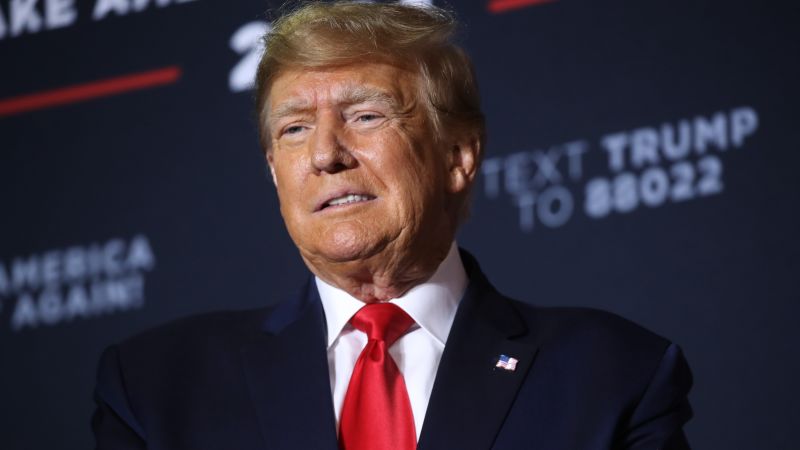
A coalition comprising healthcare providers, religious groups, university professors, and labor unions has initiated a federal lawsuit seeking to halt the Trump administration’s new $100,000 fee for H-1B visa applications. Filed in U.S. District Court in San Francisco, this action represents the first significant legal challenge to a proclamation signed by President Donald Trump on September 19, which mandated the substantial new fee. The plaintiffs argue that the fee, set to take effect with minimal notice, has plunged employers, workers, and federal agencies into considerable disarray.
This unprecedented fee marks a significant shift in the H-1B visa program, which Congress established to attract high-skilled foreign workers to fill specialized roles in the U.S. The lawsuit contends that President Trump’s proclamation oversteps executive authority, attempting to unilaterally impose taxes and rewrite federal law, powers typically reserved for Congress. The legal challenge underscores deep concerns about the fee’s legality, its potential to foster corruption, and its detrimental effects across various vital American sectors.
The plaintiffs are urgently requesting the court to immediately block the order, aiming to restore the predictability and stability that employers and workers rely on. The outcome of this lawsuit carries broad implications for immigration policy, the U.S. workforce, and the operational capabilities of institutions ranging from hospitals and universities to technology companies and religious organizations that depend on the H-1B program to meet critical staffing needs.
1. **The Core Legal Challenge: Seeking to Block the $100,000 H-1B Fee.**A broad coalition, including health care providers, religious organizations, university professors, and labor unions, filed a federal lawsuit on a Friday to contest the new $100,000 fee mandated for H-1B visa applications. This legal action, reportedly the first major challenge to the new fee, seeks an immediate injunction to stop the plan, asserting that it has generated “chaos” for employers, workers, and federal agencies. The lawsuit was formally lodged in the U.S. District Court in San Francisco.
The plaintiffs in the case are advocating for the court to “immediately block the order and restore predictability for employers and workers,” according to a press release from Democracy Forward Foundation and Justice Action Center. This legal move aims to prevent the implementation of the fee, which they argue is unlawful and highly disruptive. The swift filing underscores the urgency with which these groups view the situation and its potential negative consequences.
The challenge targets President Donald Trump, along with the Department of Homeland Security, U.S. Customs and Border Protection, and the State Department, who are named as defendants. The lawsuit represents a unified front from diverse sectors against an immigration policy that they believe infringes upon established legal frameworks and threatens various American institutions. It asserts that the president’s ability to restrict entry under the Immigration and Nationality Act does not grant the authority to impose such a fee.
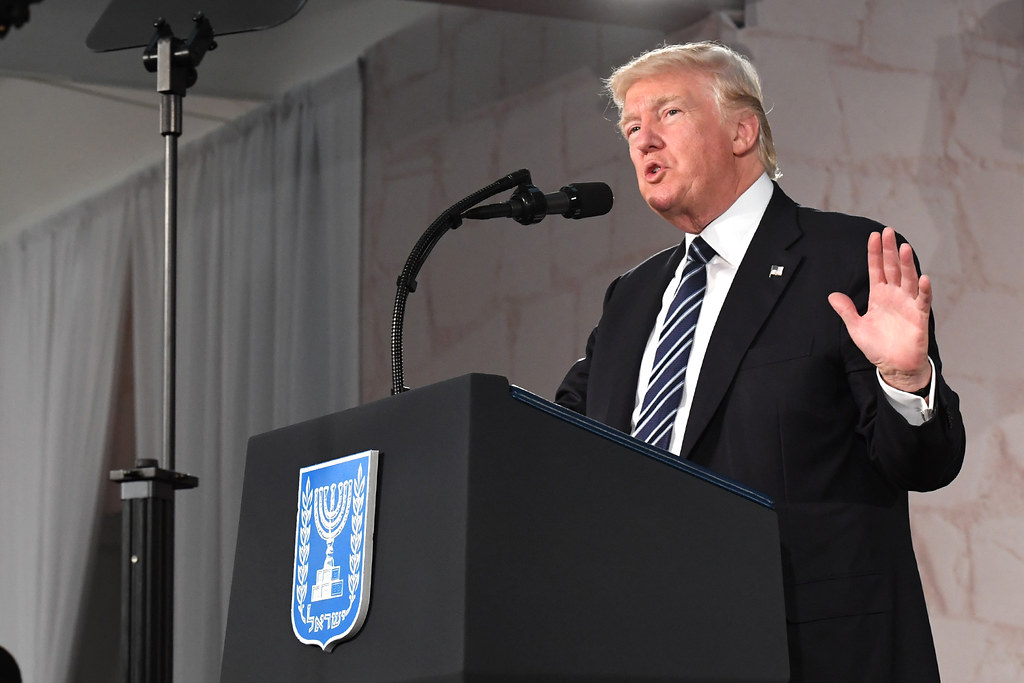
2. **President Trump’s Proclamation: The Genesis of the Fee.**President Donald Trump signed a proclamation on September 19 that introduced the new $100,000 fee requirement for H-1B visa applications. In justifying this measure, the President stated that the H-1B visa program “has been deliberately exploited to replace, rather than supplement, American workers with lower-paid, lower-skilled labor.” This statement laid the groundwork for the administration’s argument that the change was necessary to protect domestic jobs and wages.
The proclamation also articulated concerns that the “large-scale replacement of American workers” through the H-1B program posed a threat to the country’s economic and national security. The administration suggested that high numbers of lower-wage workers in the H-1B program had undermined its integrity. This perspective underpins the administration’s belief that a significant fee would deter companies from using the program in ways deemed detrimental to American interests.
Furthermore, President Trump invoked his power under federal immigration law to restrict the entry of certain foreign nationals if it would be “detrimental” to the interests of the United States. This executive authority was cited as the legal basis for imposing the new fee. The administration’s stated intent was to discourage businesses from “spamming the system and driving down American wages,” while providing certainty to employers who genuinely need to bring in top international talent.
3. **The H-1B Visa Program: Purpose and Structure.**The H-1B visa program was established by Congress with the explicit goal of attracting high-skilled workers to fill jobs that U.S. companies, particularly in the tech sector, find challenging to staff domestically. It serves as a critical pathway for employers to hire foreign workers in specialized fields, contributing to innovation and economic growth across the nation. This program addresses a shortage of qualified American workers in specific areas.
Annually, the H-1B program allocates 65,000 visas for temporary foreign workers in specialized fields, with an additional 20,000 visas designated for workers possessing advanced degrees. These visas are typically approved for periods ranging from three to six years, providing stability for both the workers and their sponsoring employers. The program has historically been a significant component of the U.S. immigration system for skilled labor.
Data indicates that India has been the primary beneficiary of H-1B visas, accounting for 71 percent of approved visas in the previous year, with China being a distant second at 11.7 percent. Geographically, California leads the nation in the number of H-1B workers. Prominent companies such as Seattle-based Amazon, Tata Consultancy, Microsoft, Apple, and Google have been among the top recipients of these visas, utilizing the program to recruit talent.
Critics, however, contend that the program often serves as a conduit for overseas workers who are prepared to accept salaries significantly lower than those typically paid to U.S. technology workers. They argue that the H-1B program is sometimes used to replace American workers with cheaper foreign labor, rather than supplementing the workforce as intended. Historically, H-1B visas have been distributed through a lottery system, a process that the Department of Homeland Security subsequently proposed to overhaul.

4. **Immediate Repercussions: Panic and Disruption for Employers and Workers.**The Trump administration’s proclamation regarding the $100,000 H-1B visa fee was slated to go into effect with extremely short notice, within 36 hours of its announcement. This rapid implementation timeframe created widespread panic and disruption across various sectors. Employers, caught off guard, immediately instructed their H-1B workers who were outside the United States to return before the new fee became effective, leading to a scramble for travel arrangements.
The surprise announcement was described in the lawsuit as having “thrown employers, workers and federal agencies into chaos.” H-1B workers who were abroad hastily arranged to return to the U.S., with some incurring thousands of dollars in travel expenses. Other workers who had planned international trips canceled them to avoid being caught by the new regulation. There were even reports of workers who had already boarded flights panicking upon hearing the news and requesting to deplane.
Amidst the confusion, the White House later issued a clarification, stating that the new fee would apply only to new H-1B visas. The administration specified that the order would not affect individuals who already held H-1B visas or those who had submitted their applications before September 21. This clarification aimed to mitigate some of the immediate uncertainty, but the initial shockwaves had already caused significant operational challenges and personal distress for many.

5. **The Plaintiffs: A Broad Coalition Against the Fee.**The federal lawsuit challenging the $100,000 H-1B visa fee has been brought forward by a diverse and extensive coalition of plaintiffs. This group includes various healthcare providers, religious organizations, university professors, and labor unions, highlighting the broad impact of the new fee across different sectors of American society. Their collective action underscores a shared concern over the implications of the Trump administration’s policy.
Key organizations and entities named among the plaintiffs include the Democracy Forward Foundation and the Justice Action Center, which have been vocal in their opposition to the fee. Other prominent plaintiffs are the United Automobile, Aerospace and Agricultural Implement Workers of America (UAW) International, a union representing thousands of workers across various industries, including higher education. The American Association of University Professors is also a crucial party, representing the interests of academic professionals.
The coalition further includes specific operational entities such as Global Nurse Force, a California-based business that assists hospitals in filling nursing vacancies globally, and Global Village Academy Collaborative, which provides services to its member charter schools in Colorado. Nonprofit religious organizations, including the Society of the Divine Word’s Chicago Province, which relies on H-1B visas for staff with specialized language skills, have also joined the suit. These groups are collectively represented by several immigration lawyers and advocacy organizations.
6. **Allegations of Unlawful Authority: Congress vs. Executive Power.**A central tenet of the lawsuit against the H-1B visa fee is the contention that President Trump overstepped his executive authority by unilaterally imposing the charge. The plaintiffs argue that the President “has no authority to unilaterally alter the comprehensive statutory scheme created by Congress” that governs the H-1B program. They assert that the power to levy fees, taxes, or other mechanisms to generate revenue for the United States, as well as to dictate how those funds are spent, is a power “reserved for Congress” under the U.S. Constitution.
While President Trump invoked his power under federal immigration law to restrict the entry of foreign nationals deemed “detrimental” to U.S. interests, the plaintiffs argue this specific authority is misapplied. They contend that this presidential power is intended to “regulate and influence conduct abroad.” The lawsuit critically observes that the proclamation “makes clear that it is concerned with domestic policy,” suggesting a misuse of an authority designed for international relations rather than domestic economic or immigration policy.
Essentially, the plaintiffs posit that the President cannot, by executive order, rewrite or supersede a comprehensive statutory scheme established by Congress. The legal challenge highlights a fundamental dispute over the separation of powers and the extent of presidential authority in immigration matters. The coalition insists that any such significant change to the H-1B program, particularly involving new fees, requires legislative action rather than an executive proclamation.

7. **The “Pay to Play” System and Corruption Concerns.**The lawsuit strongly argues that the new $100,000 H-1B visa fee transforms the H-1B program into a problematic “pay to play” system. Under this new structure, employers would ostensibly be required to either pay the exorbitant fee or seek a “national interest” exemption, which, according to the lawsuit, would be “doled out at the discretion of the Secretary of Homeland Security.” This discretionary power is flagged as a significant concern by the plaintiffs.
The legal challenge explicitly states that such a system “opens the door to selective enforcement and corruption.” Skye Perryman, president and CEO of Democracy Forward, publicly declared that the “exorbitant fee” is not only illegal but also invites corruption. This sentiment is echoed by Mike Miller, Region 6 Director of the United Automobile, Aerospace and Agricultural Implement Workers of America, who criticized Trump’s plan for allegedly “prioritiz[ing] wealth and connections over scientific acumen and diligence.”
These claims underscore worries that the high fee could create an unfair advantage for wealthier companies or individuals, potentially sidelining smaller businesses, non-profits, and educational institutions that cannot afford the increased cost. The discretionary nature of the national interest exemptions further fuels concerns about transparency and the potential for biased decision-making. The plaintiffs firmly believe that such a system undermines the integrity of the H-1B program and deviates from its original legislative intent.”

8. **Procedural Challenges and Lack of Rulemaking**The lawsuit additionally argues that the Trump administration implemented the $100,000 H-1B visa fee without adhering to proper rulemaking processes. The plaintiffs assert that agencies, including the U.S. Department of Homeland Security’s U.S. Citizenship and Immigration Services and the U.S. Department of State, adopted new policies to enact President Trump’s proclamation “without following necessary rulemaking processes.” This alleged procedural misstep forms a key part of the legal challenge against the fee.
Specifically, the complaint filed in the U.S. District Court for the Northern District of California stated that the administration failed to consider how “extorting exorbitant fees will stifle innovation.” The plaintiffs characterized the fee as “arbitrary and capricious,” underscoring their argument that the process lacked due diligence and a comprehensive assessment of potential consequences. This claim highlights concerns over transparency and the lawful establishment of new federal regulations, which often require extensive public input.
The legal challenge explicitly states that imposing the fee violated the Administrative Procedure Act (APA), a cornerstone of federal regulatory governance. The APA mandates specific steps, including public notice and opportunity for comment, before new rules or fees can be instituted. By allegedly sidestepping these established procedures, the administration is accused of imposing significant changes to an immigration program without the required due process, a fundamental aspect of fair administrative practice in the United States.
This procedural argument is distinct from the claims of overreach of executive authority, focusing instead on the method of implementation rather than the inherent power to make such a decision. The plaintiffs contend that even if the President had some underlying authority, the manner in which the fee was introduced was legally unsound, exacerbating the “chaos” reported across employers and federal agencies due to the sudden nature of the rule change.

9. **Impact on the Healthcare Sector**The new $100,000 H-1B visa fee poses significant threats to the U.S. healthcare sector, according to the lawsuit. Plaintiffs, including healthcare providers, argue that “without relief, hospitals will lose medical staff,” as cited in a press release from Democracy Forward Foundation and Justice Action Center. This potential loss of skilled workers could severely impact patient care and the operational capacity of medical facilities nationwide, particularly in areas already grappling with staffing shortages for essential roles.
The complaint further emphasizes that the fee would “exacerbate physician shortages and worsen patient care,” a critical concern given existing healthcare challenges. Global Nurse Force, a California-based business that places thousands of international nurses at hospitals in states like Washington, Ohio, Louisiana, and California, is a key plaintiff. The company’s business model depends on the H-1B program, and most of its clients reportedly cannot afford the new fee for each nurse they seek to sponsor.
The lawsuit details immediate impacts for Global Nurse Force, projecting the potential closure of its U.S.-based operations, which would result in the loss of millions of dollars in revenue. This, in turn, would directly affect its hospital clients, forcing them to “reduce capacity in I.C.U.s, emergency rooms and surgical units,” according to the suit. Such reductions would inevitably lead to increased wait times for patients and a deterioration of patient outcomes, straining an already critical sector.
The reliance of hospitals on the H-1B program extends to filling specialized roles crucial for public health. The lawsuit explicitly states that the H-1B program is a “critical pathway to hiring healthcare workers and educators,” underlining its importance beyond just technology companies. Without access to these international professionals, the ability of healthcare facilities to maintain essential services and provide comprehensive patient care would be severely compromised.
Read more about: Beyond the Buzz: Unpacking the Vision and Impact of Jeff Bezos’s Billion-Dollar Ventures Shaping Our Future

10. **Impact on the Education Sector**The education sector is another area facing substantial adverse effects from the new H-1B visa fee. The lawsuit warns that “classrooms will lose teachers” if the fee is not blocked, a statement underscored by various education groups among the plaintiffs. This directly impacts the ability of schools to maintain adequate staffing, especially in specialized fields where foreign workers often fill critical gaps, such as foreign language instruction or STEM subjects.
The legal challenge highlights that the fee would hurt K-12 school systems, risking that districts lose “valuable teachers in both urban areas suffering from staffing shortages and in rural districts where teachers are difficult to recruit.” This concern is particularly acute in regions where attracting and retaining educators, especially those with specialized language skills or in high-demand subjects, is already a significant challenge for local communities and school boards.
Furthermore, researchers and academics would also be significantly affected by the policy change. The suit points out that some workers who had received offers from universities have seen the processing of their H-1B visas placed “on hold indefinitely because of the new fee.” Todd Wolfson, president of the American Association of University Professors (AAUP), a crucial plaintiff in the case, stated that the fee “will discourage the best and brightest minds from bringing life-saving research to the U.S.”
The AAUP, along with other higher education professionals, argues that the fee interferes with research at universities. Such disruptions can impede scientific progress and limit the ability of American institutions to remain at the forefront of global innovation. This broad impact on academic staffing and research underscores the far-reaching implications of the new H-1B fee beyond initial economic considerations.
Read more about: Beyond the Limelight: Unpacking How 9 Mega-Stars Are Quietly Reshaping Tech with Billions in Startup Investments

11. **Impact on Religious Organizations**Religious organizations, a key part of the diverse plaintiff coalition, also stand to be significantly harmed by the $100,000 H-1B visa fee. The lawsuit contends that “churches will lose pastors,” jeopardizing their ability to serve diverse congregations and maintain essential religious services, especially those requiring specific cultural or linguistic backgrounds.
The Society of the Divine Word’s Chicago Province, a nonprofit religious organization and a plaintiff in the lawsuit, explicitly relies on H-1B visas to hire foreign workers with specialized language skills. These workers are crucial for serving communities that require specific linguistic and cultural expertise, allowing the organization to fulfill its mission effectively within diverse American communities.
The complaint from these groups underscores that the fee prevents religious organizations from acquiring staff with the specific language skills and cultural knowledge needed to minister effectively to their diverse communities. This impact goes beyond purely financial considerations, affecting the very fabric of religious service and outreach in the United States and the ability to connect with congregants from various backgrounds.
The lawsuit specifically mentions that about a third of H-1B workers are nurses, teachers, physicians, scholars, priests, and pastors. This statistic highlights how integral the H-1B program is for religious groups seeking to bring in specialized personnel, especially those with unique linguistic or cultural competencies essential for ministry work among immigrant communities.
Read more about: The Unfiltered Truth: When Comedy Goes Too Far – A Deep Dive into the Specials and Shows That Sparked Outrage and Faced Bans

12. **Broader Economic Consequences: Innovation and Business Operations**Beyond specific sectors, the lawsuit warns of broader economic consequences, particularly regarding innovation and business operations across the United States. The plaintiffs argue that the new fee will “stifle innovation” across the country, affecting a wide range of companies from tech start-ups to small businesses and non-profit organizations.
This argument is supported by the claim that the administration adopted new policies to implement the fee “without considering how ‘extorting exorbitant fees will stifle innovation’.” This alleged lack of foresight, according to the lawsuit, poses a direct threat to the U.S. competitive edge in a global economy. Tech start-ups, higher education leaders, and school districts have voiced criticism, stating the fee will hurt their ability to fill critical roles and remain competitive by limiting access to a diverse talent pool.
The economic impact is further illustrated by the situation of Global Nurse Force, which faces the potential closure of its U.S.-based operations, resulting in a loss of millions of dollars in revenue. This example underscores how such exorbitant fees can undermine entire business models dependent on the H-1B program, leading to significant financial losses and potentially a reduction in essential services that contribute to the economy.
Karen Tumlin, founder and director of the Justice Action Center, underscored that the H-1B visa program was not used solely by tech companies but by “many other industries that rely on foreign workers.” She emphasized, “This is how we get French speakers for our high schools and nurses in areas of chronic shortages,” illustrating the pervasive economic utility of the program beyond the high-profile tech sector. The lawsuit further highlights that the policy change would “damage plaintiffs and the public interest by disrupting companies, schools, and other institutions” that rely on the H-1B visa program.
Read more about: The Hidden Costs of “Autobesity”: What Environmentalists Really Think About Your Oversized Truck
13. **Trump Administration’s Defense for the Fee**The Trump administration has steadfastly defended the $100,000 H-1B visa fee, asserting that the program “has been deliberately exploited to replace, rather than supplement, American workers with lower-paid, lower-skilled labor.” This statement, originally made by President Donald Trump when signing the proclamation on September 19, laid the foundational rationale for the administration’s policy change, framing it as a measure to protect the domestic workforce.
The administration also articulated concerns that the “large-scale replacement of American workers” through the H-1B program posed a significant threat to the country’s economic and national security. They argued that high numbers of lower-wage workers in the program had effectively “undercut its integrity.” The fee was thus presented as a necessary deterrent, aimed at discouraging businesses from “spamming the system and driving down American wages,” while simultaneously providing certainty to employers who genuinely need to bring in top international talent for specialized roles.
A White House spokesperson, Abigail Jackson, publicly stated that the administration’s actions were “lawful” and dismissed challenges from “liberal groups” like Democracy Forward, describing their lawsuits as “frivolous.” This defense underscores the administration’s confidence in the legal basis of its executive action and its perspective that the plaintiffs’ motivations are politically driven rather than based on legitimate legal grievances.
Federal officials within the administration further argued that the new fee would help ensure that companies prioritize which foreign workers they genuinely need to hire, rather than using the program as a default source of cheaper labor. This perspective suggests the fee serves as a mechanism to refine the program, ensuring it better aligns with its original goal of attracting high-skilled individuals to fill specific gaps, thereby benefiting American interests.
President Trump had invoked his power under federal immigration law to restrict the entry of certain foreign nationals if it would be “detrimental” to the interests of the United States. This executive authority was cited as the legal basis for imposing the new fee, reflecting the administration’s view that the program’s perceived misuse was indeed detrimental to national interests, including discouraging Americans from pursuing careers in science and technology.
Read more about: Jimmy Kimmel’s Resilient Return: Navigating Suspension, Political Pressure, and the Enduring Fight for Free Speech in Hollywood
14. **Perspectives of Supporters**The Trump administration’s initiative to impose a $100,000 H-1B visa fee has garnered support from certain policy experts and immigration hard-liners. These groups generally view the fee as a necessary measure to address what they perceive as long-standing issues within the H-1B program, particularly its adverse impact on the American workforce and wages.
The Center for Immigration Studies, a prominent think tank that favors restricting immigration, has publicly applauded the change. Elizabeth Jacobs, the center’s director of regulatory affairs and policy, stated emphatically that “For too long, loopholes in the H-1B program have allowed corporations to undercut American workers and depress wages under the guise of a labor shortage.”
Jacobs further articulated the sentiment of supporters, asserting that “By imposing this new fee, the Trump administration is signaling that U.S. workers must come first.” This perspective aligns with the administration’s stated goal of prioritizing domestic employment and ensuring that the H-1B program does not inadvertently displace American workers or suppress their wages.
While applauding the fee as a positive step, Jacobs also highlighted that “meaningful legislative reform is still urgently needed,” suggesting that the fee, while impactful, is only a partial solution to what these groups view as systemic problems within the H-1B visa framework. This sentiment indicates a desire for more comprehensive changes to immigration policies affecting skilled labor.
Read more about: The Unforgettable Journeys of 2000s Child Stars: From Silver Screen to Surprising Second Acts
The ongoing legal battle over the $100,000 H-1B visa fee represents a pivotal moment for U.S. immigration policy and its economic implications. As the federal court in San Francisco deliberates, the core arguments revolving around executive authority, legislative intent, and the widespread societal impacts on vital sectors — from healthcare and education to religious organizations and broader innovation — remain at the forefront. The outcome will not only determine the future of this particular fee and the stability of the H-1B program but will also set a significant precedent for the balance of power in immigration policymaking and shape the operational landscape for countless American institutions reliant on foreign talent.