In the fast-paced, often unforgiving world of automotive manufacturing, every new model is launched with a dream of becoming a sales sensation and a cultural icon. Yet, history is littered with vehicles that, for one reason or another, stumbled out of the gate, failing to capture the public’s imagination or meet sales expectations. These cars were often derided, misunderstood, or simply ahead of their time, condemned as commercial failures that quickly faded from memory. But sometimes, just sometimes, a funny thing happens on the way to obscurity: time transforms them.
Indeed, the automotive landscape is rich with paradoxical stories of vehicles that were once considered monumental flops, only to resurface decades later as highly coveted collector’s items. What was once a burden or a punchline becomes a badge of honor, a symbol of prescient design, unique engineering, or even a testament to the power of pop culture. This intriguing phenomenon challenges our perceptions of value and desirability, reminding us that a car’s true worth isn’t always immediately apparent upon release.
We embark on a fascinating journey to uncover these automotive underdogs — the 12 cars that nobody bought when they were released but everyone wants now. Our exploration will detail their initial missteps, the often-harsh criticisms they faced, and the surprising turns of events that led to their eventual renaissance. Get ready to rethink what it means for a car to be a success, as we delve into the compelling tales of these extraordinary vehicles that defied depreciation and captured the hearts of enthusiasts years after their troubled debuts.

1. **Ford Edsel (1958–1960)**The Ford Edsel stands as a powerful testament to grand ambition colliding with market reality. Envisioned by Henry Ford II as his company’s salvation, it was designed to bridge the gap between affordable Fords and upscale Mercurys, backed by an astronomical $250 million development budget. The meticulous market research even involved poets to help name the car, underscoring the immense investment and high hopes riding on this new marque.
Despite the significant financial backing and strategic positioning, the Edsel’s launch was nothing short of a corporate disaster. Its distinctive “horse collar” grille, intended to be a unique design signature, was instead mocked mercilessly by the public and critics alike. This design misstep, combined with a timing that coincided with an economic recession, proved fatal for the Edsel, which became synonymous with commercial failure within the industry.
Ford managed to sell a mere 116,000 total units before the company was forced to pull the plug, bringing an ignominious end to a project that had promised so much. However, in a twist of fate, that very failure has imbued the Edsel with incredible value in the modern collector’s market. Today, pristine examples of this once-scorned vehicle can command over $100,000 at auction, transforming a symbol of corporate miscalculation into a highly sought-after piece of automotive history.
Car Model Information: 1958 Edsel Citation
BirthName: Edsel Bryant Ford
Caption: Ford in 1921
BirthDate: [object Object]
BirthPlace: Detroit, Michigan
DeathDate: [object Object]
DeathPlace: Grosse Pointe Shores, Michigan
Occupation: Automobile executive
Title: Ford Motor Company
Spouse: [object Object]
Parents: Henry Ford,Clara Bryant Ford
Relations: Edsel Ford II
Children: Henry Ford II,Benson Ford,Josephine Ford,William Clay Ford Sr.
Categories: 1893 births, 1943 deaths, 20th-century American businesspeople, All Wikipedia articles written in American English, All articles with dead external links
Summary: Edsel Bryant Ford (November 6, 1893 – May 26, 1943) was an American business executive and philanthropist, who was the only child of pioneering industrialist Henry Ford and his wife, Clara Jane Bryant Ford. He was the president of the Ford Motor Company from 1919 until his death in 1943.
He worked closely with his father, as sole heir to the business, but was keen to develop cars more exciting than the Model T (“Tin Lizzie”), in line with his personal tastes. Even as president, he had trouble persuading his father to allow any departure from this formula. Only a change in market conditions enabled him to develop the more fashionable Model A in 1927. Edsel also founded the Mercury division and was responsible for the Lincoln-Zephyr and Lincoln Continental. He introduced important features, such as hydraulic brakes, and greatly strengthened the company’s overseas production.
Ford was a major art benefactor in Detroit and also financed Admiral Richard Byrd’s polar explorations. He died of stomach cancer aged 49. Henry Ford temporarily reassumed the presidency of Ford Motor Company on Edsel’s death, then Edsel’s eldest son, Henry Ford II, succeeded Henry as president of the company in 1945.
He was also a member of the board of directors of American IG, the American subsidiary of the German chemical conglomerate IG Farben.
Get more information about: Edsel Ford
Buying a high-performing used car >>>
Brand: Ford Model: Edsel
Price: Not Priced Mileage: 68,904 mi.
Read more about: Beyond the Headlines: Unpacking Ford’s Enduring Legacy of Innovation, Resilience, and Global Impact

2. **Plymouth Superbird (1970)**The Plymouth Superbird emerged from an era of fierce competition in NASCAR, where aerodynamics reigned supreme. This car was not just about aesthetics; its radical nose cone and towering rear wing were purpose-built for speed and stability on the race track. Driven by “The King” Richard Petty, an astounding 18 NASCAR races were won in 1970 behind the wheel of this aerodynamic monster, cementing its performance pedigree.
Yet, for all its racing prowess and advanced engineering, the Superbird was a hard sell to the general public. Dealerships found it almost impossible to move these machines off their lots. The outrageous appearance, dominated by that massive rear wing and elongated front, proved too extreme for most potential buyers, who found it visually jarring for everyday driving. Moreover, with a price tag of around $4,300, the Superbird represented a significant financial outlay at the time, further scaring off a conservative market.
Today, the tables have turned dramatically for this once-unloved muscle car. The very features that made it unpalatable in 1970—its extreme styling and racing heritage—now make it incredibly desirable. Auction record sales for well-preserved or restored examples have soared, reaching between $125,000 and an astonishing $1.65 million, with the highest values, understandably, reserved for the legendary Hemi Superbirds. Its rarity and unique story have elevated it from a showroom dud to a million-dollar automotive icon.
Read more about: Beyond Myth and Legend: Unearthing 15 of the Rarest American Muscle Cars Ever Built

3. **DeLorean DMC-12 (1981–1983)**The DeLorean DMC-12 is perhaps one of the most recognizable automotive failures, largely due to its starring role in a cinematic masterpiece. This stainless steel sports car, famously equipped with eye-catching gullwing doors, was initially envisioned with an ambitious price point of $12,000. However, the dream quickly diverged from reality as production costs ballooned, pushing the price to an exorbitant $25,000 by the time it reached the market.
Compounding its pricing issues, the DMC-12 was fitted with a 130-horsepower V6 engine that, despite its exotic looks, simply couldn’t deliver the supercar performance buyers expected for its hefty price tag. The performance fell short of what its striking aesthetics promised, leading to significant disappointment among those who did purchase it. The company struggled to find its footing, and only about 9,000 cars were built before the DeLorean Motor Company went bankrupt, bringing an abrupt end to its production run.
However, fate intervened with a spectacular twist only Hollywood could orchestrate. The enduring popularity of the film “Back to the Future” transformed this commercial failure into an undeniable cultural icon. The DMC-12, with its distinctive design and cinematic legacy, became instantly recognizable worldwide. This incredible boost in perception has translated directly into market value; excellent examples of the DeLorean DMC-12 are now worth around $75,000, a remarkable appreciation for a car once synonymous with a company’s collapse. It featured a rear-mounted 2.85-liter PRV V6 engine, a detail often overlooked in its cinematic glow.
Car Model Information: 1982 Delorean DMC-12
Name: DMC DeLorean
Alt: 1983 DeLorean
Caption: 1983 DeLorean
Manufacturer: DeLorean Motor Company
Production: January 21, 1981 – December 1982
ModelYears: 1981–1983
Assembly: Dunmurry
Designer: Giorgetto Giugiaro
Class: Sports car
BodyStyle: coupé
Layout: Rear-engine, rear-wheel-drive layout
Doors: Gull-wing doors
Engine: 2.85 L
Abbr: on
Powerout: 130 hp
Transmission: 5-speed manual ,3-speed automatic
Wheelbase: 2413 mm
Length: 4267 mm
Width: 1988 mm
Height: 1140 mm
Weight: 1233 kg
Sp: us
Categories: 1980s cars, All Wikipedia articles written in American English, Articles with short description, Automobiles with backbone chassis, Automobiles with gull-wing doors
Summary: The DMC DeLorean is a rear-engine, two-seat sports car manufactured and marketed by John DeLorean’s DeLorean Motor Company (DMC) for the American market from 1981 until 1983—ultimately the only car brought to market by the fledgling company. The DeLorean is sometimes referred to by its internal DMC pre-production designation, DMC-12, although this was not used in sales or marketing materials for the production model.
Designed by Giorgetto Giugiaro, the DeLorean is noted for its gull-wing doors and brushed stainless-steel outer body panels, as well as its lack of power and performance. Though its production was short-lived, the DeLorean became widely known after it was featured as the time machine in the Back to the Future films.
With the first production car completed on January 21, 1981, the design incorporated numerous minor revisions to the hood, wheels and interior before production ended in late December 1982, shortly after DMC filed for bankruptcy and after total production reached an estimated 9,000 units.
Despite the car having a reputation for poor build quality and an unsatisfactory driving experience, the DeLorean continues to have a strong following, driven in part by the popularity of Back to the Future. 6,500 DeLoreans were estimated to still be on the road as of 2015.
Get more information about: DMC DeLorean
Buying a high-performing used car >>>
Brand: DeLorean Model: DMC-12
Price: $129,950 Mileage: 3,145 mi.
Read more about: Steer Clear: 15 Cars That Leave Automotive Enthusiasts Drowning in Collector’s Remorse

4. **Subaru SVX (1991–1996)**In the early 1990s, Subaru, a brand known primarily for its practical and reliable all-wheel-drive vehicles, embarked on an ambitious project to enter the luxury/performance market. They commissioned none other than Giorgetto Giugiaro, the legendary designer behind the DeLorean and Lotus Esprit, to pen their new halo car, the SVX. It was Subaru’s first foray into this upscale segment with a grand touring coupe, a bold move considering Subaru’s brand was not associated with luxury or high performance at the time.
Despite its pedigree designer, the SVX’s futuristic and aircraft-inspired design proved to be bold but divisive. Its most distinctive feature, the “window-within-a-window” side glass, while innovative, was not universally loved and certainly stood out from the crowd. This unique aesthetic, combined with the brand’s unfamiliarity in the luxury space, made it a challenging sell for dealerships. The market wasn’t quite ready for a luxury Subaru.
Financially, the SVX was a drain on Subaru, with reports indicating the company lost approximately $3,000 on every unit sold. Only 24,379 units were produced worldwide over its five-year run, making it a relatively rare sight. Today, however, that rarity and its distinctive, ahead-of-its-time design contribute to its growing appeal among collectors. The SVX is now appreciated for its unconventional styling and its place as a fascinating, if initially unsuccessful, experiment in Subaru’s history, showcasing a brand daring to step outside its comfort zone.
Car Model Information: 1994 Subaru SVX LSi
Name: Subaru SVX
Manufacturer: Subaru
Aka: Subaru Alcyone SVX
Production: 1991 – December 1996
Assembly: Subaru#Manufacturing facilities,Ōta, Gunma
Designer: Giorgetto Giugiaro
Class: Grand tourer
BodyStyle: coupé
Layout: Front-engine, four-wheel drive layout,Front-engine, front-wheel drive layout
Engine: Subaru six-cylinder engines#EG33,flat-six engine
Transmission: List of Subaru transmissions#4EAT,automatic transmission
Wheelbase: cvt
Length: cvt
Width: cvt
Height: cvt
Weight: cvt
Predecessor: Subaru XT
Categories: All-wheel-drive vehicles, All articles needing additional references, All articles that may contain original research, All articles with unsourced statements, Articles needing additional references from February 2019
Summary: The Subaru SVX, marketed in the Japanese home market as the Subaru Alcyone SVX, is a two-door, front-engine, all- or front-wheel drive coupé manufactured and marketed by Subaru from 1991 to 1996 over a single generation.
Superseding the company’s aviation-influenced XT range, the SVX was Subaru’s first entry into the luxury/performance market, and was noted for its aircraft-inspired ‘window-within-a-window’ side-glass configuration.
The nameplate “Alcyone” (pronounced “al-SIGH-uh-nee”) refers to the brightest star in the Pleiades constellation, stylized in the Subaru company logo. The suffix “SVX” is an acronym for “Subaru Vehicle X”.
Get more information about: Subaru SVX
Buying a high-performing used car >>>
Brand: Subaru Model: SVX
Price: $10,999 Mileage: 142,216 mi.

5. **Pontiac Aztek (2001–2005)**The Pontiac Aztek holds a unique, often infamous, position in automotive history. General Motors conceived the Aztek with a clear mission: to capture younger buyers with something truly revolutionary. The design brief was simple yet audacious – create an outdoor-oriented SUV that would appeal to active lifestyles and stand out from the sea of boring family haulers. It began as the aggressive “Bear Claw” concept, which unfortunately got stretched upward to share minivan underpinnings, leading to its controversial final form.
Upon its release, the Aztek’s polarizing appearance made it an immediate target for ridicule and criticism. Its awkward proportions, plastic cladding, and unconventional styling cues were widely mocked, leading to dismal sales figures. It was frequently cited as one of the ugliest cars ever made, and this widespread negative perception significantly hampered its market success during its production run, making it a difficult car for Pontiac to sell.
However, the Aztek’s story didn’t end there. In a remarkable turn of events, its DNA lives on in every modern crossover, proving its prescient vision of the future of SUVs—car-based platforms and high seating positions. The vehicle gained an unexpected boost in cultural relevance when it became the signature ride of Walter White in the hit TV series “Breaking Bad.” This exposure unexpectedly made it cool again, and now collectors appreciate its forward-thinking design and its unlikely journey from automotive outcast to a recognized pioneer. Its initial failure ironically underlined its innovative, albeit controversial, spirit.
Car Model Information: 2003 Pontiac Aztek FWD
Name: Pontiac Aztek
Manufacturer: General Motors
Production: July 2000 – December 2004
Assembly: Ramos Arizpe
Designer: Tom Peters (chief designer: 1997)
Class: Mid-size crossover SUV
BodyStyle: SUV
Platform: GM U platform
Related: Buick Rendezvous
Layout: Front-engine, front-wheel-drive layout
Engine: General Motors 60° V6 engine#LA1,V6
Transmission: GM 4T65-E transmission,Automatic transmission
Wheelbase: 108.3 in (2,751 mm)
Length: 182.1 in (4,625 mm)
Width: 73.7 in (1,872 mm)
Height: 66.7 in (1,694 mm)
Weight: 3,779–4,043 lb (1,714–1,834 kg)
Predecessor: Pontiac Sunrunner
Successor: Pontiac Torrent
ModelYears: 2001–2005
Categories: All-wheel-drive vehicles, All articles needing additional references, All articles with unsourced statements, Articles needing additional references from October 2013, Articles with short description
Summary: The Pontiac Aztek is a mid-size crossover SUV marketed by General Motors introduced in 2000 for the model years 2001 through 2005. As a four-door crossover with front-wheel drive and optional all-wheel drive, the Aztek featured a four-speed automatic transmission with a V6 engine. Marketed by Pontiac as a “sport recreational vehicle,” the Aztek used a shortened platform shared with GM’s minivans (e.g., the Pontiac Montana) featuring 94 cubic feet of cargo room with its rear seats removed. The design employed conventional rear outswing doors rather than sliding doors, and a split rear tailgate, the lower section formed with seat indentations and cupholders. Other features included a front center console that doubled as a removable cooler, optional rear stereo controls in the cargo area, optional sliding cargo floor with grocery compartments, and optional camping package with an attachable tent and air mattress.
Get more information about: Pontiac Aztek
Buying a high-performing used car >>>
Brand: Pontiac Model: Aztek
Price: $4,200 Mileage: 91,955 mi.
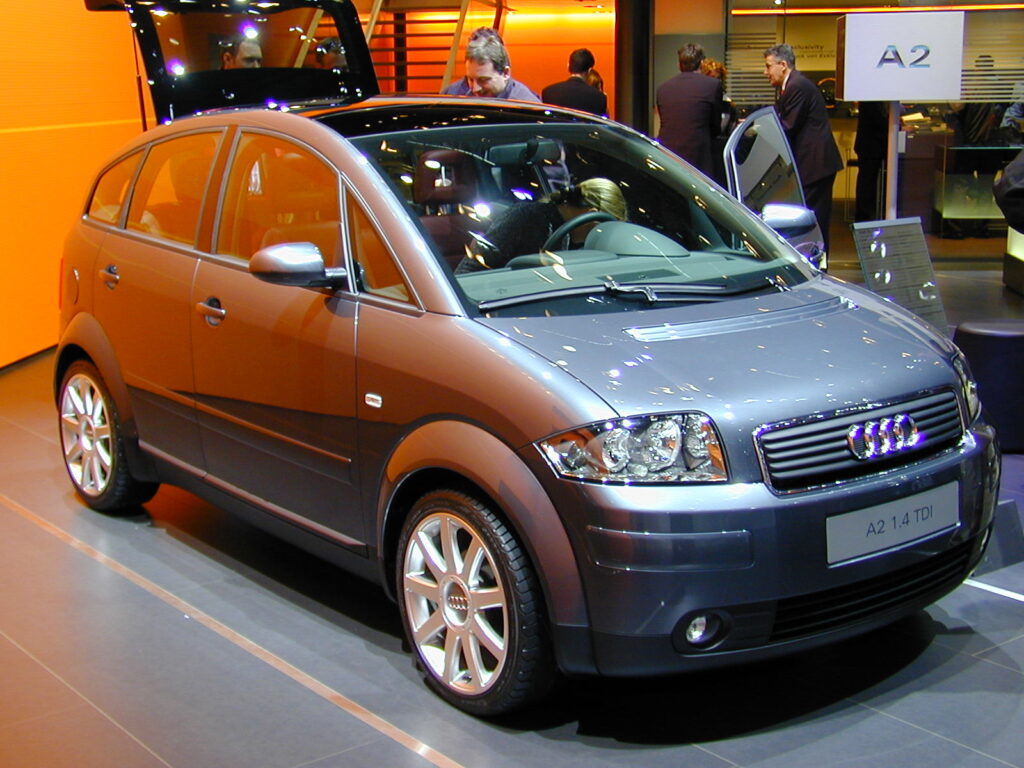
6. **Audi A2 (1999–2005)**The Audi A2 was an engineering marvel, a car that was arguably decades ahead of its time. When Audi decided to build an entire small car from lightweight aluminum, it was bleeding-edge technology. This commitment to innovation resulted in a vehicle with exceptional fuel economy, advanced aerodynamics, and a truly lightweight construction. Its space-frame architecture allowed it to weigh a mere 895–1030 kg while still offering five seats and impressive interior space, a testament to its forward-thinking design.
Despite its technical brilliance, the A2 struggled commercially. Its appearance, penned by Luc Donckerwolke, was polarizing, failing to captivate a mass market that perhaps wasn’t ready for such a radical approach to compact car design. The advanced aluminum construction also meant a higher production cost, which translated into significant financial losses for Audi – roughly $5,000 for every single car sold. These factors contributed to its early demise in production.
Today, the automotive industry is intensely focused on sustainability, lightweight materials, and fuel efficiency, making the Audi A2’s initial vision eerily relevant. People now recognize the A2 as truly visionary, appreciating its groundbreaking use of aluminum and its commitment to efficiency that predated widespread environmental consciousness. This shift in perception has transformed the A2 from a commercial misstep into a celebrated example of engineering foresight, making it a fascinating piece for enthusiasts and a symbol of what could have been.
Read more about: Beyond the Uniform: How Military Service Forged 12 Iconic Figures Who Changed America Forever
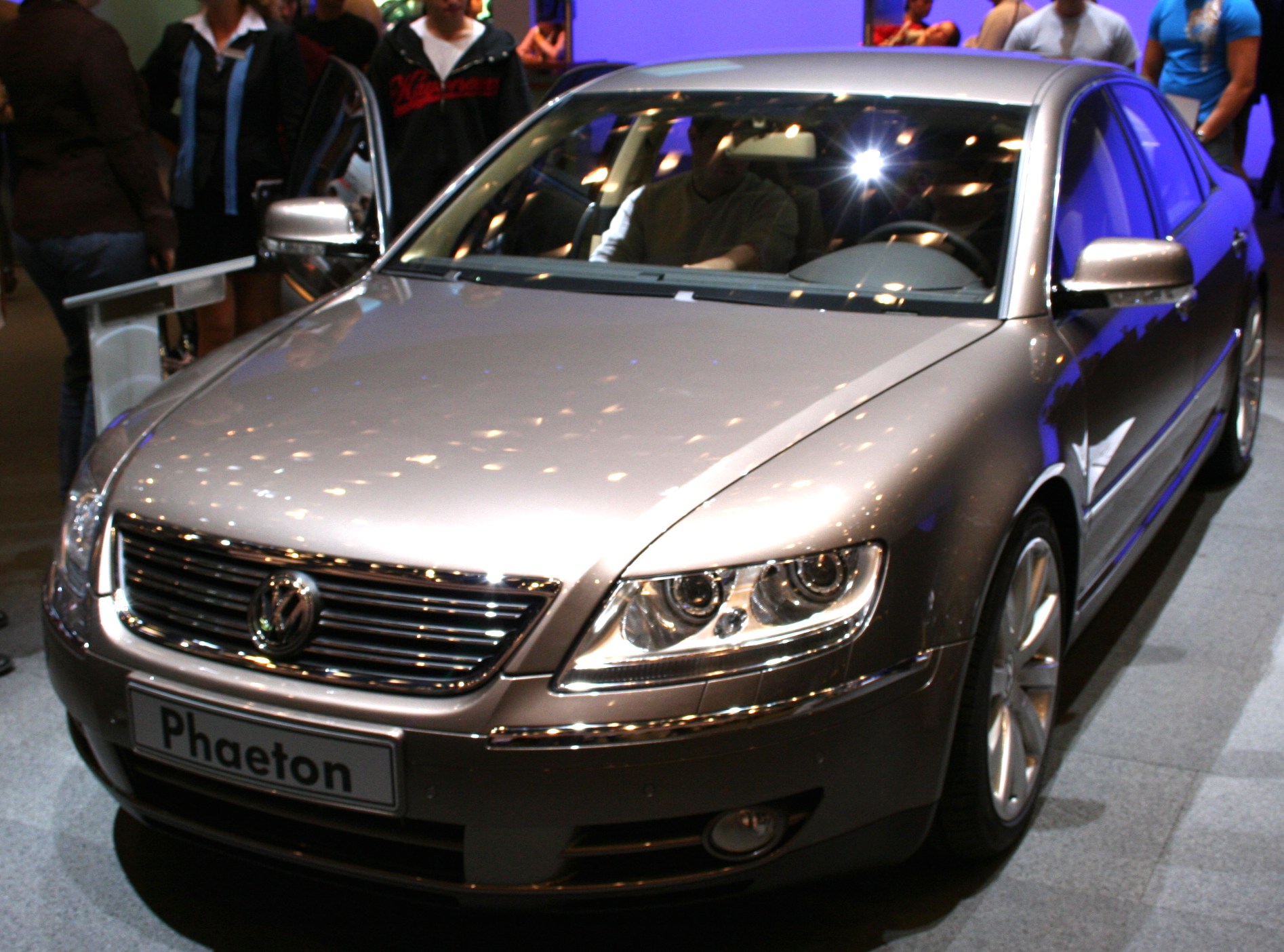
7. **Volkswagen Phaeton (2003–2016)**When Volkswagen, a brand synonymous with approachable, reliable cars, decided to launch a full-size luxury sedan to rival the likes of Mercedes-Benz and BMW, it was an audacious move. The Phaeton, introduced in 2003, was an engineering marvel, boasting a meticulously crafted luxurious interior with four-zone automatic climate control, premium leather upholstery, and extensive wood trim. It also featured advanced safety features, including Bosch ESP 5.7 stability control, ABS, and electronic brakeforce distribution, all designed to deliver an unparalleled driving experience.
However, the core issue that plagued the Phaeton from day one was its badge. American buyers, in particular, found it challenging to reconcile paying $70,000 or more for a Volkswagen, a brand they associated with more affordable vehicles, especially when similarly priced Audis carried a significantly higher prestige. This fundamental mismatch between brand perception and price point proved to be a fatal flaw in the North American market, resulting in catastrophic sales and very few units moved over its four-year run in the US.
This commercial struggle led to significant financial losses for Volkswagen. Analysts calculated that the company lost an astonishing $32,000 for every single Phaeton sold, underscoring the severity of its market rejection. Despite its inherent quality and technological sophistication, the car simply could not overcome the hurdle of consumer expectations tied to its brand name. The market just wasn’t ready for a Volkswagen that competed in the ultra-luxury segment.
Today, however, the perception of the Phaeton is undergoing a quiet renaissance. Automotive enthusiasts and connoisseurs are beginning to recognize the incredible value it represented. Beneath the unassuming VW badge lay a car that offered the kind of luxury, engineering, and refinement typically found in vehicles costing much more, but without the brand cachet. It’s now appreciated as an understated, meticulously engineered luxury sedan that was simply misunderstood in its time, a true sleeper in the world of overlooked automotive brilliance.
Car Model Information: 2004 Volkswagen Phaeton W12
Name: Volkswagen Phaeton
Manufacturer: Volkswagen
Production: December 2001 – March 2016
ModelYears: 2003–2016,2004–2006 (North America)
Assembly: Dresden
Class: Full-size car,luxury car
BodyStyle: Sedan (automobile)
Platform: Volkswagen Group D platform#D1s
Related: Audi A8,Bentley Continental GT,Bentley Continental Flying Spur (2005),Porsche Panamera,Audi S8
Layout: Front-engine, front-wheel-drive layout
Engine: List of Volkswagen Group petrol engines#3.2 VR6 24v (EA390),VR6 engine
Transmission: ZF 6HP transmission#6HP 26A,Automatic transmission
Wheelbase: 2881 mm
Abbr: on
Length: 2002–2009:,SWB: {{convert,5055,mm,1,abbr=on
Width: 1903 mm
Height: 1450 mm
Weight: convert
Successor: Volkswagen Phideon
Categories: 2010s cars, All-wheel-drive vehicles, All articles containing potentially dated statements, All articles with dead external links, All articles with unsourced statements
Summary: The Volkswagen Phaeton ( FAY-tən) (Typ 3D) is a full-size sedan/saloon manufactured by the German automobile manufacturer Volkswagen, described by Volkswagen as their “premium class” vehicle. Introduced at the 2002 Geneva Motor Show, the Phaeton was marketed worldwide. Sales in North America ended in 2006 and global sales ended in 2016.
The name Phaeton derives from Phaëton, the son of Phoebus (or Helios) in Greek mythology, by way of the phaeton auto body style and the type of horse-drawn carriage that preceded it.
Production ended in March 2016 and an all-electric second generation was slated to be produced. Starting in April 2017, the Transparent Factory Dresden began assembling the e-Golf instead.
Get more information about: Volkswagen Phaeton
Buying a high-performing used car >>>
Brand: Volkswagen Model: Phaeton
Price: $18,950 Mileage: 59,026 mi.

8. **Nash Metropolitan (1954–1962)**The Nash Metropolitan holds a unique place in automotive lore as an early pioneer in compact car design, and perhaps more notably, as America’s first car specifically designed for female buyers. This tiny Anglo-American hybrid combined Austin engineering with Nash styling, with manufacturing handled entirely in Britain before being sold in the US. Nash boldly positioned it as “a motorized shopping cart for affluent urban gals,” aiming to tap into a nascent market of women drivers seeking a nimble vehicle for city life.
However, this innovative marketing strategy and compact size did not translate into immediate success. The Metropolitan, despite its charming novelty, faced an uphill battle. Critics were often merciless, savaging it as “one of the worst cars ever made” dueading to its unconventional proportions and perceived lack of utility for the average American family. Its tiny dimensions and distinct European aesthetic were simply too far removed from the larger, more powerful vehicles Americans were accustomed to.
Further compounding its woes, the Metropolitan was plagued by performance and reliability issues throughout its eight-year production run. These mechanical shortcomings, combined with its polarizing appearance, meant that it struggled to gain widespread acceptance or cultivate a loyal following during its commercial life. It became a curiosity rather than a mainstream success, destined for the fringes of automotive history.
Fast forward to today, and the Nash Metropolitan has undergone a remarkable transformation in desirability. Its distinct, retro styling and historical significance as a pioneering compact and a car aimed at women drivers have made it a charming and quirky classic. Well-maintained or restored units now commonly command prices between $10,000 and $30,000 at auctions and sales, proving that what was once dismissed as a motoring miscalculation is now a sought-after piece of Americana, celebrated for its unique character and trailblazing spirit.
Car Model Information: 1957 Nash Metropolitan
Caption: 1957 Metropolitan
Name: Metropolitan
Manufacturer: Austin Motor Company
Aka: Hudson Motor Car Company,American Motors,Austin Metropolitan
Production: October 1953–April 1961
ModelYears: 1954–1962
Assembly: Longbridge plant,Birmingham,West Midlands (county)
Class: Economy car,Subcompact car
BodyStyle: hardtop,convertible
Layout: FR layout
Engine: {{convert,1200,cc,L,lk=on,abbr=on,BMC B-Series engine,Inline-four engine
Abbr: on (base)
Transmission: Manual transmission
Wheelbase: 85 in
Length: 149.5 in
Width: 61.5 in
Height: 54.5 in
Weight: convert
Designer: William J. Flajole
Categories: 1960s cars, All articles with unsourced statements, Articles with short description, Articles with unsourced statements from July 2008, CS1 German-language sources (de)
Summary: The Nash Metropolitan is an American automobile assembled in England and marketed from 1953 until 1962.
It conforms to two classes of vehicle: economy car and subcompact car. The Metropolitan is considered a “subcompact”, but this category was not yet in use when the car was made. At that time, it was categorized as a “small automobile” as well as an “economy car”.
The Metropolitan was also marketed as a Hudson model when Nash and Hudson merged in 1954 to form the American Motors Corporation (AMC). The Nash and Hudson lines were phased out in favor of the Rambler line, and in 1957, the Metropolitan became a standalone brand and was badged with a stylized ‘M’ on hubcaps and grille. The cars were also sold in the United Kingdom and other markets.
Get more information about: Nash Metropolitan
Buying a high-performing used car >>>
Brand: Nash Model: Metropolitan
Price: $12,000 Mileage: 535 mi.

9. **Lamborghini Miura (1966–1973)**In a fascinating twist of fate, the car that would ultimately define Lamborghini’s legacy, the Miura, was initially a clandestine project. Ferruccio Lamborghini himself, known for his pragmatic approach, actually opposed the development of what his engineering team envisioned. Gian Paolo Dallara, Paolo Stanzani, and Bob Wallace, working secretly in evenings and weekends, brought to life the mid-engine concept that would stun the world and become recognized as the world’s first true supercar, a revolutionary design that shifted the paradigm of high-performance automobiles.
Despite its groundbreaking design and exhilarating performance, the Miura’s initial sales were somewhat limited, primarily due to its stratospheric price tag. In 1966, the Miura commanded a cost of $20,000, which, adjusted for inflation, is equivalent to nearly $150,000 today. Such an investment naturally restricted its accessibility to only the most affluent buyers, preventing it from becoming an immediate widespread commercial hit, even within the exclusive supercar segment. It was a car for a very select few, an automotive masterpiece yet to fully grasp its cultural significance.
Then came 1969, and with it, the iconic film *The Italian Job*. The legendary opening sequence, featuring an orange Miura effortlessly threading through the breathtaking Alpine passes, changed everything. This cinematic showcase instantly cemented the Miura’s status, transforming it from a mere high-performance vehicle into the ultimate dream car, an undeniable symbol of style, speed, and exotic allure. Its appearance in the movie catapulted it into the global consciousness, making it recognizable even to those outside of the automotive elite.
Today, the Lamborghini Miura is not just admired; it’s revered as a definitive automotive icon. The very aspects that made it initially exclusive – its innovative mid-engine layout, stunning Bertone design, and exhilarating performance – now contribute to its almost mythical status and immense value among collectors. Its journey from a secretly developed project to a cinematic legend and then to a priceless piece of automotive history is a testament to its enduring impact and visionary design, making it one of the most desirable cars ever created.

10. **Duesenberg Model J (1928–1937)**The Duesenberg Model J emerged onto the American automotive scene in 1928, proudly proclaimed as America’s definitive answer to the sophisticated luxury of Rolls-Royce. It was a vehicle of unparalleled ambition and extravagance, boasting a massive 6.9-liter straight-eight engine that produced an astounding 265 horsepower, a figure that dwarfed the output of most contemporary cars, many of which struggled to even reach 100 horsepower. This powerhouse was paired with a chassis that, in itself, cost more than entire luxury cars from competing brands, signaling its ultra-premium positioning from the outset.
Tragically, the Model J’s launch coincided with the devastating Wall Street Crash of 1929 and the onset of the Great Depression. This economic cataclysm decimated the market for ultra-luxury goods, rendering a vehicle of the Model J’s stratospheric pricing accessible only to an impossibly small, ultra-wealthy elite. The economic climate simply wasn’t conducive to the success of such an opulent and expensive automobile, severely limiting its potential sales and widespread adoption even among the privileged few who could still afford such luxuries.
As a consequence of the challenging economic environment, only approximately 500 Model Js were completed before production was forced to cease. This limited production run, combined with the passage of time, has made each surviving example incredibly rare and precious. Many of these vehicles were custom-bodied by renowned coachbuilders, adding another layer of exclusivity and artistic value, further elevating their status beyond mere transportation.
Today, the Duesenberg Model J stands as a magnificent testament to pre-war American luxury and engineering prowess, a symbol of an era of unfathomable wealth and automotive artistry. Its scarcity and historical significance are dramatically reflected in modern auction results, where examples routinely sell for staggering sums, often exceeding $1.6 million. What was once an untimely release in a collapsing market is now a revered, million-dollar masterpiece, a benchmark for automotive excellence and a cornerstone of collector car history.
Car Model Information: 2018 BMW X3 xDrive30i
Name: Sfn
Caption: 1930 Duesenberg J Murphy Torpedo Convertible
Manufacturer: Duesenberg
Aka: Duesenberg J,Duesenberg SJ (supercharged),Duesenberg SSJ (short-wheelbase supercharged)
Production: 1928–1937,481 produced (445 Model J, 36 Model SJ)
Assembly: Indianapolis,Indiana,United States
Designer: Gordon Buehrig
Class: Luxury vehicle
BodyStyle: Coachbuilt to owner’s preference
Layout: Front-engine, rear-wheel-drive layout#Front mid-engine, rear-wheel-drive layout
Engine: 420 cuin
Abbr: on
Disp: Sfn
Transmission: Manual transmission
Wheelbase: {{convert,142.5,in,mm,1,abbr=on,disp=flip
Predecessor: Duesenberg Model A
Sp: us
Categories: 1930s cars, All articles with unsourced statements, Articles with short description, Articles with unsourced statements from December 2013, Articles with unsourced statements from June 2012
Summary: The Duesenberg Model J is a luxury automobile made by Duesenberg exclusively in 1928 and offered for ten subsequent years. Intended to compete with the most luxurious and powerful cars in the world, it was introduced in 1928, the year before the stock market crash that led to the Great Depression. Duesenberg Motors Company went bankrupt in 1937.
Get more information about: Duesenberg Model J
Buying a high-performing used car >>>
Brand: Duesenberg Model: Model J
Price: $22,988 Mileage: 40,194 mi.

11. **AMC Pacer (1975–1980)**The AMC Pacer, launched in 1975, was conceived with a revolutionary vision: a compact car designed around a compact, lightweight rotary engine. However, fate intervened when General Motors abandoned its rotary development program in 1974, leaving AMC with a critical decision. Rather than scrap the entire $60 million project, AMC chose to proceed, adapting the Pacer’s unique body to accommodate its heavier straight-six engines, a decision that profoundly shaped its controversial appearance and public perception.
This engineering compromise resulted in the Pacer’s instantly recognizable and often ridiculed design. The car’s massive glass greenhouse and stubby proportions made it wider than a Rolls-Royce Silver Shadow but shorter than a Ford Cortina, creating an aesthetic that many found awkward and unconventional. Its “fishbowl” design and unusual stance invited a significant amount of criticism and mockery, making it a commercial struggle for AMC throughout its production run.
The market was simply not ready for such a radical departure from conventional automotive styling, particularly from a brand like AMC, which often struggled to compete with the Detroit Big Three. The Pacer’s unique looks, combined with its compromised engineering due to the engine swap, meant it never achieved the sales success AMC had hoped for, eventually fading into the annals of automotive curiosities and often appearing on lists of “ugliest cars.”
Yet, the Pacer’s narrative took a truly unexpected turn three decades later, courtesy of Hollywood. Its starring role as the “Mirthmobile” in the cult classic film *Wayne’s World* rescued its reputation, transforming it from an automotive punchline into an object of nostalgic affection and cultural cool. This cinematic exposure not only granted it unexpected fame but also ignited a new appreciation among collectors. In 2016, the actual “Mirthmobile” from the movie sold for $37,400, a remarkable testament to how pop culture can reshape a car’s destiny, proving that the Pacer was simply ahead of its time in creating a truly distinctive and memorable presence.
Read more about: Steer Clear: 15 Cars That Leave Automotive Enthusiasts Drowning in Collector’s Remorse

12. **Pontiac Fiero (1984–1988)**The Pontiac Fiero, a mid-engine sports car launched in 1984, was initially heralded as GM’s ambitious foray into the affordable sports car market. However, its early years were fraught with challenges that earned it a reputation as one of GM’s biggest disappointments. While its exotic mid-engine layout and sporty aesthetics were appealing, the car was unfortunately plagued by significant reliability issues, particularly engine fires that primarily affected the 1984 models. These incidents, numbering 148 reported cases due to defective connecting rods, severely tarnished its image and deterred many potential buyers.
This early cloud of unreliability made it incredibly difficult for Pontiac to sell the Fiero, leading to steep depreciation in the used market and widespread consumer skepticism. Despite total production reaching approximately 370,168 units over its short lifespan, the initial negative publicity created an uphill battle for the car to establish itself as a credible performance vehicle. Many buyers were simply unwilling to risk ownership of a car with such a concerning safety record, regardless of its innovative design.
However, Pontiac refused to give up on the Fiero’s potential. Through continuous development and engineering improvements, particularly in its final 1988 model year, the Fiero underwent a significant transformation. This last iteration featured a vastly improved suspension system, addressing many of the handling and ride quality criticisms of earlier models. This commitment to refinement, though too late to save the production run, earned the 1988 Fiero particular respect and admiration among enthusiasts who recognized its true capabilities.
Today, the Pontiac Fiero, especially the highly sought-after 1988 models, has become a genuine collector’s item, defying its troubled past. Modern collectors are now paying serious money for what was once considered a disappointment. The average Fiero currently sells for around $12,082, while pristine examples, like the final Fiero ever built with just 582 miles, have commanded astonishing prices, reaching up to $90,000. This remarkable appreciation highlights its journey from an automotive outcast to a celebrated piece of American sports car history, proving that quality and innovation can, given time, ultimately triumph.
Car Model Information: 1988 Pontiac Fiero Formula
Name: Pontiac Fiero
Caption: 1988 Fiero Formula
Manufacturer: Pontiac (automobile)
Production: August 1983 – August 16, 1988,370,168 produced
ModelYears: 1984 – 1988
Successor: Pontiac Solstice
Assembly: Pontiac, Michigan
Designer: Hulki Aldikacti,George Milidrag
Class: Sports car
BodyStyle: fastback,notchback
Platform: GM P platform
Layout: Rear mid-engine, rear-wheel-drive layout
Engine: {{cvt,151,CID,L,1,disp=flip,Iron Duke engine#LR8,Inline-four engine
Transmission: Turbo-Hydramatic 125,Manual transmission,Getrag 282 transmission,Isuzu
Wheelbase: 2373 mm
Abbr: on
Length: 4072 mm
Width: 1750 mm
Height: 1191 mm
Weight: 1116 to
Categories: All articles with unsourced statements, Articles with short description, Articles with unsourced statements from February 2012, Articles with unsourced statements from July 2024, Articles with unsourced statements from September 2011
Summary: The Pontiac Fiero is a rear mid-engine, light sports car manufactured and marketed by Pontiac for model years 1984 – 1988. Intended as an economical commuter car with modest performance aspirations, it was Pontiac’s first two-seater since their 1926 to 1938 coupes, and the first mass-produced, rear mid-engine car by any American manufacturer.
In addition to using 4- and 6-cylinder engines to help Pontiac meet America’s ‘CAFE’ average fuel economy requirements, the Fiero’s chassis and structure technology used non-load-bearing, composite body-panels, contributing to the car’s light-weight and its unique selling proposition. Pontiac engineers modified the design over its life to enhance its performance and reposition the two-seater closer to the implications of its sporty configuration.
The Fiero 2M4 (two-seat, mid-engine, four-cylinder) placed on Car and Driver magazine’s Ten Best list for 1984, and was the Official Pace Car of the Indianapolis 500 for 1984.
A total of 370,168 Fieros were manufactured over five years’ production, its mild performance, reliability and safety issues becoming points of criticism. The Fiero was discontinued after annual sales fell steadily.
Get more information about: Pontiac Fiero
Buying a high-performing used car >>>
Brand: Pontiac Model: Fiero
Price: $11,000 Mileage: 101,027 mi.
Read more about: The Great Deception: 12 Vintage Sports Cars That Looked Like Supercars But Drove Like Sloths
Our journey through these 12 automotive underdogs serves as a compelling reminder that success in the car world isn’t always immediate or universally recognized. Some vehicles, initially misunderstood or hampered by circumstances, possess an inherent brilliance that only time and evolving tastes can truly unearth. From the daring luxury of the Phaeton to the cinematic charm of the Fiero, these cars teach us a valuable lesson: what one generation dismisses, another might cherish. So, the next time you see a seemingly obscure model, remember that beneath its surface, there might be a future classic just waiting to be rediscovered and revered by enthusiasts worldwide. The automotive landscape is a dynamic tapestry, and these “flops-turned-favorites” are some of its most intriguing threads.