When you hear ‘Microsoft,’ what comes to mind? For many, it’s the operating system that powered their first computer, the productivity suite that runs their workday, or perhaps the gaming console that dominates their living room. But behind these ubiquitous products lies a fascinating, often tumultuous, and undeniably impactful journey of a company that started with a bold vision and reshaped the very fabric of our digital lives.
From its humble origins in 1975, founded by two childhood friends with a knack for programming, Microsoft has not just ridden the waves of technological change—it has often created them. This isn’t just a story of software and hardware; it’s a saga of innovation, fierce competition, strategic pivots, and sometimes, intense controversy. It’s about a company that dared to dream big and, against all odds, achieved a level of market dominance few could have imagined.
So, get ready to peel back the layers as we take a deep dive into the defining moments that forged Microsoft into the global technology conglomerate it is today. We’re talking about the breakthroughs that changed everything, the bold moves that solidified its position, and the challenges that tested its resilience. This is the real history, straight from the source, charting the evolution of a true tech titan.
1. **The Genesis Story: From BASIC to MS-DOS Dominance (1975-1985)**It all started with a big idea and a small microcomputer. Childhood friends Bill Gates and Paul Allen, driven by their programming skills, founded Traf-O-Data in 1972, a precursor that sold a basic computer for tracking traffic data. But the real spark ignited in January 1975, when the Micro Instrumentation and Telemetry Systems’ (MITS) Altair 8800 microcomputer graced the pages of Popular Electronics magazine. This inspired Allen to suggest they could program a BASIC interpreter for the device, a proposition that would change everything.
Gates, ever the entrepreneur, called MITS and, without a working product, claimed he had a functional interpreter. MITS, intrigued, requested a demonstration. The pressure was on! Allen quickly got to work on an Altair simulator, while Gates hammered out the interpreter. Their efforts paid off handsomely; in March 1975, in Albuquerque, New Mexico, the demonstration worked flawlessly. MITS wasted no time, agreeing to distribute it as Altair BASIC, a pivotal moment that led Gates and Allen to formally establish Microsoft on April 4, 1975, with Gates at the helm as CEO. Allen, with a touch of ingenuity, suggested the name “Micro-Soft,” a clever abbreviation for micro-computer software.
Microsoft soon branched into the operating system business in 1980 with Xenix, their rendition of Unix. However, it was MS-DOS that truly cemented their market dominance. In November 1980, IBM awarded Microsoft a crucial contract to provide an OS for the upcoming IBM Personal Computer (IBM PC). Microsoft, quick on its feet, acquired an existing CP/M clone called 86-DOS from Seattle Computer Products, rebranded it as MS-DOS, and supplied it to IBM (who then rebranded it as IBM PC DOS). Crucially, Microsoft retained ownership of MS-DOS. Since IBM copyrighted its PC BIOS, other companies had to reverse-engineer it to create compatible hardware, but no such restriction applied to the operating systems. This strategic move allowed Microsoft to become the leading PC operating systems vendor, setting the stage for decades of market leadership.
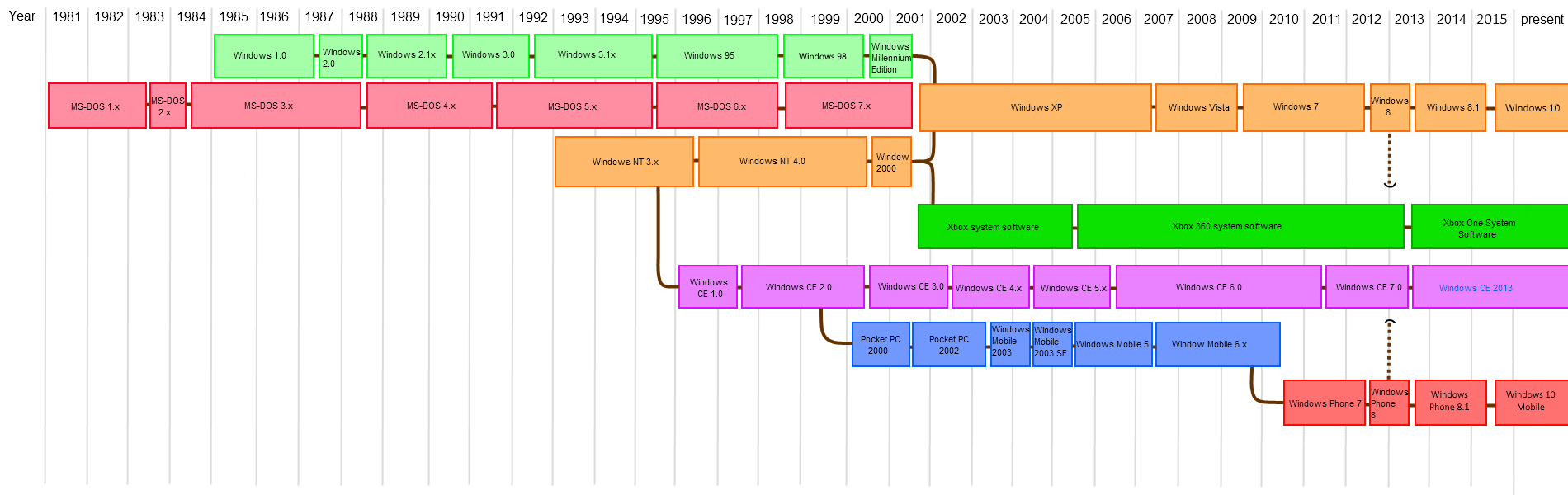
2. **Windows Takes Over: Graphical Interfaces and Office Power (1985-1994)**Having established its foothold with MS-DOS, Microsoft was ready for its next big leap: graphical user interfaces. On November 20, 1985, Windows 1.0 was released, presented as a graphical extension for MS-DOS. This wasn’t just a minor update; it was Microsoft’s first major stride towards making computers more intuitive and accessible to the everyday user, even as they were already jointly developing OS/2 with IBM.
This era also saw a significant corporate shift. Microsoft moved its headquarters from Bellevue to Redmond, Washington, on February 26, 1986. Just a couple of weeks later, on March 13, the company went public with an initial public offering (IPO) on the NASDAQ exchange. The resulting surge in stock value was legendary, creating an estimated four billionaires and an astonishing 12,000 millionaires among Microsoft employees. Talk about hitting the jackpot!
Simultaneously, Microsoft was expanding its software arsenal beyond operating systems. In 1990, the company introduced the Microsoft Office suite, a bundle that brought together separate, powerful applications like Microsoft Word and Microsoft Excel. That same year, on May 22, Microsoft launched Windows 3.0, which sported significantly streamlined user interface graphics and improved protected mode capability for the Intel 386 processor. Both Office and Windows quickly rose to become dominant forces in their respective fields, becoming indispensable tools for businesses and individuals worldwide.
3. **The Internet Tidal Wave: Web Expansion and Windows 95 (1995-2000)**The mid-1990s brought a seismic shift in technology: the advent of the World Wide Web. Bill Gates recognized this monumental change early on, memorializing his foresight in the internal “Internet Tidal Wave memo” on May 26, 1995. Following this, Microsoft rapidly began redefining its offerings, aggressively expanding its product line into computer networking and, crucially, the World Wide Web. This quick adaptation was key; unlike many established companies that were slow to react, Microsoft moved fast enough to be a significant player almost from the start, a move that would solidify its market dominance against rivals like Borland, WordPerfect, Novell, IBM, and Lotus.
The culmination of this push was the release of Windows 95 on August 24, 1995. This wasn’t just an update; it was a revolution. Windows 95 introduced pre-emptive multitasking, a completely redesigned user interface featuring the now-iconic Start button, and full 32-bit compatibility. It provided the Win32 API, making it easier for developers. The operating system came bundled with the online service MSN, designed to compete with early internet services like CompuServe and AOL. Interestingly, the web browser Internet Explorer wasn’t initially bundled with the retail release of Windows 95; it was included later in the Microsoft Plus! pack and OEM releases.
Backed by a “high-profile marketing campaign” and what The New York Times famously called “the splashiest, most frenzied, most expensive introduction of a computer product in the industry’s history,” Windows 95 was an instant sensation. Microsoft’s aggressive expansion continued into new markets; in 1996, the company partnered with General Electric’s NBC unit to create MSNBC, a 24/7 cable news channel. It also created Windows CE 1.0, a new operating system tailor-made for devices with limited memory and other constraints, such as personal digital assistants, showing its ambition to be everywhere.
4. **Antitrust Battles: Monopoly Scrutiny and Legal Fights (1990-2008)**With immense success came intense scrutiny. Microsoft’s rapid rise and dominant market position inevitably drew the attention of regulatory bodies, leading to more than a decade of legal clashes with the government. The first rumblings began in 1990 when the Federal Trade Commission (FTC) examined Microsoft for possible collusion due to its partnership with IBM, setting the stage for what would become a series of high-stakes legal battles.
One of the most significant legal challenges came on July 27, 1994, when the Department of Justice’s Antitrust Division filed a competitive impact statement. It detailed how, “Beginning in 1988 and continuing until July 15, 1994, Microsoft induced many OEMs to execute anti-competitive per processor licenses.” This licensing model effectively penalized manufacturers for using non-Microsoft operating systems by charging them a royalty for every computer sold with a particular microprocessor, regardless of the OS installed. The Justice Department argued this was a “penalty, or tax” on competing operating systems, and its use had only increased since 1988.
The legal drama escalated, culminating in a judgment on April 3, 2000, in the case of United States v. Microsoft Corp., which famously labeled the company an “abusive monopoly.” This was a bombshell, forcing Microsoft to reckon with its business practices. The company eventually settled with the U.S. Department of Justice in 2004. However, the legal challenges weren’t confined to the United States. In March 2004, the European Union launched its own antitrust legal action, accusing Microsoft of abusing its dominance with the Windows OS. This resulted in a hefty judgment of €497 million ($613 million) and demanded that Microsoft produce new versions of Windows XP without Windows Media Player: Windows XP Home Edition N and Windows XP Professional N. The EU wasn’t done yet, imposing another massive fine of €899 million ($1.4 billion) on February 27, 2008, for Microsoft’s failure to comply with the 2004 judgment, specifically citing unreasonable prices charged to rivals for key information about its server products. Microsoft, for its part, maintained it was in compliance, stating that “these fines are about the past issues that have been resolved,” but the message was clear: market dominance comes with a heavy price and constant oversight.
5. **Gaming’s New Player: Xbox Enters the Arena (2001-2007)**While software and operating systems defined Microsoft’s early decades, the new millennium saw the company make a bold, unexpected leap into a completely different market: video game consoles. In 2001, Microsoft released the first installment in the Xbox series of consoles, throwing its hat into an arena long dominated by established giants like Sony and Nintendo. This wasn’t a tentative step; Xbox was designed to be a serious contender.
What made the original Xbox stand out? It was graphically powerful for its time, featuring a standard PC’s 733 MHz Intel Pentium III processor. This was a direct challenge to its rivals, signaling Microsoft’s intent to leverage its PC hardware and software expertise to carve out a significant share of the lucrative gaming market. The launch was a statement, demonstrating Microsoft’s willingness to diversify and compete head-on in entirely new sectors.
The success of the original Xbox paved the way for its successor, the Xbox 360, which was released in November 2005. The 360 came in two versions, a basic model for $299.99 and a deluxe version for $399.99, catering to different segments of the market. The Xbox brand quickly became a cornerstone of Microsoft’s portfolio, proving that the company could extend its influence beyond the desktop and into the entertainment space, establishing itself as a formidable force in the competitive world of video gaming and demonstrating a crucial shift in its business strategy towards consumer hardware.
6. **The Ballmer Years Begin: Leadership Shift and Early Acquisitions (2000-2007)**The turn of the millennium marked a significant transition in leadership for Microsoft. On January 13, 2000, Bill Gates, the visionary co-founder and CEO, handed over the chief executive position to Steve Ballmer, an old college friend of Gates and a long-time employee of the company since 1980. Gates, however, didn’t entirely step away, creating a new role for himself as Chief Software Architect, maintaining a hand in the company’s core technological direction.
Ballmer’s initial years as CEO saw Microsoft continue its trajectory of growth and strategic moves. While the company was grappling with antitrust issues, it also made significant internal and external changes. This period saw a heightened focus on security and intellectual property, exemplified by Microsoft, along with various other companies, forming the Trusted Computing Platform Alliance in October 1999. This alliance aimed to identify hardware and software changes to increase security, although it also drew criticism as a potential way to impose restrictions on how consumers used software.
During this time, Microsoft also made strides in securing its future through various product releases and initiatives, including the pivotal launch of Windows XP in October 2001, which unified the mainstream and NT lines of operating systems under a single, more robust codebase. Ballmer’s leadership was characterized by a push for market presence and an expansion into diverse areas, laying the groundwork for further hardware commitments and significant acquisitions in the years to come, truly marking a new era for the tech giant.
7. **Hardware Ambitions: From Mice to Media Players and Beyond (1983-2007)**While often seen as a software company, Microsoft’s interest in hardware runs deeper than many realize, beginning surprisingly early in its history. The company’s first notable foray into physical products was with the Microsoft Mouse, released all the way back in 1983. This wasn’t just a peripheral; it was a crucial component in making graphical user interfaces, like those found in Windows, truly usable and accessible to the masses. It showed an early understanding that a complete computing experience often required control over both software and hardware.
As the company matured, its hardware ambitions grew. By 2007, Microsoft was not just dabbling; it was dominating in certain accessory categories, selling the best-selling wired keyboard (the Natural Ergonomic Keyboard 4000), mouse (IntelliMouse), and desktop webcam (LifeCam) in the United States. These weren’t just add-ons; they were essential components of the PC ecosystem, demonstrating Microsoft’s ability to compete and lead in tangible product markets alongside its software empire.
Beyond basic accessories, Microsoft also ventured into more complex consumer electronics. In 2006, the company released the Zune series of digital media players, positioned as a successor to its earlier software platform, Portable Media Center. This was a direct challenge in a rapidly evolving personal electronics landscape. The same year also saw the launch of the Surface “digital table,” later rebranded as PixelSense, an innovative multi-touch computing platform that showcased Microsoft’s vision for interactive, large-format computing. These hardware initiatives, though not all equally successful, underscored a growing commitment to delivering end-to-end user experiences, from the code that runs the machine to the devices users interact with daily, significantly broadening Microsoft’s footprint in the technology landscape.
Alright, so we’ve seen how Microsoft kicked things off, muscling its way into personal computers and even making some waves with hardware. But hold up, because the story doesn’t end there! The tech world is a relentless beast, always demanding more, and Microsoft, ever the hustler, was about to make some serious pivots. Get ready, because the next chapters are all about new leaders, game-changing tech, and some truly massive bets on the future.
8. **The Cloud Era Begins: Azure and Windows Vista/7 (2007-2011)**So, by 2007, Microsoft was still under Steve Ballmer’s watch as CEO, and the company was cooking up some big things for Windows. January 2007 saw the rollout of Windows Vista, an OS that came with a fresh look, dubbed Aero, and a heavy focus on security. At the same time, Microsoft Office 2007 dropped, shaking things up with its totally redesigned ‘Ribbon’ interface. These two products actually did pretty well, helping Microsoft rake in a record profit for 2007. Not too shabby, right?
But it wasn’t all smooth sailing. That same year, a multi-core unit was created at Microsoft, showing they were thinking about serious computing power, following in the footsteps of big server players like Sun and IBM. And speaking of challenges, the European Union was still on Microsoft’s case. They slapped the company with another massive fine—€899 million ($1.4 billion)—in February 2008. The accusation? Not playing fair with rivals on server information, a repeat offense from their 2004 judgment. Microsoft, of course, was like, ‘Nah, we’re good, that’s old news,’ but the message from regulators was loud and clear: play by the rules!
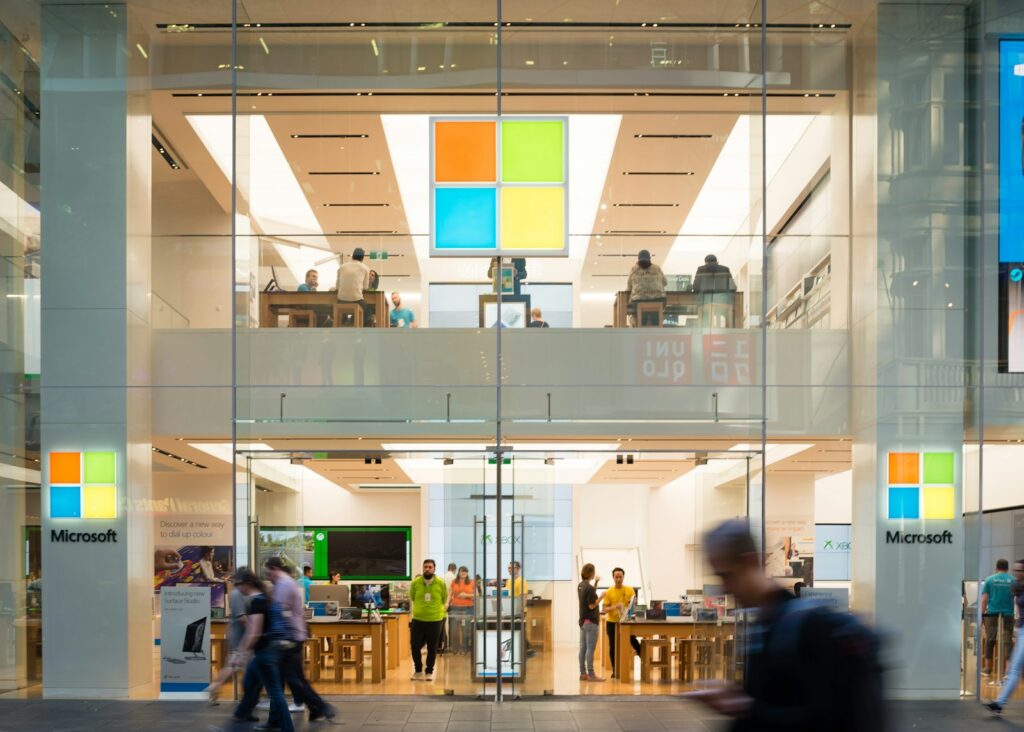
Then came a real game-changer: cloud computing. Microsoft officially entered the market with its Azure Services Platform on October 27, 2008. This was a huge deal, laying the groundwork for what would become a massive part of their business. Around this time, Bill Gates, who’d been Chief Software Architect, stepped down from that role in June 2008, though he stayed on as an advisor. By October 2009, Windows 7 hit the streets, focusing on refining Vista’s features and performance rather than a total overhaul. Plus, Microsoft started opening its own branded retail stores, with the first one popping up in Scottsdale, Arizona. They were ready to get up close and personal with customers!
Microsoft also took a shot at the booming smartphone scene, which they’d been struggling in, falling behind Apple and Google’s Android. So, in October 2010, they ditched their old Windows Mobile for the sleek new Windows Phone OS, complete with its minimalist ‘Metro’ design. They even teamed up with Nokia in 2011 to co-develop it, showing they were serious about mobile. And in a surprising move, Microsoft became a founding member of the Open Networking Foundation in March 2011, joining tech giants like Google and Yahoo! to push for software-defined networking, proving they weren’t afraid to collaborate with the ‘enemy’ when it came to industry innovation.

9. **Mobile Ambitions and Surface Takes Form (2011-2014)**Following that big Windows Phone push, Microsoft started giving its entire product lineup a makeover in 2011 and 2012. Everything from logos to websites began to sport that minimalist ‘Metro’ design. It was a visual revolution! And then, in June 2011 in Taipei, they dropped a bombshell: Windows 8. This wasn’t just another operating system; it was built to power *both* traditional PCs and the hot new tablet computers. Talk about a bold move to bridge the gap!
But wait, there’s more! On June 18, Microsoft unveiled the Surface, a tablet that was *completely* designed and manufactured by them. This was huge—the first time in the company’s history they’d made their own computer hardware. They were tired of just doing software; they wanted to control the whole experience, challenging Apple head-on. Not long after, they shelled out $1.2 billion for the social network Yammer, and launched Outlook.com to duke it out with Gmail. They were expanding everywhere!
October 2012 was a busy month for Redmond. Windows 8 and the Microsoft Surface officially launched, followed closely by Windows Phone 8. Microsoft even opened a bunch of ‘holiday stores’ across the U.S. to handle the expected rush, beefing up their physical retail presence. They were clearly all in. However, the shiny newness didn’t last forever. By July 2013, Microsoft stocks took a massive hit, their biggest one-day percentage sell-off since 2000. Investors were seriously worried about the lackluster performance of both Windows 8 and the Surface tablet, leading to a whopping $32 billion loss. Ouch!
In a bid to regroup, Microsoft announced a major business reorganization in July 2013, splitting into four new divisions: Operating Systems, Apps, Cloud, and Devices. No layoffs, just a reshuffle to get things in order. And then came another huge acquisition: in September 2013, they agreed to buy Nokia’s mobile unit for $7 billion, a move that really cemented their push into mobile hardware, despite the earlier struggles. It was a clear signal that Microsoft wasn’t giving up on the phone game, come hell or high water.

10. **Nadella’s Ascent: Cloud, Open Source, and AI Seeds (2014-2016/early)**Alright, so the biggest shake-up since Bill Gates stepped down as CEO happened on February 4, 2014. Steve Ballmer officially passed the torch, and Satya Nadella, who had been running Microsoft’s Cloud and Enterprise division, took over as the new CEO. Talk about a promotion! Gates, meanwhile, moved into a technology advisor role, while John W. Thompson became the new chairman, only the second in Microsoft’s history. It was a new era, and everyone was watching.
Nadella wasted no time making his mark. On April 25, 2014, Microsoft finalized the $7.2 billion acquisition of Nokia Devices and Services, rebranding it as Microsoft Mobile Oy. Then, in September, they surprised everyone by buying Mojang, the creators of the insanely popular Minecraft, for $2.5 billion. It was a clear signal that gaming was a serious priority and that Nadella wasn’t afraid to make big moves. They even launched their first interactive whiteboard, the Surface Hub, in January 2015, showing their hardware ambitions were still very much alive.
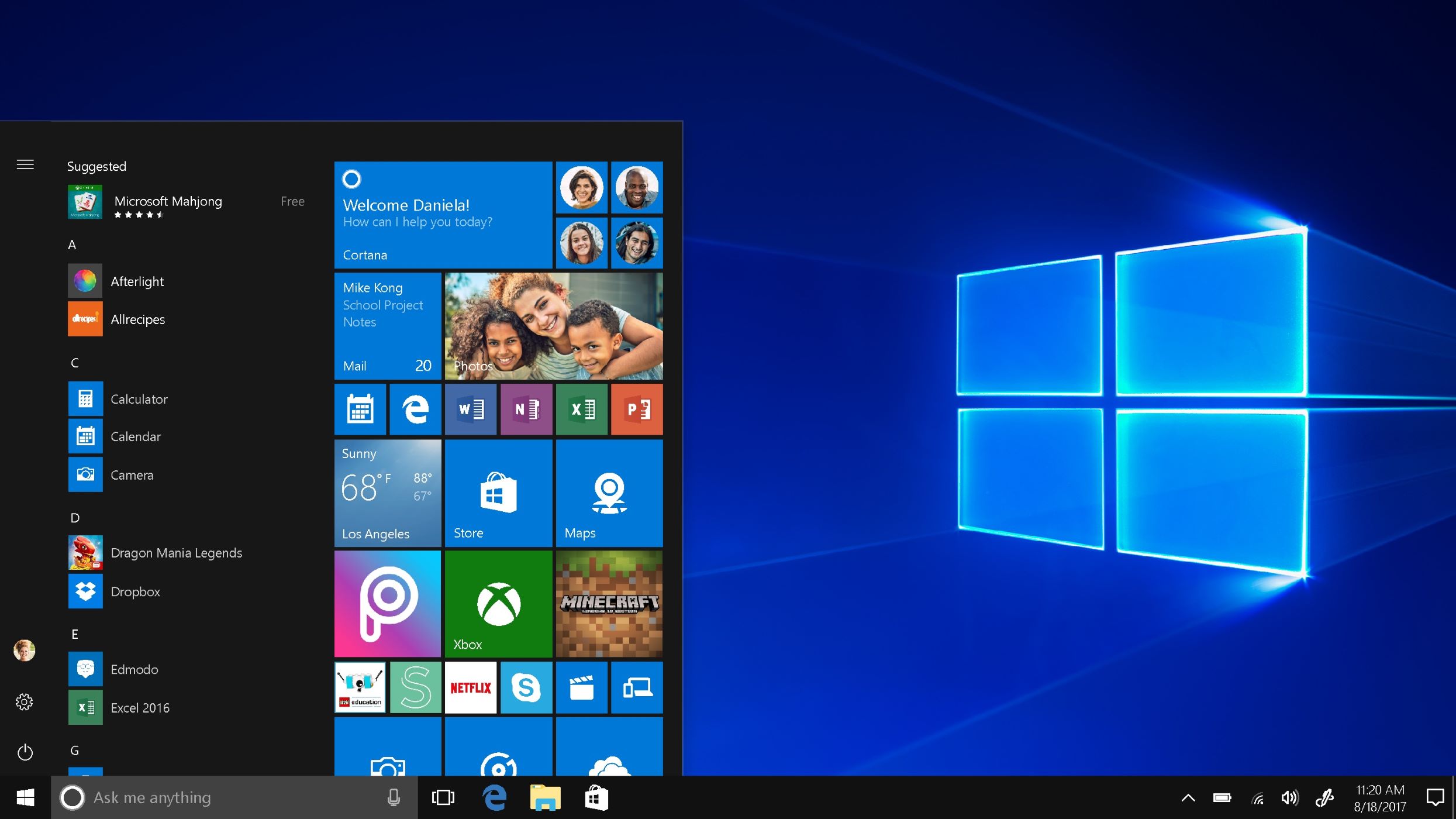
Fast forward to July 29, 2015, and Windows 10 officially hit the streets, promising a more unified experience across devices. Its server counterpart, Windows Server 2016, followed in September 2016. But despite these big launches, Microsoft’s mobile phone business continued to struggle. In Q1 2015, they were the third-largest mobile phone maker, but only a tiny fraction of those phones ran Windows Phone. By early 2016, their share of the U.S. smartphone market had dwindled to a measly 2.7%. The mobile dream was quickly turning into a nightmare.
Things got real in the summer of 2015 when Microsoft announced a staggering $7.6 billion loss related to its mobile-phone business, along with 7,800 layoffs. Brutal! But amid the mobile woes, Nadella was quietly making some truly strategic moves. In June 2016, Microsoft announced ‘Microsoft Azure Information Protection,’ focusing on securing enterprise data in the cloud. And then, in a move that would have been unthinkable just a decade prior (especially with Ballmer’s famous ‘Linux is a cancer’ comment), Microsoft joined the Linux Foundation as a Platinum member in November 2016, shelling out a cool $500,000 a year. Talk about burying the hatchet and embracing open source!

11. **Gaming Empire Expands & Open Source Deepens (2016-2018)**So, with Satya Nadella at the helm, Microsoft was clearly serious about gaming. On March 1, 2016, they merged their PC and Xbox divisions, with Phil Spencer, the Xbox chief, announcing that Universal Windows Platform (UWP) apps would be the new focus for Microsoft’s gaming future. This meant games would be more integrated across Windows and Xbox, a smart play for their ecosystem. They also grabbed Hexadite, an Israeli security firm, for $100 million in June 2017, beefing up their cybersecurity game.
But the real buzz was around their continued embrace of open source. Remember that Linux Foundation move? Well, in April 2018, Microsoft took it even further, releasing the source code for the classic Windows File Manager under an MIT License to celebrate its 20th anniversary. It was a total throwback for the tech geeks! That same month, they announced Azure Sphere, their very own derivative of the Linux operating system, showing just how committed they were to playing nice with the open-source world. Who would’ve thought?
However, not everything was rainbows and sunshine. By February 2018, Microsoft quietly ceased notification support for Windows Phone devices, effectively ending firmware updates for the dying platform. It was the final nail in the coffin for their mobile OS ambitions. March 2018 also saw Windows 10 S recalled, changing it from a separate OS to just a ‘mode’ within Windows. And in a more controversial move, they established guidelines censoring profanity in private Office 365 documents. Talk about big brother watching!
Interestingly, during this period, Microsoft wasn’t just looking at consumer tech. In May 2018, they partnered with 17 American intelligence agencies to develop cloud computing products under the ‘Azure Government’ project, which was tied to the Joint Enterprise Defense Infrastructure (JEDI) surveillance program. From gaming and open source to intelligence tech, Microsoft was covering all the bases, showing their incredible breadth and strategic focus on leveraging Azure for critical, high-stakes applications.

12. **AI Everywhere & Hardware Innovation Continues (2018-2020)**Microsoft was on a roll, and in June 2018, they dropped another bombshell: the acquisition of GitHub for a staggering $7.5 billion. The deal officially closed in October, bringing the world’s largest code-hosting platform under Microsoft’s wing. This was a massive statement about their commitment to developers and the open-source community. Later that month, they unveiled the Surface Go, a more affordable, portable addition to their hardware lineup, and even made Microsoft Teams free. Talk about making waves!
The AI game was heating up, and Microsoft was diving headfirst. In August 2018, they teamed up with Toyota Tsusho to create fish farming tools using the Microsoft Azure application suite. We’re talking AI-powered water pump mechanisms that count fish, analyze data, and optimize water flow. How cool is that? It showed how Azure Machine Learning and IoT Hub were making real-world impacts in unexpected places.
But it wasn’t all about new tech; some old favorites were fading out. In September 2018, Microsoft quietly discontinued Skype Classic, pushing users to their newer versions. On the security front, in November, they introduced Azure Multi-Factor Authentication, beefing up cloud security. And in a controversial move, Microsoft agreed to supply 100,000 Microsoft HoloLens headsets to the U.S. military to ‘increase lethality.’ This move even sparked protests from hundreds of Microsoft employees in February 2019, who were not happy about the company profiting from war.
December 2018 saw Microsoft making even more open-source moves, releasing Project Mu, an open-source implementation of UEFI, and open-sourcing Windows Forms and Windows Presentation Foundation (WPF). This was a clear message to developers, showing transparency and community engagement. That same month, they decided to ditch the old Microsoft Edge browser project for a new Chromium-based version. Microsoft was clearly not afraid to reinvent, even when it came to its core products, and was showing everyone they were ready to embrace the future, whatever it looked like.
13. **Next-Gen Gaming & Pandemic-Driven Growth (2020-2022)**The new decade kicked off with Microsoft continuing its aggressive acquisition strategy. On March 26, 2020, they announced they were acquiring Affirmed Networks for about $1.35 billion. Then, the whole world changed with the COVID-19 pandemic, leading Microsoft to close all its retail stores indefinitely. But even with lockdowns, Microsoft was still making big moves. On July 22, they announced they were shutting down their Mixer game streaming service, shifting existing partners over to Facebook Gaming. It was a quick pivot to stay competitive.
Then came the really juicy stuff. In September 2020, Microsoft announced its intent to acquire video game giant ZeniMax Media, the parent company of Bethesda Softworks, for a whopping $7.5 billion. This deal, finalized in March 2021 for $8.1 billion, brought powerhouse franchises like The Elder Scrolls and Fallout into the Xbox Game Studios family. This acquisition solidified Microsoft’s position as a major player in gaming content.
And speaking of game-changers, in September 2020, Microsoft snagged an exclusive license to use OpenAI’s GPT-3 artificial intelligence language generator. Remember GPT-2, the one deemed ‘too dangerous to release’? Well, Microsoft now had the keys to its successor, with capabilities like designing websites and penning articles. This was a massive play in the AI space. Then, in November 2020, the new Xbox Series X and Xbox Series S consoles dropped, marking Microsoft’s latest entry into the console wars.
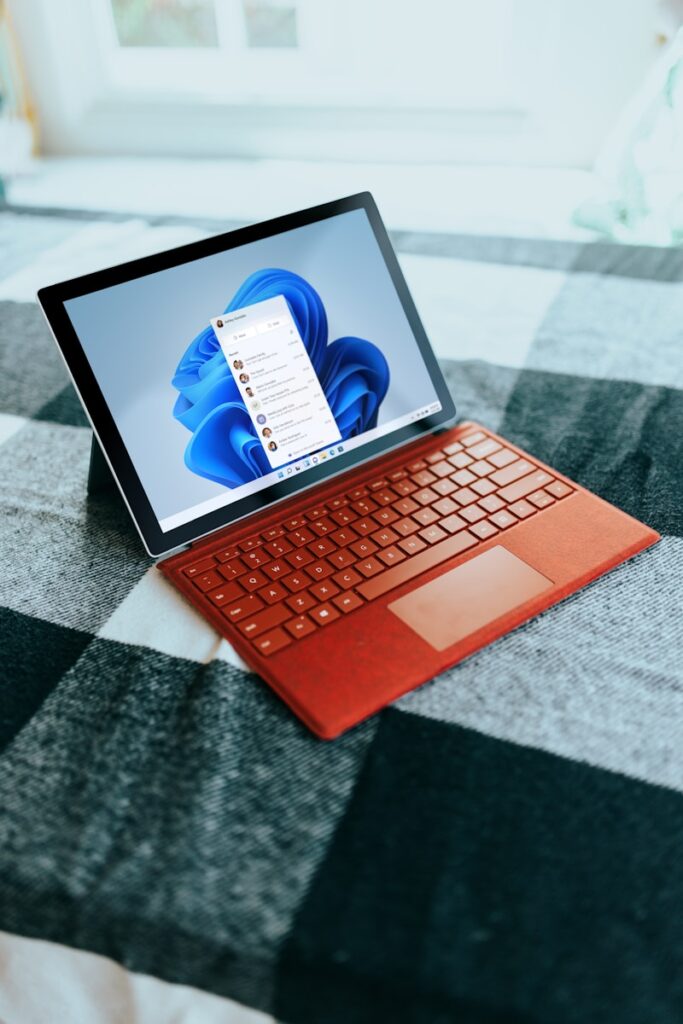
The pandemic actually fueled Microsoft’s growth. By 2021, thanks to a huge demand for cloud computing and gaming sales driven by remote work and distance education, Microsoft’s valuation soared to nearly $2 trillion. They were making bank! In April 2021, they bought Nuance Communications for about $16 billion, further boosting their AI capabilities, especially in healthcare. And in June 2021, in a move that surprised everyone after they’d said Windows 10 would be the last, Microsoft announced Windows 11, which officially rolled out in October. It was a new look and a fresh start for their flagship OS, showing they could still surprise us.

14. **AI Dominance & Global Expansion (2022-Present)**The biggest headline-grabber of all dropped on January 18, 2022: Microsoft announced it was acquiring Activision Blizzard for an insane $68.7 billion in an all-cash deal! We’re talking Call of Duty, Warcraft, Diablo, Candy Crush – all under the Xbox umbrella. This was a game-changing move, cementing Microsoft’s position as a top-tier gaming powerhouse and a clear play in the emerging ‘metaverse.’ Phil Spencer, the Xbox head, was even named CEO of the new Microsoft Gaming division. This wasn’t just about games; it was about content, platform, and future digital worlds. The deal finally closed in October 2023, making it Microsoft’s largest acquisition ever.
But Microsoft wasn’t just about gaming. In December 2022, they inked a massive 10-year deal with the London Stock Exchange Group for Azure products, even acquiring a 4% stake in LSEG. Talk about a strategic investment! And in January 2023, Satya Nadella announced some tough news: 10,000 employees would be laid off. This came right after a Sting concert for executives in Davos, which naturally, raised some eyebrows.
Despite the layoffs, Microsoft was still pouring billions into AI. That same month, they announced a new multi-year, multi-billion dollar investment deal with OpenAI, the brains behind ChatGPT. Then, in June 2023, they launched Azure Quantum Elements, a platform blending AI, high-performance, and quantum computing for molecular simulations. It even included Copilot, a GPT-4 based AI assistant for researchers! They were literally building the future.
The company continued to innovate with its own hardware, announcing custom-designed Maia (for large language models) and Cobalt (for cloud services) chips in November 2023. And in a dramatic saga straight out of Hollywood, OpenAI’s Sam Altman and Greg Brockman briefly joined Microsoft to lead a new AI team after a boardroom drama, only to return to OpenAI days later. Still, Microsoft wasn’t deterred. In March 2024, they ‘acqui-hired’ nearly the entire 70-person team from Inflection AI, including co-founders Mustafa Suleyman and Karen Simonyan, to start Microsoft AI, paying Inflection $650 million to license its tech.
In January 2024, Microsoft hit another milestone, becoming the most valued publicly traded company, and launched Copilot Pro, an AI subscription for small businesses. Their global ambitions were just as huge: a $1.5 billion investment in Emirati AI firm G42 in April 2024, with G42 committing to use Azure. Later that month, they announced a massive $1.7 billion investment in AI and cloud infrastructure in Indonesia, including new data centers. And in May 2024, they tripled their initial proposal to invest $3.3 billion to build an artificial intelligence hub in southeast Wisconsin. From cloud to gaming to AI, Microsoft has proven time and again that it’s not just riding the tech wave; it’s practically creating the ocean. This tech titan, born from a brilliant idea, continues to evolve, innovate, and dominate, cementing its place as an economic powerhouse shaping our digital world for decades to come.