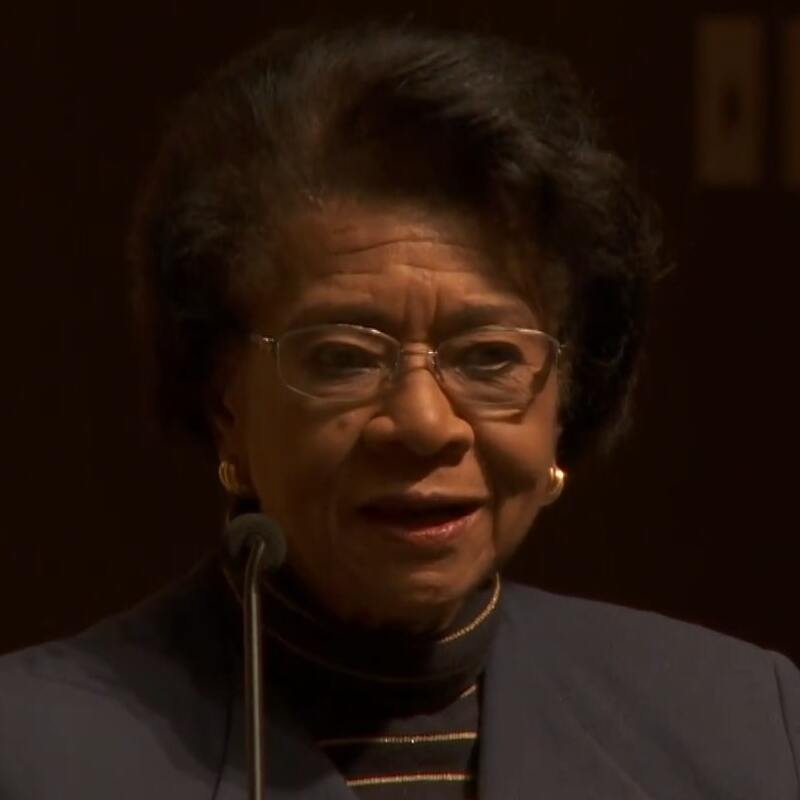
The landscape of American journalism, particularly on the West Coast, recently lost one of its most profound and transformative figures. Belva Davis, a pioneering journalist who shattered racial and gender barriers to become the first Black woman hired as a television reporter in the region, died on September 24 at her home in Oakland, California, at the age of 92. Her passing marks the end of an era defined by her nearly 50 years of steadfast commitment to reporting the truth, giving voice to the voiceless, and advocating for greater inclusivity within the media industry. She leaves behind a legacy of courage, integrity, and journalistic excellence that continues to resonate deeply.
Ms. Davis’s journey was far from conventional, forged through personal struggle and unwavering determination in the face of pervasive prejudice. She rose from humble beginnings, overcoming the debilitating obstacles of poverty and systemic discrimination, to become a respected and beloved figure in broadcast news. Her career, which commenced in an era when newsrooms were overwhelmingly white and male, laid the groundwork for countless journalists of color who followed in her footsteps, demonstrating that authenticity and diverse perspectives were not just beneficial, but essential to comprehensive storytelling.
Her life story is a testament to the power of resolve and the profound impact one individual can have on societal norms and professional standards. Ms. Davis’s ability to navigate and ultimately transcend the intense hostility and career roadblocks she encountered makes her a perennial exemplar of journalistic grit. This article will embark on an in-depth exploration of the various facets of her remarkable life and career, chronicling the pivotal moments, defining achievements, and enduring influence of Belva Davis, a true trailblazer whose vision helped shape the modern media landscape.

1. **Breaking Barriers on the West Coast: The First Black Woman Television Reporter**
Belva Davis made indelible history in 1966 when she was hired by KPIX-TV, the CBS affiliate in San Francisco, becoming the first Black woman television journalist on the entire West Coast of America. This monumental achievement was not merely a personal triumph but a significant crack in the long-standing color barrier that had systematically excluded Black women from mainstream broadcast news. Her debut on the air in February 1967 marked a pivotal moment for both the industry and the communities she served.
At a time when pervasive ism, racism, and discrimination defined the broadcast landscape, Ms. Davis’s entry into television was extraordinary. Journalism jobs in major media outlets, beyond community-focused radio stations and newspapers catering to predominantly Black audiences, were almost unheard of for Black women. Her presence on screen instantly challenged preconceived notions and opened a vital pathway for diverse voices to enter the public discourse.
Her colleague, Barbara Rodgers, encapsulated this impact profoundly, stating, “I say that Belva kicked open the door, but left her shoe in it. She wanted to prop it open for all the rest of us and really encouraged us.” This sentiment highlights not only Ms. Davis’s individual success but her deliberate and enduring commitment to creating opportunities for those who would follow, transforming a personal milestone into a collective gain for aspiring journalists of color.

2. **Early Life and Formative Struggles: Overcoming Poverty and Prejudice**
Belvagene Melton was born on October 13, 1932, in Monroe, Louisiana, a region deeply entrenched in the Jim Crow era of segregation. Her early life was characterized by significant hardship; her mother, Florene Wood, was only 14 years old at the time of Belva’s birth, and her father, John Melton, was a sawmill worker. The crushing realities of poverty meant that Belva spent her early years living with various relatives, experiencing a lack of stable home life.
In the early 1940s, fleeing racism and difficult economic conditions in the Deep South, her extended family migrated west to Oakland, California. The initial living conditions in Oakland were starkly challenging; for a period, 11 relatives resided in a cramped, rented basement until they could secure housing in a West Oakland housing project. Belva herself recalled sleeping on the kitchen floor during this time, a stark illustration of the overcrowding and deprivation she experienced. She famously wrote, “My home was overstuffed with people but lacking in affection.”
Despite the emotional and material scarcities of her youth, Ms. Davis found solace and escape in books. She attended the academically rigorous Berkeley High School, from which she earned a diploma in 1951, becoming the first in her immediate family to achieve this educational milestone. Though she was accepted into San Francisco State University, financial constraints prevented her from attending college. Reflecting on these early challenges, Ms. Davis articulated a philosophy of resilience: “I learned to survive. And, as I moved from place to place, I learned to adapt. When I got older, I just figured I could become whatever it was that I needed to become.”

3. **The Crucible of the 1964 RNC: A Pivotal Incident that Ignited Resolve**
One of the most defining experiences that solidified Belva Davis’s commitment to journalism occurred in 1964, while she was reporting for KDIA-AM, a Black-oriented Bay Area radio station. She was covering the Republican National Convention at the Cow Palace arena south of San Francisco, an assignment that unexpectedly turned into a profound confrontation with overt racism. Ms. Davis, alongside a Black male reporter, Louis Freeman, endured egregious hostility from the convention attendees.
The crowd, composed of fans of the nominee, Senator Barry Goldwater of Arizona, “snarled racial epithets and tossed garbage” at them. Ms. Davis vividly recounted in her 2010 memoir, “Never In My Wildest Dreams: A Black Woman’s Life in Journalism,” that “a hurled soda bottle narrowly missed her head.” They were denied press passes, forced to sit “in the rafters, sitting quietly, trying to make sure nobody found us.” When discovered, attendees yelled racial slurs, leading to them being “driven out of that hall as people threw debris” at them.
This incident, though deeply traumatizing and a stark reminder of the racial animosity prevalent in the country, did not deter her; rather, “it shook but did not deter her.” Ms. Davis later reflected that “it was a bad, terrible incident, but it inspired me to do something that I might not have ever done had that been a pleasant, ordinary, normal convention.” It was this crucible that deepened her resolve to pursue journalism with even greater fervor, transforming a moment of abuse into a catalyst for an impactful career.

4. **The Power of Storytelling: Her Motivation to Report the Realities of Black Americans**
The harrowing experience at the 1964 Republican National Convention profoundly shaped Belva Davis’s motivation to pursue journalism, imbuing her with a clear mission. She understood the critical need for honest reporting on race relations, stating, “All too many white Americans refused to believe the harsh truth about race relations in their own country.” This stark realization fueled her commitment to an industry that often overlooked or distorted the narratives of Black communities.
Even without formal training in news gathering, Ms. Davis resolved to report the often-unacknowledged realities of life for many Black Americans, particularly during an era when much of the country was living amid de facto segregation. She recognized that journalists had a crucial role to play in societal change, observing, “Journalists were beginning to bring the stories of Black Americans out of the shadows … and into the light of day.” Her ambition was to be at the forefront of this crucial endeavor.
She articulated a clear purpose for her journalistic pursuits: to confront the uncomfortable truths of racial injustice. Ms. Davis spoke of reporting on “the cross burnings and water hosings, the beatings and lynchings, in vivid details that the public could no longer ignore.” This dedication to unflinching truth-telling was the bedrock of her career, driven by a profound sense of responsibility to her community and to the wider American public, ultimately declaring, “I wanted to be one of them.”

5. **From Radio Waves to Television Screens: Transitioning and Pioneering in Broadcast**
Belva Davis’s journey into broadcast journalism began with a foundation in print media, illustrating her innate talent for storytelling. Her first foray into the world of journalism came in 1957, when she accepted a freelance assignment for *Jet*, a magazine focusing on African-American issues, becoming a stringer for the publication. She soon expanded her reach, writing for other African-American publications such as the *Sun Reporter* and *Bay Area Independent*, even editing the *Sun Reporter* from 1961 through 1968.
Her transition to radio occurred in the early 1960s, a significant step towards her future in broadcasting. She hosted “The Belva Davis Show” on KDIA, an AM radio station in Oakland focused on Black listeners, where she played jazz and rhythm-and-blues records and interviewed prominent performers visiting Oakland or San Francisco, including notable figures like Frank Sinatra and Bill Cosby. Ms. Davis even made her television debut in 1963 for KTVU, an Oakland-based station, covering an African-American beauty pageant.
Despite her evident talent and experience, securing a full-time television position proved to be a challenging endeavor for years. Newsrooms of the era were overwhelmingly white and male, creating significant barriers to entry for Black women. Yet, as Ms. Davis reflected on a rejection during an early job interview, she realized, “It helped me in my resolve to demonstrate that I could do whatever they were doing in that station as well as anybody,” embodying a determination that would eventually see her break through these formidable obstacles.

6. **The Challenge of Entry: Facing Explicit Racism and Self-Doubt in TV News**
Even with her undeniable skills and growing experience, Belva Davis’s pursuit of a television career was met with blatant and painful racism. She vividly recalled being turned away by one Bay Area television news director who, without equivocation, told her, “I’m sorry, we’re just not hiring any Negresses.” This overt expression of prejudice, she noted years later on KQED’s Forum, was “something that was very hurtful,” particularly for a young woman striving to enter the professional world.
Adding to the external systemic barriers, Ms. Davis also wrestled with profound internal self-doubt, stemming from not having a college degree. Though she was accepted into San Francisco State University, financial constraints prevented her from attending, a fact that weighed on her. Retired news anchor Barbara Rodgers, who worked with Davis at KPIX, recalled, “she always sort of felt she didn’t have everything she needed because she didn’t get to go to college.”
Despite these profound challenges – explicit racial discrimination and personal insecurities – Ms. Davis persevered. Her sheer will, as encapsulated by a colleague who said, “She confronted prejudice, confronted every possible barrier,” was a driving force. Even when KPIX finally hired her, her entry came with an unexpected stipulation: “she needed to lose 10 pounds,” a testament to the myriad biases she navigated to secure her groundbreaking position.

7. **A Career Forged in Turmoil: Reporting on the Tumultuous Bay Area of the 1960s and ’70s**
Belva Davis’s formative years in television coincided with an extraordinarily tumultuous period in the Bay Area, a crucible of social and political upheaval. Immediately after joining KPIX as a general-assignment reporter, she was swiftly immersed in covering some of the most pressing and often violent events of the era. Her early assignments included reporting on crime, intense clashes between the police and student protesters at the University of California, Berkeley, and the unfolding presidential campaign of Robert F. Kennedy before his assassination in Los Angeles in June 1968.
One of her most significant and delicate assignments involved reporting on the rise of the Black Panther Party. With a co-founder, Huey P. Newton, having dated an acquaintance of hers, Ms. Davis possessed a unique understanding of the community dynamics at play. She dedicated herself to explaining to an often-alarmed white viewership why these “gun-toting militants” commanded respect in the very neighborhoods where she had grown up, particularly because they sought to defend Black residents against brutality by a nearly all-white police department.
Ms. Davis’s ability to cover such complex and sensitive issues with a calm demeanor and deep insight established her reputation for fairness and context. Her career would continue to span major historical moments, including the AIDS and crack epidemics, and the 1998 United States embassy bombing in Tanzania, demonstrating her enduring capacity to cover critical national and international stories with depth and authority.
Having established her formidable presence in the challenging landscape of 1960s and 1970s Bay Area journalism, Belva Davis’s career trajectory continued its ascent, marking her as a trusted and influential anchor. Her unwavering commitment to fair and comprehensive reporting, often on the most sensitive and complex issues, cemented her status as a respected figure across multiple prominent television stations. Her move from general assignment reporting to the anchor desk was a natural evolution for a journalist whose integrity and depth of understanding were consistently evident.
Indeed, Ms. Davis became a steady presence in the living rooms of Bay Area residents for decades, anchoring for three major TV stations: KPIX, KRON, and KQED. Her ascent to anchorwoman at KPIX in 1970 signaled a broader acceptance and recognition of her capabilities, shattering another layer of the glass ceiling. Later, she would join KQED in 1977 and KRON-TV, San Francisco’s NBC affiliate, in 1984, where she remained for 18 years, including a notable stint co-anchoring national political conventions with Rollin Post.
Her capacity for calm and authoritative delivery was particularly evident during moments of profound crisis. On November 27, 1978, Ms. Davis anchored KQED’s prime-time newscast, delivering news of the assassinations of San Francisco Mayor George R. Moscone and Supervisor Harvey Milk. Her exemplary coverage of this tragic event, which included interviewing key figures like Willie Brown and Dianne Feinstein, earned the broadcast an award from the Corporation for Public Broadcasting for best local news program, underscoring her ability to perform with distinction under immense pressure.

8. **Becoming a Respected Anchor: A Steady Presence Across Bay Area Airwaves**
Belva Davis’s transition from a groundbreaking field reporter to a prominent anchorwoman signified a deeper entrenchment of her influence within American media. Her calm demeanor, coupled with her profound insight, allowed her to navigate the demanding environment of live news broadcasts with a grace that resonated with viewers and colleagues alike. This shift from reporting from the heart of tumultuous events to leading the delivery of complex narratives from the anchor desk solidified her reputation as a journalist of exceptional caliber.
After her impactful years at KPIX, Ms. Davis brought her distinctive voice and perspective to other key Bay Area media institutions. She joined KQED in 1977, a public television station known for its in-depth public affairs programming, and then moved to KRON-TV, San Francisco’s NBC affiliate, in 1984. Her tenure at KRON lasted for 18 years, during which she further expanded her portfolio, notably co-anchoring national political conventions with colleague Rollin Post.
Upon her return to KQED, Ms. Davis took on the role of host for the acclaimed round-table show “This Week in Northern California,” a position she held for many years until her retirement. This program became a significant platform for discussing critical local and regional issues, allowing Ms. Davis to moderate complex conversations with the clarity and even-handedness that had become her hallmark, further cementing her legacy as a pillar of thoughtful journalism in the Bay Area.

9. **The Impact of Her Interviews: Conversing with Icons and Shaping Narratives**
Throughout her extensive career, Belva Davis demonstrated a singular ability to engage with some of the most influential figures of her time, extracting insights and presenting their perspectives to a broad audience. Her interviews were not merely exchanges but often probing conversations that illuminated the cultural and political currents shaping society. This skill in connecting with powerful voices contributed significantly to her stature as a journalist.
Ms. Davis’s interview roster reads like a chronicle of 20th-century leadership and activism. She engaged with literary giant James Baldwin, the revered civil rights leader the Rev. Dr. Martin Luther King Jr., Cuban revolutionary Fidel Castro, and boxing icon Muhammad Ali. These conversations showcased her capacity to handle diverse subjects and personalities with an intellectual rigor and empathetic understanding that transcended mere questioning.
Beyond these national and international figures, Ms. Davis also conducted historically significant local interviews, such as those following the Moscone-Milk assassinations. Her prime-time newscast featured interviews with Willie Brown, then a state assemblyman, and Dianne Feinstein, then a supervisor, who had discovered Mr. Milk’s body. Moreover, she famously challenged comedian Lenny Bruce on his use of racial slurs, highlighting her steadfast commitment to addressing racial injustice even in unexpected contexts, refusing to accept the premise that the word could be disarmed of its power to wound.

10. **A Champion for Diversity: Advocacy On and Off the Air**
Belva Davis’s commitment to breaking barriers extended far beyond her own professional achievements; she actively championed racial visibility and opportunity for others within the media industry and beyond. Her advocacy was a cornerstone of her legacy, distinguishing her as not just a reporter of news, but a catalyst for change. She understood the systemic nature of discrimination and worked tirelessly to dismantle it, both structurally and institutionally.
Within the broadcast union, AFTRA (now SAG-AFTRA), Ms. Davis served as the national equal employment opportunities chair, wielding her influence to push for greater diversity in newsrooms. This role allowed her to advocate for policies and practices that would create more equitable pathways for journalists of color, ensuring that the doors she had opened would remain wide for those who followed. Her efforts were instrumental in shaping a more inclusive industry landscape.
Her dedication to cultural preservation and representation was equally profound. In 2002, then-San Francisco Mayor Willie Brown recruited Ms. Davis to help establish the Museum of the African Diaspora in the city. Leveraging her extensive network and influence among San Francisco’s wealthy cultural patrons, she successfully raised millions of dollars for the project and became its board president. Her involvement was crucial in bringing this vital institution to fruition, further solidifying her impact on the cultural fabric of the Bay Area. She also served on the boards of the Institute on Aging and the Fine Arts Museums of San Francisco, underscoring her broad commitment to community and cultural enrichment.

11. **Mentorship and Inspiration: Propelling Future Generations of Journalists**
Beyond her on-air work and formal advocacy, Belva Davis’s impact as a mentor and an inspirational figure for aspiring journalists, especially women of color, cannot be overstated. She was renowned for her generosity in guiding and encouraging others, transforming her personal triumphs into opportunities for collective advancement within the profession. Her approachability and willingness to share her experiences created a supportive environment for many.
Barbara Rodgers, a retired news anchor who worked with Ms. Davis at KPIX, eloquently articulated this mentorship, stating, “I say that Belva kicked open the door, but left her shoe in it. She wanted to prop it open for all the rest of us and really encouraged us.” Rodgers, who met Davis in 1979, affectionately recalled Ms. Davis taking her “under her wing,” becoming her “San Francisco mom” and hosting inclusive holiday dinners, particularly for newcomers to the Bay Area.
Similarly, Pam Moore, a former KRON TV anchor, described Ms. Davis as “a legend and she was a mentor, a friend, a mom,” emphasizing that “you don’t work in California and journalism as a person of color and not know about Belva Davis.” Carla Marinucci, a respected journalist, echoed this sentiment, hailing Ms. Davis as “the gold standard for a generation of journalists” and a “trailblazer like no other,” acknowledging her profound influence as a mentor to countless individuals throughout the Bay Area and the nation. Ms. Davis also notably mentored Kathleen H. Arnold (now Kathleen Rand Reed), an African-American woman and AWRT member, for decades, highlighting her consistent dedication to fostering new talent.

12. **Accolades and Recognition: A Career Honored and Celebrated**
Belva Davis’s remarkable contributions to journalism and her pioneering spirit were widely recognized and celebrated throughout her illustrious career. Her dedication to factual reporting, her integrity, and her profound influence on the media landscape earned her a multitude of prestigious awards and honors, reflecting the high esteem in which she was held by her peers and the public alike. These accolades stand as a testament to her enduring impact.
Among her most notable achievements were the eight local Emmy Awards she garnered from the San Francisco / Northern California chapter, a significant recognition of her excellence in broadcast journalism. Furthermore, the Corporation for Public Broadcasting honored the KQED newscast she anchored following the Moscone-Milk assassinations with an award for best local news program, underscoring the critical importance and quality of her work during a pivotal historical moment.
Beyond specific reporting achievements, Ms. Davis received lifetime achievement awards from both the American Women in Radio and Television and the National Association of Black Journalists, acknowledging the entirety of her groundbreaking career and her lasting legacy. These honors highlighted her status not just as an accomplished journalist, but as a pivotal figure who opened doors and inspired generations. She was also an honorary member of Alpha Kappa Alpha, a prestigious sorority, reflecting her broad community recognition.
Read more about: Otis Davis: An Olympic Pioneer Who Shattered Barriers on Track and Defied Racism, Dies at 92

13. **The Enduring Influence: A Legacy of Integrity and Truth-Telling**Belva Davis’s nearly five-decade career left an indelible mark on American journalism, her influence extending far beyond the stories she reported or the barriers she broke. Her professional life became a testament to unwavering integrity and an unyielding commitment to truth, shaping the standards for countless journalists who followed. She cultivated a reputation that was, as Mary Bitterman, former CEO of KQED, noted, “always highly respected, noted for its fairness and for putting stories into context.”
Belva Davis’s nearly five-decade career left an indelible mark on American journalism, her influence extending far beyond the stories she reported or the barriers she broke. Her professional life became a testament to unwavering integrity and an unyielding commitment to truth, shaping the standards for countless journalists who followed. She cultivated a reputation that was, as Mary Bitterman, former CEO of KQED, noted, “always highly respected, noted for its fairness and for putting stories into context.”
Colleagues and observers consistently highlighted her unique blend of strength and grace. Rita Williams, a reporter for KTVU, described Ms. Davis as having “so much class, so much presence, so much intuition,” deeming her “the grande dame” of Bay Area journalism. Ms. Bitterman further emphasized, “Her legitimacy as an excellent reporter, her integrity, her professional accomplishments and her personal attributes made her the sort of person that everyone aspired to become.”
Ms. Davis often articulated a deep personal drive to uphold her community, with a colleague observing that “She wants to prove, more to herself than to anybody else, that she cannot, and will not, let down the African American community.” Her autobiography’s foreword, penned by Bill Cosby, acknowledged her symbolic value to the African-American television audience as “someone who sustained us, who made us proud,” who proved “the stereotypical ugliness of those days to be wrong.” Her famous motto, “Don’t be afraid of the space between your dreams and reality. If you dream it, you can make it so,” encapsulates the spirit of resilience and aspiration that defined her journey and continues to inspire.

14. **Retirement and Final Years: An Unwavering Voice Until the End**
After a distinguished career spanning nearly five decades, Belva Davis retired in November 2012, at the age of 80, from her role as host of “This Week in Northern California” on KQED. Her departure from daily broadcasting marked the end of an extraordinary era, yet her legacy of journalistic excellence and pioneering spirit remained vibrantly alive. Her final broadcast was thoughtfully curated, featuring a taped interview with her personal friend, Maya Angelou, with the theme of friendship serving as a poignant valedictory note.
Even in retirement, Ms. Davis’s impact continued to resonate. She had shaped the landscape of local and national news, demonstrating that diverse voices were not only necessary but invaluable. Her life’s work served as a blueprint for advocating for racial equity and professional integrity, long after she stepped away from the camera. The foundation she laid for inclusive journalism continues to benefit the industry and the communities it serves.
Read more about: Beyond the Uniform: How Military Service Forged 12 Iconic Figures Who Changed America Forever
Belva Davis passed away on September 24, 2025, at the age of 92, at her home in Oakland, California, following a long illness. She leaves behind a profound legacy, survived by her beloved second husband, Bill Moore; her two children from her first marriage, Darolyn Davis and Steven Davis; and a granddaughter, Sterling Davis. Her passing marked not just the end of a remarkable life, but the conclusion of a chapter in American media history that she so courageously helped write, leaving Mary Bitterman to aptly conclude, “we shall not soon see her like again.” Her journey, from overcoming early adversity to becoming a revered icon, stands as a powerful testament to the transformative power of perseverance, vision, and unwavering dedication to truth.