Ford. The name alone conjures images of groundbreaking innovation, legendary performance, and vehicles that have shaped the very fabric of American (and global) car culture. From the revolutionary Model T to the iconic Mustang and the ubiquitous F-Series trucks, the Blue Oval has certainly had its fair share of triumphs, cementing its place in automotive history as a titan of industry. But let’s be frank, even titans stumble, and when they do, the results can be spectacularly, memorably bad.
Every car company, no matter how storied, has its skeletons in the closet – those designs that made engineers scratch their heads, marketing teams sweat, and consumers wonder if the designers were having a particularly off day. This isn’t about safety recalls, performance woes, or sales figures (though sometimes, ugly cars don’t sell well, go figure). Today, we’re putting on our most critical spectacles to scrutinize the aesthetics, the lines, the curves, and the outright visual misfires that Ford probably wishes could be airbrushed out of history.
Join us as we take an unflinching, opinionated, and perhaps slightly sarcastic journey through the annals of Ford’s sedan design history. We’re sifting through the archives to pull out the cars that were, in our humble but highly informed opinion, truly hideous. These are the nine Ford sedans that, for their polarizing looks and questionable styling cues, should have never, ever, left the drawing board. Prepare yourselves for a visual onslaught; it’s going to be a bumpy ride.

1. **Ford Edsel (1958-1960)**Let’s kick things off with a name that has become, for better or worse, synonymous with automotive failure. The Ford Edsel wasn’t just a car; it was a division, born of ambition and a massive $250 million investment in the late 1950s. Ford had high hopes, aiming to create a distinct brand named after Henry Ford’s only son, Edsel Ford. The company poured resources into research, development, engineering, and an aggressive marketing campaign, anticipating a grand success.
Unfortunately for Ford, the Edsel Pacer, one of the division’s flagship models, quickly found itself topping “worst cars ever” lists, largely due to its infamous front grille. Many critics and consumers alike likened this unique, tall snout, sitting smack dab in the middle of the car’s face, to a “horse collar.” Others, perhaps more provocatively, saw something vaguely anatomical or even a “goldfish impression.” It was a design choice so polarizing that it overshadowed almost everything else about the car, including its decent 410 cubic inch V8 engine and the innovative Teletouch Drive push-button transmission.
Beyond the controversial grille, the Edsel’s overall appearance was criticized as an “overreach in design innovation.” The “unconventional vertical front grille” was often paired with an “overly busy dashboard,” creating a disjointed and aesthetically challenging package. The designers tried to be unique, to stand out from the crowd, but in doing so, they veered into territory that most found unattractive, even dated upon arrival in 1958. It felt like a car trying too hard, resulting in a cluttered and confused visual identity.
While the Edsel’s commercial flop can be attributed to a confluence of factors—including a change in market trends, its launch during a recession, and mechanical and quality control issues—there’s no denying that its “bad looks certainly didn’t help.” The design was a critical factor in its rejection by the public, ensuring its place as a cautionary tale in industrial design. It was a visual miscalculation of epic proportions, a car whose face launched a thousand critiques, cementing its legacy as a truly hideous Ford.
Car Model Information: 1958 Edsel Citation
BirthName: Edsel Bryant Ford
Caption: Ford in 1921
BirthDate: [object Object]
BirthPlace: Detroit, Michigan
DeathDate: [object Object]
DeathPlace: Grosse Pointe Shores, Michigan
Occupation: Automobile executive
Title: Ford Motor Company
Spouse: [object Object]
Parents: Henry Ford,Clara Bryant Ford
Relations: Edsel Ford II
Children: Henry Ford II,Benson Ford,Josephine Ford,William Clay Ford Sr.
Categories: 1893 births, 1943 deaths, 20th-century American businesspeople, All Wikipedia articles written in American English, All articles with dead external links
Summary: Edsel Bryant Ford (November 6, 1893 – May 26, 1943) was an American business executive and philanthropist, who was the only child of pioneering industrialist Henry Ford and his wife, Clara Jane Bryant Ford. He was the president of the Ford Motor Company from 1919 until his death in 1943.
He worked closely with his father, as sole heir to the business, but was keen to develop cars more exciting than the Model T (“Tin Lizzie”), in line with his personal tastes. Even as president, he had trouble persuading his father to allow any departure from this formula. Only a change in market conditions enabled him to develop the more fashionable Model A in 1927. Edsel also founded the Mercury division and was responsible for the Lincoln-Zephyr and Lincoln Continental. He introduced important features, such as hydraulic brakes, and greatly strengthened the company’s overseas production.
Ford was a major art benefactor in Detroit and also financed Admiral Richard Byrd’s polar explorations. He died of stomach cancer aged 49. Henry Ford temporarily reassumed the presidency of Ford Motor Company on Edsel’s death, then Edsel’s eldest son, Henry Ford II, succeeded Henry as president of the company in 1945.
He was also a member of the board of directors of American IG, the American subsidiary of the German chemical conglomerate IG Farben.
Get more information about: Edsel Ford
Buying a high-performing used car >>>
Brand: Ford Model: Edsel
Price: Not Priced Mileage: 68,904 mi.
Read more about: The 14 Most Embarrassing Automotive Design Flops That Taught the Industry Hard Lessons

2. **Ford Thunderbird (1958-1960)**Just as we were recovering from the Edsel, Ford decided to give us another aesthetic challenge with the second-generation Thunderbird, which sold from 1958 to 1960. The first-generation Thunderbird, a sleek two-seater, remains a beautiful piece of art and a timeless symbol of 1950s American car culture. It embodied cool. The second generation, however, veered dramatically off course, proving that sometimes, even successful bloodlines can produce an ugly duckling.
MotorTrend, in a move that feels almost like a backhanded compliment in retrospect, actually awarded the 1958 Thunderbird its Car of the Year Award. Yet, some 65 years later, the very same magazine included it on its list of ugliest cars ever made. This dramatic shift in perception speaks volumes about how poorly the design aged. The biggest complaint? It became “larger just about everywhere—price, payload, and passenger capacity—except for performance,” which was an anemic 144 hp from its engine.
But it wasn’t just the bulk; it was the way that bulk was handled. The classic, sleek 1950s look of the original gave way to an “oversized body with a lot of chrome trim that dripped with excess.” The “massive chrome grille that blended into the chrome bumper made it look like the car went to a cosmetic surgeon to give it a plump lip job.” It was a car that screamed opulence but delivered questionable taste, exchanging the original’s restrained elegance for a heavy-handed, almost cartoonish, grandiosity.
This aesthetic departure alienated many who cherished the original’s sporty, personal luxury car ethos. The second-gen T-bird tried to be a grander, more family-friendly four-seater, but its visual execution was a misstep, leading to a bloated, overly ornamented appearance that lacked the grace of its predecessor. Even later attempts at revival, like the 2002 Thunderbird, another “retro craze” model, similarly “completely missed the mark,” demonstrating a recurring struggle for Ford to recapture the Thunderbird’s original design magic.
Car Model Information: 1966 Ford Thunderbird Base
Name: Ford Thunderbird
Caption: 1957 Thunderbird
Manufacturer: Ford Motor Company
Production: unbulleted list
ModelYears: unbulleted list
Class: unbulleted list
Layout: Front-engine, rear-wheel drive layout
Categories: 1960s cars, 1970s cars, 1980s cars, 1990s cars, 2000s cars
Summary: The Ford Thunderbird is a personal luxury car manufactured and marketed by Ford Motor Company for model years 1955 to 2005, with a hiatus from 1998 to 2001.
Ultimately gaining a broadly used colloquial nickname, the T-Bird, the model was introduced as a two-seat convertible, subsequently offered variously in a host of body styles including as a four-seat hardtop coupe, four-seat convertible, five-seat convertible and hardtop, four-door pillared hardtop sedan, six-passenger hardtop coupe, and five-passenger pillared coupe, before returning in its final generation, again as a two-seat convertible.
At its inception, Ford targeted the two-seat Thunderbird as an upscale model. The 1958 model year design introduced a rear seat and arguably marked the expansion of a market segment that came to be known as personal luxury cars, positioned to emphasize comfort and convenience over handling and high-speed performance.
Get more information about: Ford Thunderbird
Buying a high-performing used car >>>
Brand: Ford Model: Thunderbird
Price: $44,999 Mileage: 71,017 mi.
3. **Ford Pinto (1971-1980)**The Ford Pinto, oh, the Pinto. Before we dive into its questionable looks, it’s almost impossible to mention this car without acknowledging its infamous propensity to catch fire when rear-ended – a controversy that tragically tied 27 deaths to its design and led to a “$4 billion lawsuit” against the company. That safety issue alone cements its place in history, but setting that aside for a moment (a difficult feat, we admit), the Pinto was also just one truly bland, and frankly, ugly car.
Its design was characterized by an “egg-shaped design and stubby appearance,” which “didn’t win many fans in the beauty department.” It looked like many other cheap subcompacts of the 1970s, but even within that uninspired class, the Pinto managed to stand out for its sheer lack of aesthetic appeal. The context explains that “Ford engineers simply removed the latter half of the car to save weight and development costs, so the Pinto is technically a larger car with its rear shaved off.” This cost-saving measure resulted in a car with “bulbous looks” that were “made worse by its mismatched proportions,” giving it an awkward and incomplete silhouette.
On the surface, the Pinto offered affordability, with a base price of $1,919 (around $15,000 today), and it was a fuel-efficient little hatchback, which was particularly important during the oil crisis of 1973. These practical considerations did make it popular for a time. However, practicality rarely translates to visual poetry, and the Pinto was certainly no exception. It was a utilitarian box, albeit one with a severely stunted rear end, making it an uninspiring presence on the roads of its era.
Ultimately, while its safety record casts a dark shadow, the Pinto’s design was also a significant contributor to its negative legacy. It wasn’t just a car that was dangerous; it was a car that looked like a compromise from every angle, an automotive equivalent of a hastily assembled lunchbox on wheels. The lack of thoughtful aesthetic integration, especially at the rear, made it a true design disaster, forever etched in the collective memory as both a hazard and an eyesore.
Car Model Information: 1980 Ford Pinto WAGON
Name: Ford Pinto
Caption: Ford Pinto
Manufacturer: Ford Motor Company
Aka: Mercury Bobcat
Production: September 1970 – July 1980
ModelYears: 1971–1980 (Pinto),1974–1980 (Bobcat)
Assembly: Edison, New Jersey,Milpitas, California
Designer: Robert Eidschun (1968)
Class: Subcompact car
BodyStyle: Sedan (automobile),sedan delivery,station wagon,hatchback
Related: #Mercury Bobcat (1974–1980),Ford Mustang (second generation)
Layout: Front-engine, rear-wheel-drive layout
Chassis: Unibody
Engine: unbulleted list
Abbr: on
Disp: Ford Cologne engine
Transmission: unbulleted list
Wheelbase: 94.0 in
Length: 163 in
Width: 69.4 in
Height: 50 in
Weight: convert
Predecessor: Ford Cortina#Mark II (1966–1970)
Successor: Ford Escort (North America)
Categories: 1980s cars, Articles with short description, Cars discontinued in 1980, Cars introduced in 1970, Commons category link from Wikidata
Summary: The Ford Pinto is a subcompact car that was manufactured and marketed by Ford Motor Company in North America from 1970 until 1980. The Pinto was the first subcompact vehicle produced by Ford in North America.
The Pinto was marketed in three body styles throughout its production: a two-door fastback sedan with a trunk, a three-door hatchback, and a two-door station wagon. Mercury offered rebadged versions of the Pinto as the Mercury Bobcat from 1975 until 1980 (1974–1980 in Canada). Over three million Pintos were produced over its ten-year production run, outproducing the combined totals of its domestic rivals, the Chevrolet Vega and the AMC Gremlin. The Pinto and Mercury Bobcat were produced at Edison Assembly in Edison, New Jersey, St. Thomas Assembly in Southwold, Ontario, and San Jose Assembly in Milpitas, California.
Since the 1970s, the safety reputation of the Pinto has generated controversy. Its fuel-tank design attracted both media and government scrutiny after several deadly fires occurred when the tanks ruptured in rear-end collisions. A subsequent analysis of the overall safety of the Pinto suggested it was comparable to other 1970s subcompact cars. The safety issues surrounding the Pinto and the subsequent response by Ford have been cited widely as business ethics and tort reform case studies.
Get more information about: Ford Pinto
Buying a high-performing used car >>>
Brand: Ford Model: Pinto
Price: $5,951 Mileage: 107,000 mi.
Read more about: Unpacking Automotive Catastrophes: 12 Infamous Engineering Failures That Reshaped Car Safety
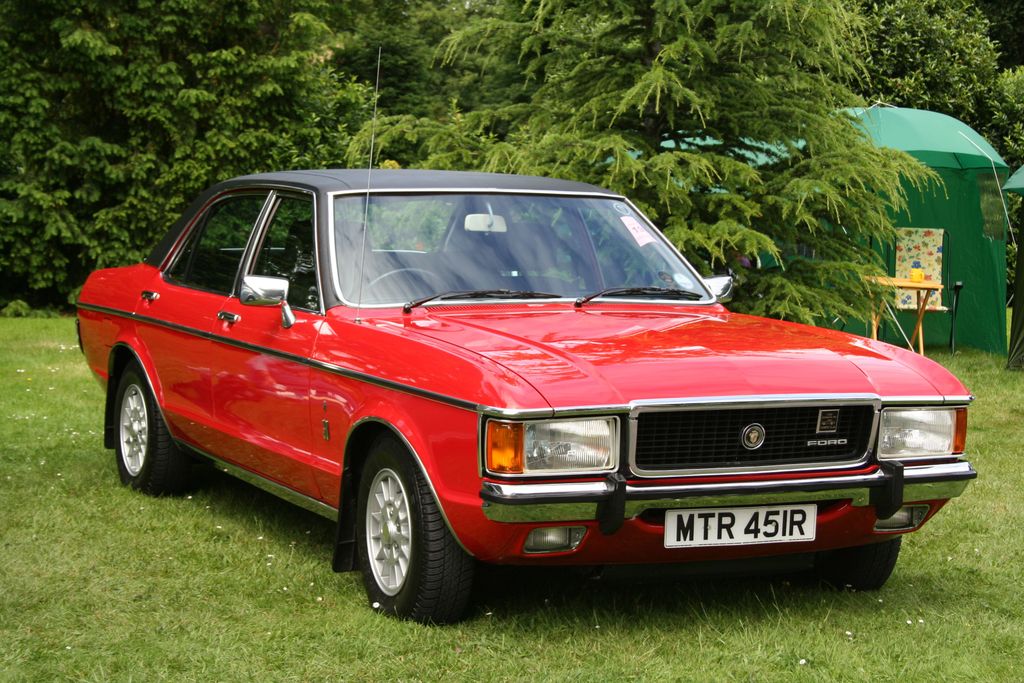
4. **Ford Granada (1975-1982)**Ah, the Ford Granada, Ford’s audacious attempt to bring European luxury compact styling to the American masses in the mid-1970s. Marketed as a sophisticated alternative, the Granada aimed to mimic the upscale sedans flowing out of Germany. But, as often happens when imitation is involved, the result was less champagne and more flat soda, especially in the design department. It tried to project an image it simply couldn’t deliver, both in performance and, crucially, in looks.
The Granada was “often criticized for its boxy design that mimicked more luxurious European sedans without delivering on actual luxury or performance.” It was a car that looked like it had raided a European luxury car’s wardrobe, but couldn’t quite pull off the outfit. The straight lines and severe angles felt heavy-handed, lacking the subtlety and elegance of its intended rivals. Instead, it presented itself with “awkward proportions and a plain appearance,” failing to achieve either genuine sportiness or convincing opulence.
With lackluster power outputs from both its V6 and V8 options, the Granada was “neither exciting to drive nor particularly good-looking.” It was designed to look substantial, perhaps even dignified, but it ended up merely looking ponderous. The visual weight and uninspired details meant that instead of commanding presence, it just blended into the background, a box on wheels trying to be something more than it was, and failing spectacularly in its aesthetic aspirations.
So, while it was Ford’s effort to tap into a burgeoning market for perceived luxury, the Granada’s design became its Achilles’ heel. It lacked the visual charisma, the distinctive features, and the proportional harmony that truly good design demands. It stands as a testament to the idea that merely adopting a shape doesn’t impart the essence, making it a forgettable, if not actively unappealing, chapter in Ford’s design history.
Car Model Information: 1978 Ford Granada
Name: Ford Granada
Caption: Ford Granada Ghia (Mk II)
Manufacturer: Ford of Europe
Production: Cologne Body & Assembly
Class: Executive car
Layout: Front-engine, rear-wheel-drive layout
Predecessor: Ford Zephyr,Ford P7
Successor: Ford Scorpio,Hyundai Grandeur
Categories: 1970s cars, 1980s cars, 1990s cars, All Wikipedia articles written in British English, Articles with short description
Summary: The European Ford Granada is an executive car manufactured by Ford Europe from 1972 until 1994.
The first-generation model was produced from 1972 to 1976 at Ford’s German factory in Cologne and at its British factory in Dagenham. In 1976, production switched entirely to Germany. The original version was replaced in 1977 by a second-generation model which was produced until 1985. From 1985 to 1994, the Granada name was used, in the United Kingdom and Ireland only, for a third-generation model which was sold in other European markets as the Ford Scorpio and in North America as the Merkur Scorpio.
Get more information about: Ford Granada (Europe)
Buying a high-performing used car >>>
Brand: Ford Model: Granada
Price: $10,888 Mileage: 34,396 mi.
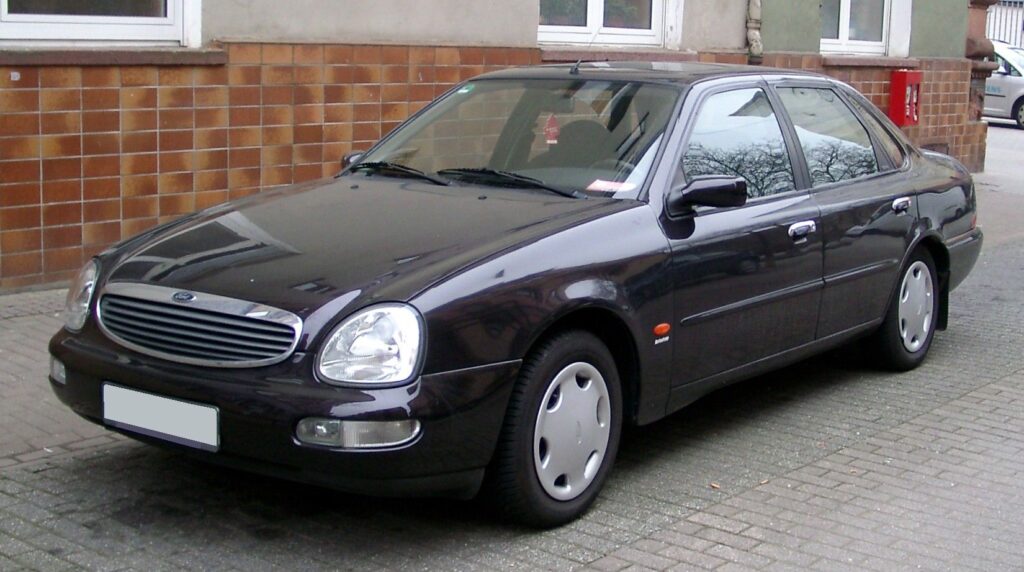
5. **Ford Scorpio (1985-1998)**Let’s turn our attention to one of Ford’s European endeavors, the Ford Scorpio, specifically its Mk II version which launched in 1994. While many in the U.S. might be unfamiliar with this mid-size sedan, its design choices were so utterly perplexing that it earns a prominent spot on our list of hideous Fords. It was a “significant departure from the straight lines and sleek look of the first-gen Scorpio,” and not in a good way.
The Mk II Scorpio became infamous for its unique, or rather, bizarre, front and rear styling. It featured “oval headlights flanking the chrome grille” and “rear lights were lowered to the bumper line.” The entire body was adorned with “lots of rounded edges and curved surfaces.” Individually, these elements might not be a crime, but “the way they were brought together made the Scorpio Mk II ugly.” It was as if a design committee, each member with a different vision, simply bolted their ideas onto the car without any overarching sense of cohesion.
If you truly want a visual, imagine this: “If you look at the car from the front, it looks like a gelatinous blobfish that has been pulled from the depths, causing its form to collapse like a water balloon.” That’s right, a blobfish. The Scorpio Mk II’s “large grille even resembles the giant nose-like feature that appears on the blobfish’s face when it is brought to the surface.” This isn’t just a harsh critique; it’s an observation echoed by many, highlighting a design that was truly out of sync with contemporary aesthetics, and arguably, any aesthetic.
Such was the consensus that “automotive reporters called this car ugly even before it went on the market.” That’s a rare feat – a design so universally panned that its fate was sealed before the first customer could even kick a tire. The Scorpio Mk II represents a moment of extreme design miscalculation, where an attempt at organic forms resulted in something utterly grotesque. It’s a powerful reminder that sometimes, less truly is more, and a blobfish should stay in the ocean, not on the road.
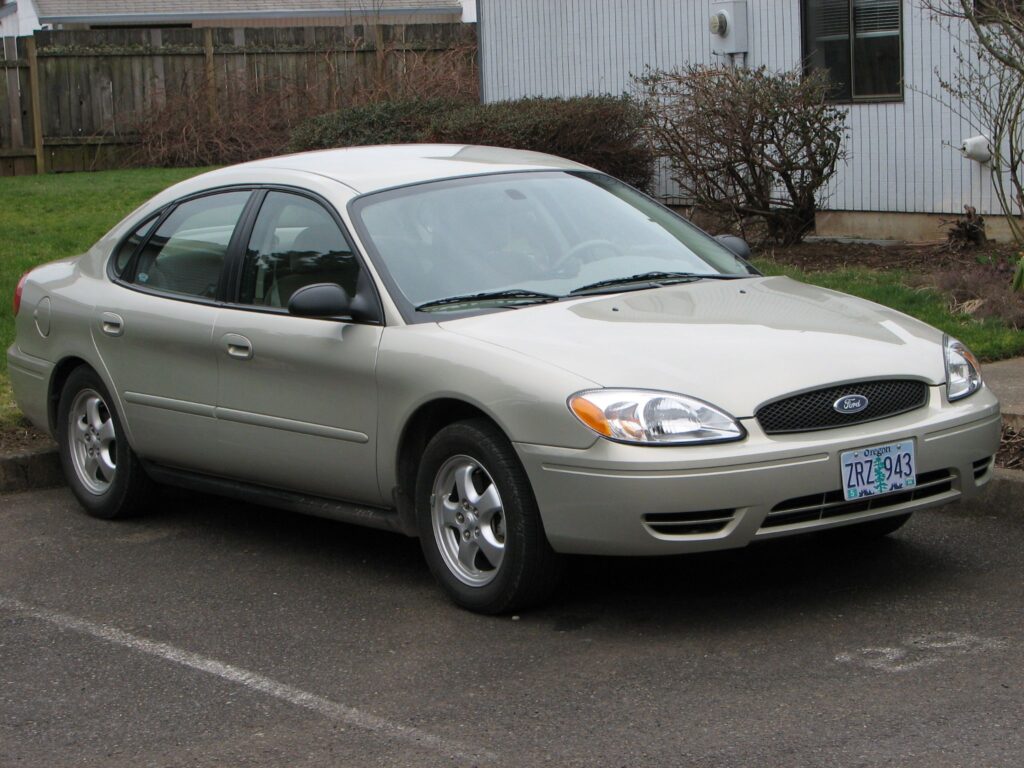
6. **Ford Taurus (1996-1999)**If the first-generation Taurus was a revolutionary breath of fresh air, the 1996 redesign was a baffling gas leak. Ford, in a move that still makes us scratch our heads, decided that the future was *all* about ovals. And when we say “all about ovals,” we mean every single curve and line on this car was seemingly dictated by a ruler that only had one setting: “oval.” The previous Taurus generations had truly “changed market” and were celebrated for their sleek, aerodynamic forms, but this iteration veered wildly into what many consumers affectionately (or not-so-affectionately) dubbed the “jelly bean” or “oval obsession.”
This aesthetic dogma permeated every crevice of the car. The context states it “featured rounded shapes everywhere, which many found unattractive and overly futuristic at the time.” It’s one thing to be futuristic; it’s another to be futuristic in a way that ages worse than milk left out on a summer’s day. Ford “tried to emulate the designs that luxury brands like Jaguar and Infiniti had during that time,” but the execution was, to put it mildly, a misfire. The most egregious offender? That notorious “oval rear window,” a design choice so utterly perplexing it deserves its own dedicated wing in the Museum of Automotive Blunders.
The visual assault continued at the front, where the “four headlights on the ’96 Taurus make it look like Dr. Jumba Jookiba, the four-eyed alien from the Lilo & Stitch animated movie.” Yes, you read that right. A children’s cartoon villain. Not exactly the aspirational image one usually seeks in a family sedan. And just in case you thought the front and middle were enough, the rear lighting design was equally perplexing, making it “look like a fat Mazda RX-7 FD.” So, not only did it look like an alien, but it also resembled an iconic sports car after a particularly indulgent holiday season.
The market’s reaction was swift and brutal. “The market reaction to the Taurus was so bad that the company updated it within a year of its release.” That’s a clear sign of a design disaster, folks. Despite managing to hold the best-selling car title in 1996, likely due to massive fleet sales that year, it was a short-lived victory. The Toyota Camry swiftly dethroned it the following year, a testament to how quickly consumers rejected this overly curvilinear experiment. The 1996 Taurus remains a poignant example of what happens when a design team becomes so enamored with a singular motif that they lose all sense of proportion, elegance, and, frankly, good taste. It was an oval too far.
Car Model Information: 2016 Ford Taurus Limited
Name: Ford Taurus
Caption: 2010 Ford Taurus Limited
Manufacturer: Ford Motor Company
Production: October 1985 – October 2006,May 2007 – March 2019
ModelYears: 1986–2019 (2007 sold only to fleets)
Class: Mid-size car
Layout: Transverse engine,front-engine, front-wheel drive,Transverse engine,front-engine, all-wheel drive
Predecessor: Ford LTD (North America)
Successor: Ford Taurus X
Categories: 1980s cars, 1990s cars, 2000s cars, 2010s cars, All-wheel-drive vehicles
Summary: The Ford Taurus is an automobile that was manufactured and marketed by the Ford Motor Company in the United States from 1985 to 2019. From 1985 to 2009, Ford marketed the Taurus alongside its rebadged variant, the Mercury Sable. Four generations of the high-performance version (named the Ford Taurus SHO) were also manufactured from 1988-1999 and 2009-2019.
The original Taurus was a milestone for Ford and the American automotive industry, as the first automobile at Ford designed and manufactured using the statistical process control ideas brought to Ford by W. Edwards Deming, a prominent statistician consulted by Ford to bring a “culture of quality” to the enterprise. The Taurus had an influential design that introduced new features and innovations.
In the late 1990s and early 2000s, sales of the Taurus declined as it lost market share to Japanese mid-size sedans and as Ford shifted resources towards developing SUVs. The Taurus was withdrawn after the 2007 model year, with production ending on October 27, 2006. As part of a model line revision, the Taurus and the larger Ford Crown Victoria were to be replaced with the full-size Five Hundred and mid-size Fusion sedans; the Taurus station wagon was replaced with the Ford Freestyle wagon, branded as a crossover SUV. During the 2007 Chicago Auto Show, the nameplates of the Taurus and Sable were revived, intended as 2008 mid-cycle revisions of the Five Hundred. The Freestyle was renamed the Ford Taurus X. For the 2010 model year, Ford introduced the sixth-generation Taurus, marking a more substantial model update, alongside the revival of the Taurus SHO; in 2013, the Ford Police Interceptor Sedan was introduced as a successor for its long-running Crown Victoria counterpart.
From 1985 to 2007, the Taurus was a mid-size car, offering front-wheel drive. Initially built on the DN5 platform (renamed the DN101 platform in 1995 and the D186 platform in 1999), the Taurus became a full-size car in 2007, adopting the Volvo-derived D3 platform, offering front- or all-wheel drive. The Taurus was produced as a four-door sedan through its entire production, with a five-door station wagon offered from 1986 to 2005.
All generations of the Taurus were assembled by Chicago Assembly on Chicago’s South Side. Prior to its 2006 closure, Atlanta Assembly also produced both the Taurus and Sable. From its 1985 launch to its initial withdrawal following the 2007 model year, Ford assembled 7,519,919 examples of the Taurus. The fifth best-selling Ford nameplate in North America, the Taurus has been surpassed only by the F-Series, Escort, Model T, and Mustang. Between 1992 and 1996, the Taurus was the best-selling car nameplate in the United States, overtaken by the current title holder in 1997, the Toyota Camry.
Get more information about: Ford Taurus
Buying a high-performing used car >>>
Brand: Ford Model: Taurus
Price: $13,950 Mileage: 41,489 mi.
Read more about: The 37 Ugliest Cars Ever Made: Automotive Design Fails

7. **Ford Five Hundred (2005-2007)**After the “jelly bean” Taurus, Ford clearly learned a lesson about design extremism, but perhaps they learned it a little *too* well. Enter the Ford Five Hundred, a vehicle that seemingly aimed for such broad appeal that it inadvertently achieved the aesthetic equivalent of a beige wall. This was meant to be the successor to the storied Taurus, but instead of inheriting a legacy of bold innovation, it became a poster child for uninspired, forgettable design. If the 1996 Taurus was an audacious failure, the Five Hundred was a timid whimper.
The overarching critique of the Five Hundred was its profound lack of character. It was “often criticized for its bland, uninspired design, which lacked the flair and character one would expect from a flagship sedan.” Imagine going to an auto show, and the highlight is a car that makes you wonder if you’ve seen it before, or if it was just a particularly vivid dream of a toaster on wheels. Its generic silhouette and anonymous fascia meant it “blend[ed] too easily with the cars of its era,” making it utterly indistinguishable in a parking lot full of equally bland competitors. This car didn’t push boundaries; it barely acknowledged they existed.
One of our esteemed colleagues, in a moment of brutal honesty, perfectly encapsulated the Five Hundred’s essence by calling it “dishwater dull to look at.” They further added that it “wasn’t particularly fancy or budget-y, and most people would have no idea what it was if you asked them.” Ouch. That’s the kind of critique that sticks, because it’s so tragically accurate. For a car intended to carry the torch from a once-revolutionary nameplate, the Five Hundred’s design was simply an exercise in extreme caution, resulting in a product that felt like it had been run through a committee countless times until all vestiges of personality were stripped away.
It’s a stark reminder that while avoiding controversial design is one thing, actively pursuing invisibility is another. The original Taurus was a “game changer,” yet its successor, the Five Hundred, was “such a ‘meh’ car.” This isn’t just about being ugly; it’s about being so devoid of distinctive features that it almost offends with its sheer mediocrity. It’s the automotive equivalent of elevator music – you know it’s there, but you can’t quite remember what it sounds like a minute later. The Five Hundred served its purpose as transportation, but as a piece of design? It was a dull, dull, dull affair.
Car Model Information: 2020 Alfa Romeo Stelvio Base
Name: Ford Five Hundred
Caption: 2005 Ford Five Hundred
Manufacturer: Ford Motor Company
Production: July 2004 – April 2007
ModelYears: 2005–2007
Assembly: Chicago, Illinois
Designer: George Bucher (2001),Jan Vulcan, Chief Engineer
Class: Full-size car
BodyStyle: Sedan (automobile)
Layout: Transverse engine,Front-engine, front-wheel-drive layout
Platform: Ford D3 platform
Related: Mercury Montego,Mercury Sable#(Fifth generation (2008–2009),Ford Taurus (fifth generation)
Engine: Ford Duratec V6 engine#RFF,V6 engine
Transmission: ZF Friedrichshafen,Batavia Transmission#Partnership
Wheelbase: 112.9 in
Abbr: on
Length: 200.7 in
Width: 74.5 in
Height: 61.5 in
Predecessor: Ford Taurus (fourth generation),Ford Crown Victoria
Successor: Ford Taurus (fifth generation)
Categories: All-wheel-drive vehicles, Articles with short description, Cars discontinued in 2007, Cars introduced in 2004, Commons category link from Wikidata
Summary: The Ford Five Hundred is a full-size four-door, five-passenger, front-engine front- or all-wheel drive, high-roof sedan manufactured in Chicago and marketed in North America and Mexico by Ford in a single generation for model years 2005–2007. It was a direct byproduct of Ford’s rapid acquisition of numerous brands (e.g., Volvo Cars in 1999); a critical need to leverage those investments; the company’s dwindling market share (18.3% in 2004, 17.4% in 2005) and its Way Forward efforts to restructure itself. Notably, with a strong market shift in automotive tastes away from sedans to minivans and SUV/CUVs, Ford made a concerted effort with the Five Hundred to rethink the traditional sedan/wagon formula.
Presented as a single concept drawing at the 2002 New York Auto Show, the Five Hundred was formally presented in production form at the 2004 North American International Auto Show along with its co-developed platform-mates, the Mercury Montego and the crossover Ford Freestyle — the so called Chicago D3’s, for the plant where they were manufactured (Chicago Assembly) and the platform they shared, the D3 platform, a revised variant of Volvo’s P2 platform.
Ford chose to continue its fourth generation Taurus, critical to the company’s fleet sales (to large corporations, small businesses, rental car firms, utility companies, and government agencies) and overlap that production with the Five Hundred, emphasizing the latter’s optional all-wheel drive, continuously variable transmission, extensive safety features, large interior volume and high H-point seating, the latter marketed as Command View seating.
Internally designated the D258 model, the Five Hundred was styled by George Bucher, Chief Designer, under the direction of Ford Vice President of Design, J Mays who gave the Five Hundred its name, recalling the “500” suffix Ford had used to designate a model’s top trim level, as with the Galaxie “500”.
The Five Hundred’s 203hp engine and conservative styling became points of criticism, and sales fell markedly short of company projections — requiring substantive discounts by its second model year. The Five Hundred was quickly but lightly facelifted and given a new nameplate for model years 2008–2009 — becoming the fifth generation Ford Taurus.
Having entered production on July 12, 2004 and gone on sale in September 2004, the Five Hundred reached 65% of its projected annual sales of 120,000 — or total domestic sales of 241,000 over three model years. The Five Hundred nameplate continued in use outside North America.
Get more information about: Ford Five Hundred
Buying a high-performing used car >>>
Brand: Ford Model: Five Hundred
Price: $16,684 Mileage: 70,086 mi.
Read more about: Defying the Odds: 12 Vintage and Modern Vehicles That Conquer 150,000 Miles with Legendary Reliability
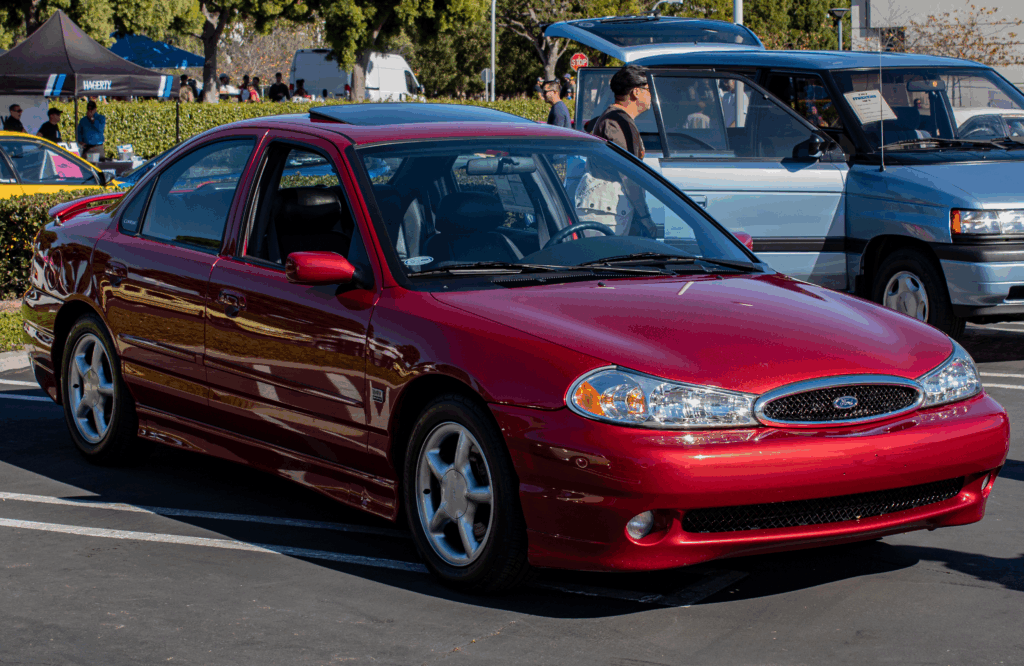
8. **Ford Contour (1995-2000)**Next up, we have the Ford Contour, a car that perfectly exemplifies the perils of the “world car” concept when executed with a severe case of cognitive dissonance. The idea was noble: a single platform and design philosophy for a global market. But what arrived on American shores was a vehicle “criticized for its cramped interior and generic design that made it blend too easily with the cars of its era, lacking distinctive features.” It was supposed to be a unifying force, but instead, it became a symbol of watered-down compromise.
The core problem, from a design perspective, was that it “failed to meet American expectations for size and power.” European consumers might have appreciated its more compact dimensions, but for a market accustomed to the generous proportions of American sedans, the Contour felt less like an evolution and more like a regression. This mismatch in perceived size directly impacted its visual appeal. It looked ordinary, uninspired, and frankly, a bit too small for the market it was trying to conquer. The lines were inoffensive, which is often a polite way of saying “boring.”
Despite its “decent handling,” a characteristic often praised by those who could overlook its aesthetic shortcomings, the “design did not resonate with consumers, resulting in lackluster sales and a short lifespan on the market.” This is the brutal truth of automotive design: you can have all the engineering prowess in the world, but if the car doesn’t look the part, it’s fighting an uphill battle. The Contour’s blandness, its inability to project any sense of excitement or innovation, left it stranded in the automotive purgatory of forgotten models. It wasn’t offensively ugly like a blobfish, but it was offensively *plain*.
The Contour’s ultimate fate, a swift discontinuation after just five years, speaks volumes about its reception. It never managed to capture the imagination, nor did it offer a compelling visual identity that could stand out in an increasingly competitive segment. It was a car that simply existed, a placeholder for something more interesting, something with actual design intent. In a world of iconic Fords, the Contour remains a footnote, a testament to how even well-intentioned global strategies can go awry when the visual language fails to connect with its audience. It’s a reminder that “generic” is often just another word for “hideous” in the lexicon of passionate car enthusiasts.
Car Model Information: 1998 Ford Contour
Name: Ford Mondeo (first generation)
Manufacturer: Ford Motor Company
Aka: Mercury Mystique
Production: 23 November 1992–31 August 1996 (pre-facelift),1 September 1996 – 1 November 2000 (facelift)
ModelYears: 1993–2001
Assembly: Genk
Designer: John Oldfield (engineer)
Class: Midsize
BodyStyle: saloon (automobile)
Platform: Ford CDW27 platform
Related: Ford Cougar,Mercury Cougar#Eighth generation (1999–2002)
Layout: Front-engine, front-wheel-drive layout,Front-engine, four-wheel-drive layout
Engine: Ford Zetec engine,Ford Zetec engine,Ford Endura-D engine,Ford Zetec engine,V6,Ford Zetec engine,Ford Endura-D engine,Ford Zetec engine,Ford Duratec engine
Transmission: Ford MTX-75 transmission,Ford CD4E transmission
Wheelbase: 2704 mm
Abbr: on (estate)
Length: 4481 mm
Width: 1747 mm
Height: 1372 mm
Predecessor: Ford Sierra
Successor: Ford Mondeo (second generation),Ford Fusion (Americas)
Categories: 2000s cars, All-wheel-drive vehicles, All Wikipedia articles written in British English, All articles with unsourced statements, Articles with short description
Summary: The Ford Mondeo I (first generation) is a mid-size car manufactured and marketed by Ford, beginning on 23 November 1992, with sales beginning on 22 March 1993. It is also known as the Mk I Mondeo; the 1996 facelift versions are usually designated Mk II. Available as a four-door saloon, a five-door hatchback, and a five-door estate, all models for the European market were produced at Ford’s plant in the Belgian city of Genk. In December 1992, Autocar published a section on the Mondeo, and how it would conquer rivals.
Intended as a world car, it replaced the Ford Sierra in Europe, the Ford Telstar in a large portion of Asia and other markets, while the Ford Contour and Mercury Mystique replaced the Ford Tempo and Mercury Topaz in North America. Despite being billed as a world car, the only external items the Mondeo shared initially with the Contour were the windscreen, front windows, front mirrors and door handles. Thus, the CDW27 project turned out not to be a true world car in the sense that the original Ford Focus and newer Fords developed under the “One Ford” policy turned out to be. The first generation Mondeo was replaced in 2000, by the larger second generation; in the United States and Canada, the Contour/Mystique were replaced initially by the Focus and later the Fusion.
Get more information about: Ford Mondeo (first generation)
Buying a high-performing used car >>>
Brand: Ford Model: Contour
Price: Not Priced Mileage: 0 mi.
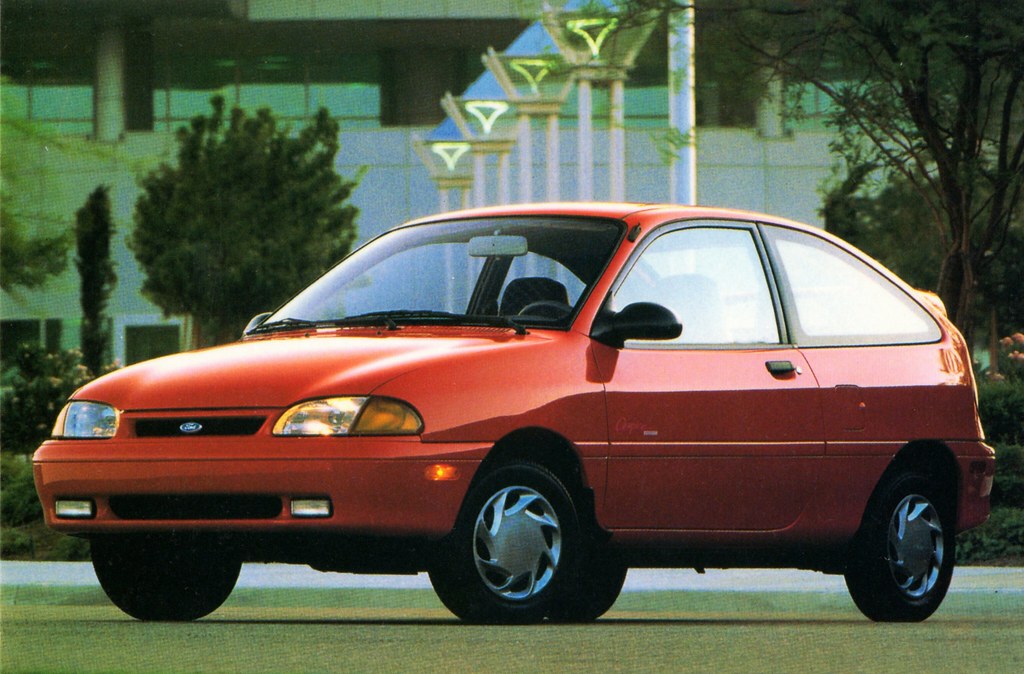
9. **Ford Aspire (1994-1997)**And finally, we arrive at the Ford Aspire, a car whose name promised ambition but delivered an aesthetic that consistently disappointed. This little subcompact, a badge-engineered Kia Avella for the North American market, certainly didn’t “inspire” much in the way of design admiration. In fact, if you were to compile a visual dictionary of “bland,” the Aspire’s picture would likely occupy the entire page. It’s a testament to how even the most basic transportation needs don’t necessitate such a complete disregard for visual appeal.
The context is blunt: “Its name implied ambition, but its design was often seen as bland and uninspiring.” This sentiment is further underscored by the fact that “the egg-like shape combined with tiny wheels made it look somewhat disproportionate.” Imagine taking an egg, giving it some windows, and then sticking four bicycle wheels on it – that’s pretty much the visual shorthand for the Aspire. The overall effect was less “cute and compact” and more “awkward and slightly deflated.” It lacked any aggressive styling, any sleek lines, or any visual cues that suggested performance or dynamism.
A car’s proportions are foundational to its aesthetic success, and the Aspire utterly fumbled this basic principle. The small wheels, coupled with its “egg-like shape,” made the entire vehicle look like it was perpetually skipping leg day at the gym. It didn’t just blend in; it actively tried to disappear into the background, a task at which it was remarkably successful. Even its front fascia, a critical point for a car’s identity, was utterly forgettable, featuring unremarkable headlights and a grille that was more a void than a statement.
As one critic succinctly put it, “There is literally nothing aspirational about this car.” This isn’t just a critique of its performance (which was also modest), but a searing indictment of its visual identity. It was a bare-bones offering that looked every bit the part, a rolling embodiment of compromise and cost-cutting. The Ford Aspire stands as a dull, disproportionate entry in Ford’s long history, proving that sometimes, even when aiming for pure utilitarianism, a little bit of aesthetic effort can go a long, long way. This car aspired to be nothing, and in doing so, achieved a truly hideous blandness.
Car Model Information: 2017 Ford Transit-350 XL
Categories: All set index articles, Articles with short description, Ford vehicles, Set index articles on cars, Short description is different from Wikidata
Summary: The Ford Aspire nameplate has been used by the American automobile manufacturer Ford for the following cars, in the following markets:
Ford Festiva, in North America from 1993 to 1997
The sedan version of the Ford Figo, a rebadged third generation Ford Ka in India since 2015
Get more information about: Ford Aspire
Buying a high-performing used car >>>
Brand: Ford Model: Aspire
Price: $24,900 Mileage: 91,281 mi.
So there you have it, a candid and, dare we say, rather painful, stroll through Ford’s gallery of automotive design faux pas. From the horse-collared Edsel to the blobfish-esque Scorpio, the jelly-beaned Taurus, and the uninspiring Aspire, these vehicles stand as stark reminders that even automotive giants can sometimes lose their way, sacrificing aesthetics for ambition, economy, or simply a bewildering lack of vision. These aren’t just cars that looked bad; they’re cautionary tales etched in sheet metal, proving that good design isn’t just a luxury, it’s a necessity. Because at the end of the day, no matter how revolutionary the engine or how spacious the interior, if a car can’t hold its head high, it’s destined to be remembered for all the wrong reasons. Let’s hope Ford has learned its lesson, and that future drawing boards yield only masterpieces, not these memorable monstrosities.