Hollywood, the glittering dream factory, often presents a paradox: a single film can elevate an actor to unprecedented heights, cementing their legacy in cinematic history, or it can cast a long, daunting shadow over a once-promising career. The stakes are incredibly high, and the journey from acclaimed performer to box office poison can sometimes be shorter than anticipated. While some actors gracefully navigate the choppy waters of critical panning and commercial failure, others find their leading-man or leading-lady status significantly diminished, forcing years of careful career recovery or even a quiet exit from the limelight.
This intricate dance between artistic ambition, market reception, and personal impact forms a compelling narrative within the film industry. We often celebrate the blockbusters and the Oscar winners, but the stories of films that falter, and the stars caught in their wake, offer equally valuable insights into the capricious nature of Tinseltown. These are not merely tales of financial loss but deeply personal sagas of professional setbacks, public scrutiny, and the arduous path back to relevancy.
In this in-depth exploration, we delve into 14 such movies that, for various reasons, left indelible and often notorious marks on the careers of their leading actors. From unexpected commercial flops that baffled audiences to critically panned endeavors that became industry punchlines, these films significantly altered trajectories. We’ll dissect how these projects, sometimes due to creative missteps, genre departures, or sheer bad luck, impacted the professional journeys of some of Hollywood’s most recognizable names, turning what should have been a career boost into a significant hurdle.

1. **Gigli (2003) – Ben Affleck**Ben Affleck’s involvement in “Gigli” stands as a widely recognized turning point, marking a significant downturn in his career trajectory. The film, a much-hyped romantic comedy co-starring Jennifer Lopez, arrived with considerable buzz, partly fueled by the off-screen relationship of its two leads. However, instead of delivering on its promise, “Gigli” quickly devolved into both a commercial and critical failure, becoming a prime example of a project gone awry.
This box office disaster was met with widespread derision, largely mocked for its convoluted storyline and wooden performances, which regrettably included Affleck’s. The film’s narrative struggled to find its footing, and its humor largely fell flat, preventing audiences from forming any meaningful connection with the characters or the plot. This collective dismissal by critics and the viewing public severely impacted Affleck’s leading man status, which had previously soared with successful roles.
In the immediate aftermath of “Gigli’s” release, Affleck faced considerable challenges in securing major, high-profile roles. The film’s notoriety made it a reference point for poor cinematic choices, highlighting the precarious nature of Hollywood stardom and how quickly public perception can shift. Fortunately, Affleck, demonstrating remarkable resilience and talent, eventually found his footing again, notably through his critically acclaimed work behind the camera as a director, which helped him rebound impressively.
Ultimately, “Gigli” serves as a stark reminder of the often-unforgiving landscape of the film industry, illustrating how a single project, despite the star power attached, can temporarily derail an actor’s carefully built career. Its legacy, though tinged with infamy, underscores the importance of strong scripts and directorial vision, even for established stars.
Read more about: Hold Up! Don’t Even Think About Watching These 12 Seriously Cheesy Romance Flops That Critics Absolutely Panned

2. **Catwoman (2004) – Halle Berry**Halle Berry, an Academy Award-winning actress celebrated for her dramatic prowess, made a significant leap into the superhero genre with “Catwoman,” a move that, unfortunately, proved to be a considerable misstep. Portraying Patience Phillips, a graphic designer who gains feline abilities, Berry found herself trapped in a film that was widely criticized from nearly every angle. The movie’s shortcomings included a lackluster plot, questionable visual effects, and a general failure to capture the essence of its iconic comic book character.
Despite Berry’s undeniable talent and charisma, “Catwoman” did her no favors in showcasing her abilities as an actress. The script offered little in the way of compelling character development or coherent storytelling, forcing Berry to deliver a performance that many found unconvincing and out of place with her established gravitas. This critical panning and commercial underperformance became a major talking point within the industry.
The film’s resounding failure unfortunately overshadowed Berry’s previous, highly celebrated achievements, including her historic Oscar win. Her career momentum, which had been building steadily, slowed considerably in the wake of “Catwoman,” leading to a period where she struggled to find roles that matched her earlier successes or potential. It became a prominent example of how even an immensely talented actor can be undone by a flawed project.
While Halle Berry eventually navigated her way back into impactful roles and renewed her presence in Hollywood, “Catwoman” remains a glaring reminder of how a single project can temporarily derail an actor’s trajectory. It highlights the inherent risks of franchise filmmaking and the importance of a strong creative vision to support even the most gifted performers.
Read more about: From Cinematic Giants to Screen Stumbles: 14 Great Actors and Their Most Questionable Performances

3. **Battlefield Earth (2000) – John Travolta**John Travolta’s involvement in “Battlefield Earth” is frequently cited as one of the most bizarre and ill-advised career decisions in modern Hollywood history. Intended by Travolta, a devout Scientologist, as a sci-fi epic based on L. Ron Hubbard’s novel, the film was conceived as a passion project with grand ambitions. However, its execution was met with almost universal condemnation, cementing its place as one of the biggest critical and commercial flops of its time.
The film received overwhelmingly harsh criticism across the board, particularly for its convoluted and often nonsensical story, its glaringly poor special effects, and its distinctive, often ridiculed, visual style. Travolta’s portrayal of the villainous alien Terl, complete with an exaggerated accent and distinctive appearance, became a significant source of mockery. His performance, intended to be menacing, instead contributed to the film’s campy reputation.
“Battlefield Earth” significantly tarnished Travolta’s career, which had experienced a remarkable revitalization only a few years prior with Quentin Tarantino’s “Pulp Fiction.” Critics found virtually nothing to praise in the film, and its box office performance was dismal, leading to substantial financial losses. This spectacular failure put a severe dent in Travolta’s carefully reconstructed image as a versatile and bankable star, pushing him back towards more conventional roles.
Ultimately, “Battlefield Earth” serves as a quintessential cautionary tale about the immense risks associated with passion projects, especially when they stray far from conventional storytelling and critical standards. It vividly illustrates how even established actors with significant star power can see their careers adversely affected when such ambitious endeavors go spectacularly awry.
Read more about: 12 Movies That Are So Bad They’re Absolutely Hilarious – You *Have* To See Them With Friends!

4. **The Love Guru (2008) – Mike Myers**Mike Myers, a comedic genius celebrated for creating iconic characters like Austin Powers and Shrek, faced a notable setback with “The Love Guru.” This film was envisioned as a grand return to live-action comedy, an attempt to recapture the widespread success and adoration that his “Austin Powers” franchise had enjoyed. However, instead of a triumphant comeback, the movie faltered both critically and commercially, disappointing many who had eagerly awaited his next big comedic offering.
Audiences and critics alike found the film’s humor severely lacking, with many describing it as juvenile, repetitive, and ultimately uninspired. The comedic elements, which had been Myers’ strong suit in previous endeavors, failed to resonate, leading to widespread disappointment among his loyal fanbase and a general sense of bewilderment from new viewers. This failure was particularly impactful given the high expectations surrounding his return.
“The Love Guru” regrettably ended up being one of Myers’ last major live-action film roles for years, casting a considerable shadow over his career as a leading man in Hollywood. Its poor reception led to a noticeable decline in his visibility in mainstream cinema, temporarily halting the momentum he had built as a comedic powerhouse. The film served as a harsh lesson in the fickle nature of comedic tastes and audience expectations.
Despite this significant career hiccup, Myers remains a beloved figure in the world of comedy, his earlier works enduring as classics. However, “The Love Guru” serves as a poignant reminder of the fine, often imperceptible line between humor that brilliantly resonates with a mass audience and one that fundamentally misses its mark, highlighting the challenges even a comedic legend can face.
Read more about: From Cinematic Giants to Screen Stumbles: 14 Great Actors and Their Most Questionable Performances

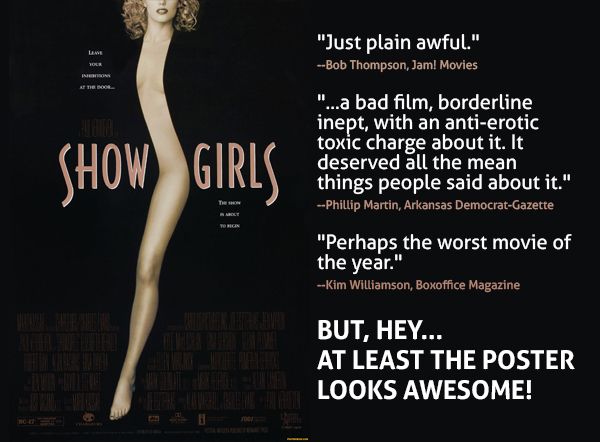
5. **Showgirls (1995) – Elizabeth Berkley**Elizabeth Berkley’s performance in “Showgirls” was widely anticipated as her vehicle to catapult from television stardom, specifically her role in “Saved by the Bell,” into a prominent career on the big screen. Directed by the controversial Paul Verhoeven, the film aimed for a gritty, unvarnished look at the world of Las Vegas showgirls. However, its explicit content and notoriously over-the-top direction led to it being overwhelmingly panned by critics, causing an immediate and severe backlash.
Berkley’s dramatic transition from a family-friendly television show to such a ually charged and polarizing film was abruptly halted by its negative reception. Her performance, intended to be powerful and transformative, was instead largely viewed as exaggerated and became synonymous with the film’s broader notoriety. This made it incredibly challenging for her to secure new, meaningful roles that could distance her from the movie’s infamy.
Despite the film eventually achieving cult status years later, particularly within certain cinematic circles for its sheer audacity, “Showgirls” initially dealt a significant blow to Berkley’s career prospects. She struggled to shake off the perception created by the film, finding herself facing an uphill battle to be taken seriously as a dramatic actress. The association became a heavy burden for her early film career.
Ultimately, while Berkley did find other opportunities and continued her acting career, “Showgirls” remains a classic, albeit painful, example of how risky projects, particularly those pushing boundaries, can profoundly impact emerging talents. It underscores the fragility of an actor’s public image and the lasting consequences of a critically maligned role on a nascent career.
Read more about: From Flops to Fan-Favorites: 9 Movies So ‘Bad They’re Good’ That Became Massive Cult Classics

6. **The Adventures of Pluto Nash (2002) – Eddie Murphy**Eddie Murphy, a versatile and immensely beloved comedian and actor known for his unparalleled ability to command both laughter and dramatic weight, faced a significant career hiccup with “The Adventures of Pluto Nash.” This ambitious sci-fi comedy, with a reported budget of $100 million, was positioned as a major tentpole release. Yet, it spectacularly failed to resonate with either audiences or critics, turning into one of the most infamous box office bombs in history.
From its release, the film was universally panned for its uninspired script, derivative plot, and a surprising lack of genuine humor, which was particularly jarring for a Mike Murphy vehicle. The costly production, coupled with its abysmal critical reception and anemic box office returns, led to significant financial losses for the studio. Murphy’s formidable star power, which had salvaged many a middling project, proved utterly incapable of saving “The Adventures of Pluto Nash” from its dismal fate.
The film’s failure had a tangible impact on Murphy’s career choices for several years following its release. It contributed to a period where his live-action roles became less frequent or less successful, prompting a shift in focus towards voice acting, notably in the highly successful “Shrek” franchise. “Pluto Nash” became a benchmark for cinematic misjudgment, a clear indicator of how even a superstar can stumble badly.
Though Eddie Murphy later regained his footing with other successful projects and earned new critical acclaim, “Pluto Nash” is consistently remembered as a significant misstep in an otherwise remarkable and enduring career. It serves as a potent illustration of how even the most established and talented stars can fall victim to projects that are fundamentally flawed in their conception or execution.
Read more about: Ouch! 14 Hollywood Movies That Absolutely Bombed at the Box Office (And the Wild Stories Behind Their Massive Losses)

7. **Cutthroat Island (1995) – Geena Davis**Geena Davis starred in “Cutthroat Island,” a sprawling pirate-themed adventure that harbored ambitious intentions of reviving a dormant genre within Hollywood. However, despite its grand scale and high production values, the film instead sailed straight into cinematic infamy. Its journey from production to release was plagued with difficulties, budget overruns, and ultimately, it became one of the most infamous box office flops in the history of Hollywood, earning a place in the Guinness World Records for its financial losses.
Davis’s career, which had seen her rise as an action star and a respected dramatic actress, took a substantial hit as a direct result of “Cutthroat Island’s” colossal failure. The loss was not merely financial for the studio; it also inflicted significant damage in terms of career momentum for Davis. The film’s poor performance impacted her future roles, making it harder to secure the kind of high-profile projects she had previously enjoyed and setting back her trajectory as a leading lady.
The production woes, including director changes and cast injuries, contributed to a chaotic environment that translated onto the screen, leading to a film that struggled to find an audience or critical appreciation. The sheer scale of its failure made it a cautionary tale within the industry about over-ambitious projects and the perils of mounting productions without a solid foundation, regardless of the star power involved.
Despite the significant setback and the lingering shadow of “Cutthroat Island,” Davis continued her career, diversifying her roles and finding success in other endeavors, including her advocacy work. Nevertheless, the film remains a stark reminder of the immense risks associated with ambitious cinematic ventures and how a single, spectacularly unsuccessful project can profoundly affect the career of even an accomplished actress. It underscores the unpredictable nature of film production and audience reception.

8. **Swept Away (2002) – Madonna**Madonna, a music icon whose influence spanned decades, ventured into Hollywood with directorial husband Guy Ritchie at the helm of “Swept Away.” This 2002 remake of an Italian classic aimed to solidify her presence on the big screen, yet it quickly became a cinematic misfire, failing to capture critical or audience approval. Instead of a triumphant statement, it largely served as an example of ambition outweighing execution.
The film faced widespread criticism for its “lackluster storytelling and performances,” with many deeming Madonna’s portrayal “unconvincing.” Her vibrant, rebellious persona, so captivating on stage, struggled to translate effectively into a dramatic film role requiring nuanced transformation. The narrative itself often drifted without a clear emotional anchor, leaving viewers disconnected from the characters’ plight.
This critical drubbing and commercial failure highlighted the significant challenges many musicians face when crossing over into serious acting. While her music career remained largely unscathed, “Swept Away” undoubtedly “adversely affected Madonna’s aspirations within the movie industry,” making subsequent leading film roles more elusive. It underscored that immense global fame doesn’t guarantee cinematic success.
Ultimately, “Swept Away” serves as a stark reminder of how difficult it can be for musical legends to achieve the same level of crossover success in acting. It was a bold attempt that, regrettably, reinforced industry skepticism about pop stars leading major dramatic features. For Madonna, it became a notable footnote rather than a highlight in her extensive artistic journey.
Read more about: 15 Cinematic Catastrophes: The Movie Remakes That Should’ve Stayed Locked in the Vault

9. **Glitter (2001) – Mariah Carey**Musical superstar Mariah Carey also sought to expand her formidable talent into acting with the 2001 film “Glitter.” Unfortunately, her cinematic debut proved a significant stumble, landing with a resounding thud rather than a glittering ovation. The film was widely “panned for its clichéd storyline and weak performances,” severely undermining Carey’s bid for acting credibility.
The narrative, a classic rags-to-riches tale set in the music industry, offered little originality or depth, making audience investment difficult. Carey’s performance, while enthusiastic, often felt unpolished, leading to her “acting debut [being] overshadowed by the film’s negative reception.” Critics were particularly unforgiving, pointing out the film’s predictable script and underdeveloped characters.
Compounding the film’s troubles, its release tragically “coincided with personal and professional challenges for Carey,” which “magnified the impact on her career.” This unfortunate timing meant the film’s failure intertwined with a period of intense public scrutiny for the singer. It led to a temporary period where her presence in mainstream entertainment became less pronounced.
While Mariah Carey eventually orchestrated a spectacular musical comeback, “Glitter” indelibly “stands as an example of how a single project can influence public perception of an artist’s capabilities.” It is frequently cited as a cautionary tale, illustrating the profound risks involved when a beloved music icon attempts a foray into an unforgiving film industry.
Read more about: 12 Movies That Are So Bad They’re Absolutely Hilarious – You *Have* To See Them With Friends!

10. **The Postman (1997) – Kevin Costner**Kevin Costner, a celebrated actor and director known for epic visions, experienced a considerable cinematic setback with 1997’s “The Postman.” This ambitious post-apocalyptic film, which he also directed, was intended to be a grand narrative but was instead “criticized for its lengthy runtime and melodramatic tone.” It was a monumental undertaking that, regrettably, did not achieve its intended impact.
Costner, having found success with “Dances with Wolves,” poured significant resources into this project. However, the film’s sprawling narrative and often solemn approach “failed to connect with audiences,” who found its three-hour length taxing and emotional beats forced. Critics largely echoed these sentiments, questioning the film’s pacing and overall thematic coherence.
The “film’s poor performance impacted Costner’s career, leading to fewer leading roles” in the immediate years that followed. While he has remained “a respected figure in Hollywood” and showcased his enduring talent, “The Postman” undeniably “serves as an example of how ambitious projects can fall short.” It cast a long shadow, forcing a re-evaluation of his large-scale endeavors.
Despite this notable blemish, Costner demonstrated resilience, eventually “bounced back with other successful endeavors,” continuing to deliver memorable performances. Yet, “The Postman” persists as a reminder of the inherent risks of creative overreach, even for an established and acclaimed filmmaker, highlighting the unpredictability of audience reception for such grand ventures.
Read more about: 12 Movies So Unbelievably Boring You’d Rather Watch Paint Dry (Seriously, We Asked!)

11. **Howard the Duck (1986) – Lea Thompson**”Howard the Duck,” the 1986 cinematic adaptation of the Marvel comic, became an unexpected and unfortunate “turning point” in actress Lea Thompson’s burgeoning career. This bizarre fantasy-comedy featuring a humanoid duck from outer space was met with almost universal scorn, largely “criticized for its bizarre premise and execution.” It rapidly earned a reputation as one of the most infamous films of its era.
Thompson, riding a wave of success from films like “Back to the Future,” found herself at the center of a project that fundamentally misfired on almost every creative level. The special effects were mocked, and the script struggled to balance comedy and drama, often veering into absurdity. This critical failure “overshadowed Thompson’s previous successes,” linking her prominently to the film’s notoriety.
Despite her energetic performance, Thompson’s “involvement is often remembered more for the film’s infamy than its content,” creating a significant hurdle for her professional trajectory. The movie’s resounding failure made it challenging for her to shake off the association, temporarily impacting the momentum she had built as a versatile young actress. The film became a punchline within the industry for years.
Over time, Lea Thompson admirably “found other roles” and carved out a distinguished career in television and independent films. Nevertheless, “Howard the Duck” remains a potent “cautionary tale about the unpredictability of Hollywood projects,” vividly illustrating how even promising careers can be impacted by a fundamentally flawed and widely derided film.

12. **Stop! Or My Mom Will Shoot (1992) – Sylvester Stallone**Sylvester Stallone, synonymous with gritty action and iconic characters like Rocky and Rambo, took an unexpected “detour” into action-comedy with 1992’s “Stop! Or My Mom Will Shoot.” Co-starring Estelle Getty as his meddling mother, the film was a stark departure from his tough-guy image, and this genre shift proved disastrous, with the film being “criticized for its humor and plot.”
The premise, pairing Stallone’s police sergeant with his overly involved mother, struggled to land its comedic beats effectively. Critics found the humor forced and the plot convoluted, leading to overwhelmingly negative reviews. “Stallone’s tough-guy image was at odds with the film’s tone,” creating a dissonance audiences found difficult to reconcile, contributing to its commercial and critical failure.
The movie’s poor reception significantly “affected Stallone’s career, causing a temporary lull in his action-star appeal” and leading to fewer high-profile roles. It served as a clear example of the “risky genre departures” even established actors undertake at their peril, demonstrating how a miscalculated role can temporarily dilute a carefully cultivated brand. The project became a point of professional regret.
Despite this notable misstep, Stallone eventually “managed to recover and continue his legacy in Hollywood,” reaffirming his status as a formidable action hero and earning critical acclaim in later years. Yet, “Stop! Or My Mom Will Shoot” endures as a peculiar chapter in his extensive filmography, illustrating the unpredictable nature of audience expectations for action stars in comedy.

13. **Love Ranch (2010) – Joe Pesci**Joe Pesci, an Academy Award-winning actor renowned for intense, volatile performances, made a rare return to the screen with the 2010 drama “Love Ranch.” After a hiatus from major roles, his comeback was highly anticipated, but the film, “based on the first legal brothel in Nevada,” unfortunately “failed to impress critics and audiences,” leading to a mixed, largely muted reception.
The film, delving into the complex lives surrounding the Mustang Ranch, presented a compelling premise that ultimately struggled in its execution. “Pesci’s performance, while typically committed, was overshadowed by the film’s lackluster execution,” with many finding the storytelling uneven and lacking depth. This meant the film couldn’t capitalize on Pesci’s star power as hoped.
For an actor who had largely stepped away from the limelight, the film’s lukewarm reception “did little to entice him back into the industry” on a more consistent basis. It was an opportunity for a high-profile return that, instead of sparking a resurgence, quietly faded, leaving little lasting impact on his already legendary career. It became another example of a promising project falling short.
Ultimately, “Love Ranch” “highlights the importance of strong scripts and direction, even for seasoned actors attempting comebacks.” While it did not diminish Pesci’s established legacy, it served as a poignant reminder that even the most talented performers require a robust cinematic framework to truly shine and reignite their presence in a competitive industry.
Read more about: The Enigmatic Exit: Unraveling the True Reasons Why Joe Pesci Became Hollywood’s Most Fascinating Recluse

14. **The Bonfire of the Vanities (1990) – Tom Hanks**Tom Hanks, an actor who has built one of Hollywood’s most beloved and critically acclaimed careers, found himself in a peculiar position with Brian De Palma’s 1990 adaptation of Tom Wolfe’s bestselling novel, “The Bonfire of the Vanities.” This film, intended as a biting satire of 1980s New York, is often “viewed as an anomaly in his illustrious career,” largely due to its “criticism for its deviation from the source material and uneven tone.”
Hanks, usually adept at portraying relatable characters, played Wall Street bond trader Sherman McCoy in a role that, despite his efforts, “was overshadowed by the film’s shortcomings.” The ambitious adaptation struggled to capture the sharp wit and complex social commentary of Wolfe’s novel, resulting in a disjointed film that missed its satirical mark. Casting choices, including Hanks, were often points of contention for book fans.
The film’s reception led to “one of his few critical failures,” marking a rare instance where a project with Tom Hanks in a leading role failed to connect with both critics and a wide audience. Fortunately, the impact on Hanks’ trajectory was fleeting; he swiftly “continued to find success with other projects,” soon embarking on a streak of iconic performances that cemented his status as America’s everyman.
“The Bonfire of the Vanities” ultimately “serves as a reminder of the challenges in adapting complex narratives to the screen, impacting even talented actors.” It highlights that even impeccable star power and a celebrated director cannot always overcome fundamental misjudgments in adaptation, leaving a fascinating case study in Hollywood’s perennial struggle with literary giants.
These 14 cinematic ventures stand as powerful testaments to the often-unforgiving landscape of Hollywood, where the brightest stars can sometimes find their paths momentarily dimmed by unforeseen professional missteps. From genre departures that misfired to ambitious adaptations that lost their way, each film offers unique insight into the precarious balance between artistic vision, audience expectation, and enduring star power. Yet, what these stories also reveal is the remarkable resilience of talent. Many of these actors, after facing public scrutiny and career setbacks, demonstrated an incredible capacity to rebound, learn, and ultimately, continue to shape the cinematic narratives that captivate us. Their journeys underscore that even in failure, there’s often a compelling story of survival and eventual triumph, reinforcing the unpredictable yet endlessly fascinating nature of the film industry.