For enthusiasts who grew up on the promise of Detroit muscle, with its thunderous V8s and quarter-mile glory, the late 1970s and early 1980s delivered a stark and often painful reality. This was an era where the roar under the hood often dwindled to a mere wheeze, a direct consequence of an unfortunate convergence of factors: stringent emissions rules, pervasive fuel crises, and engineering efforts that felt more rushed than refined. Automakers, once purveyors of raw power, found themselves in the unenviable position of stuffing their most iconic vehicles with engines that seemed better suited for economy cars than the legendary status they once commanded.
This period wasn’t just marked by disappointing vehicles; it was a cultural letdown, a stark reminder of how far America’s celebrated muscle cars had fallen from their peak. Legends like the Camaro and Mustang, names synonymous with performance and speed, stumbled through what many now refer to as a ‘lost decade,’ characterized by sluggish sprints and horsepower figures that barely registered a pulse. The expectations built by generations of powerful machines were met with an underwhelming reality, forcing a re-evaluation of what a ‘muscle car’ truly meant.
In this comprehensive exploration, we delve into some of the most prominent examples of this horsepower drought. We’ll examine fourteen iconic classics that, despite their aggressive styling or revered badges, ultimately delivered a profoundly disappointing performance experience. Our journey begins by dissecting the individual missteps and engineering compromises that defined the early years of this challenging automotive chapter, proving that even the most revered names were not immune to the era’s pervasive power shortage.
1. 1982 Chevrolet Camaro Iron Duke: The Ultimate Misfire
The 1982 Chevrolet Camaro Iron Duke stands as perhaps the most spectacular muscle car misfire in automotive history. For a vehicle synonymous with American performance, Chevy’s decision to equip its iconic Camaro with a 2.5L “Iron Duke” inline-4 engine was nothing short of baffling. This powerplant, originally designed for compact cars, produced a meager 90 horsepower and a modest 132 lb-ft of torque, figures that were woefully inadequate for anything bearing the Camaro badge.
This engineering choice delivered acceleration times that truly tested the patience of any driver, let alone a muscle car enthusiast. The 0-60 mph sprint took over 20 seconds, a pace so lethargic it would “make a glacier impatient.” Such performance not only contradicted the Camaro’s fundamental identity but also erased any semblance of its storied heritage as a performance icon.
Even the engine’s modest fuel economy, around 24 mpg combined, couldn’t justify the monumental sacrifice in performance. This iteration of the Camaro was widely seen as a “complete abandonment of everything the Camaro nameplate represented,” leaving a lasting stain on its reputation during this difficult period for American automotive engineering. It remains a stark example of how far design ideals could diverge from real-world execution.
2. 1982 Mustang GT: Ford’s Revival Stumbles
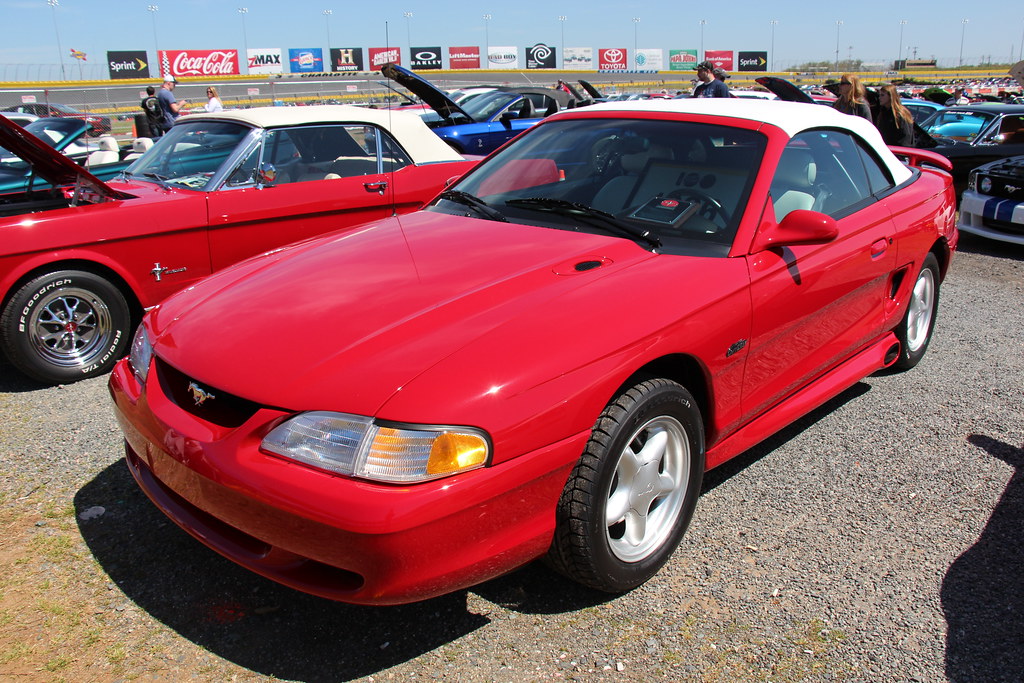
Ford’s 1982 Mustang GT represented a crucial attempt to revive the legendary badge, a name steeped in performance folklore. However, early iterations of this much-anticipated model managed only 157 horsepower and 240 lb-ft of torque from its 5.0L V8 engine. While these numbers were an improvement over some of its contemporaries, they still fell significantly short of the muscle car expectations for a vehicle bearing the ‘GT’ designation.
The 0-60 mph sprint, clocking in at approximately 8.2 seconds, was undeniably “respectable for a minivan” but simultaneously “embarrassing for a muscle car.” This performance placed the Mustang GT in an awkward position, unable to fully reclaim its heritage as a drag strip contender while struggling to compete with increasingly agile foreign imports that prioritized handling and efficiency.
Despite the power deficit, the Fox Body platform upon which the Mustang GT was built did offer improved handling dynamics, a silver lining in an otherwise cloudy period. Yet, genuine Mustang performance, the kind that delivered classic muscle car thrills, wouldn’t fully return until the decade’s final years. For enthusiasts, the 1982 Mustang GT offered a profound “lesson in patience instead,” hinting at future potential rather than immediate gratification.
Car Model Information: 2021 Genesis GV80 2.5T
Name: Ford Mustang
Caption: 2018 Ford Mustang GT 5.0
Aka: Ford T5 (Germany)
Manufacturer: Ford Motor Company
Production: March 1964 – present
ModelYears: 1965–present
Class: Unbulleted list
BodyStyle: Unbulleted list
Layout: Front-engine, rear-wheel-drive layout
Categories: 1970s cars, 1980s cars, 1990s cars, 2+2 coupés, 2000s cars
Summary: The Ford Mustang is an American automobile manufactured and marketed by Ford since 1964, as Ford’s longest nameplate in continuous production. Currently in its seventh generation, it is the fifth-best selling Ford car nameplate. The namesake of the “pony car” automobile segment, the Mustang was developed as a highly styled line of sporty coupes and convertibles derived from existing model lines, initially distinguished by its pronounced “long hood, short deck” proportions.
Originally predicted to sell 100,000 vehicles yearly, the 1965 Mustang became the most successful vehicle launch since the 1927 Model A. Introduced on April 17, 1964 (16 days after the Plymouth Barracuda), over 400,000 units were sold in its first year; the one-millionth Mustang was sold within two years of its launch. In August 2018, Ford produced the 10-millionth Mustang; matching the first 1965 Mustang, the vehicle was a 2019 Wimbledon White convertible with a V8 engine.
The success of the Mustang launch led to multiple competitors from other American manufacturers, including the Chevrolet Camaro and Pontiac Firebird (1967), AMC Javelin (1968), and Dodge Challenger (1970). It also competed with the Plymouth Barracuda, which was launched around the same time. The Mustang also had an effect on designs of coupes worldwide, leading to the marketing of the Toyota Celica and Ford Capri in the United States (the latter, by Lincoln-Mercury). The Mercury Cougar was launched in 1967 as a unique-bodied higher-trim alternative to the Mustang; during the 1970s, it included more features and was marketed as a personal luxury car.
From 1965 until 2004, the Mustang shared chassis commonality with other Ford model lines, staying rear-wheel-drive throughout its production. From 1965 to 1973, the Mustang was derived from the 1960 Ford Falcon compact. From 1974 until 1978, the Mustang (denoted Mustang II) was a longer-wheelbase version of the Ford Pinto. From 1979 until 2004, the Mustang shared its Fox platform chassis with 14 other Ford vehicles (becoming the final one to use the Fox architecture). Since 2005, Ford has produced two generations of the Mustang, each using a distinct platform unique to the model line.
Through its production, multiple nameplates have been associated with the Ford Mustang series, including GT, Mach 1, Boss 302/429, Cobra (separate from Shelby Cobra), and Bullitt, along with “5.0” fender badging (denoting 4.9 L OHV or 5.0 L DOHC V8 engines).
Get more information about: Ford Mustang
Buying a high-performing used car >>>
Brand: Ford Model: Mustang GT
Price: $34,319 Mileage: 36,145 mi.

3. 1981 Pontiac Trans Am (Turbo): Aggressive Looks, Underwhelming Power
The 1981 Pontiac Trans Am continued its tradition of aggressive, iconic styling, promising high performance from its turbocharged 4.9L V8. This engine was rated at 200 horsepower, a figure that on paper suggested a return to form for the legendary Firebird variant. However, the reality of its performance was marred by significant technological limitations of the era.
The turbocharging system, while innovative for its time, was plagued by substantial turbo lag and poor throttle response. These issues masked much of the engine’s potential, making real-world acceleration profoundly disappointing. The 0-60 mph time, achieved at around 7.5 seconds, was considered mediocre, especially for a vehicle with such a potent visual presence and a history rooted in raw power. It became “emblematic of the era’s power shortage,” showcasing the struggles manufacturers faced in balancing emissions regulations with performance desires.
Despite these performance shortcomings, the Trans Am maintained its iconic aggressive styling and distinctive features, ensuring it still turned heads. Yet, this model became a stark “rolling reminder that looking fast and being fast weren’t the same thing,” highlighting the growing chasm between a car’s perceived capability and its actual on-road performance. It was a visual powerhouse that, regrettably, couldn’t quite deliver the punch its looks implied.
Car Model Information: 2021 RAM 2500 Big Horn
Name: Pontiac Firebird
Caption: The second, third, and fourth generations of,the Pontiac Firebird Trans Am
Manufacturer: Pontiac (automobile)
Production: February 23, 1967 – August 30, 2002
ModelYears: 1967 – 2002
Class: Pony car,Muscle car
Platform: GM F platform
Related: Chevrolet Camaro
Layout: Front engine, rear-wheel-drive layout
Categories: 1970s cars, 1980s cars, 1990s cars, 2000s cars, All articles with dead external links
Summary: The Pontiac Firebird is an American automobile built and produced by Pontiac from the 1967 to 2002 model years. Designed as a pony car to compete with the Ford Mustang, it was introduced on February 23, 1967, five months after GM’s Chevrolet division’s platform-sharing Camaro. This also coincided with the release of the 1967 Mercury Cougar, Ford’s upscale, platform-sharing version of the Mustang.
The name “Firebird” was also previously used by GM for the General Motors Firebird series of concept cars in the 1950s.
Get more information about: Pontiac Firebird
Buying a high-performing used car >>>
Brand: Pontiac Model: Trans Am
Price: $33,564 Mileage: 45,952 mi.
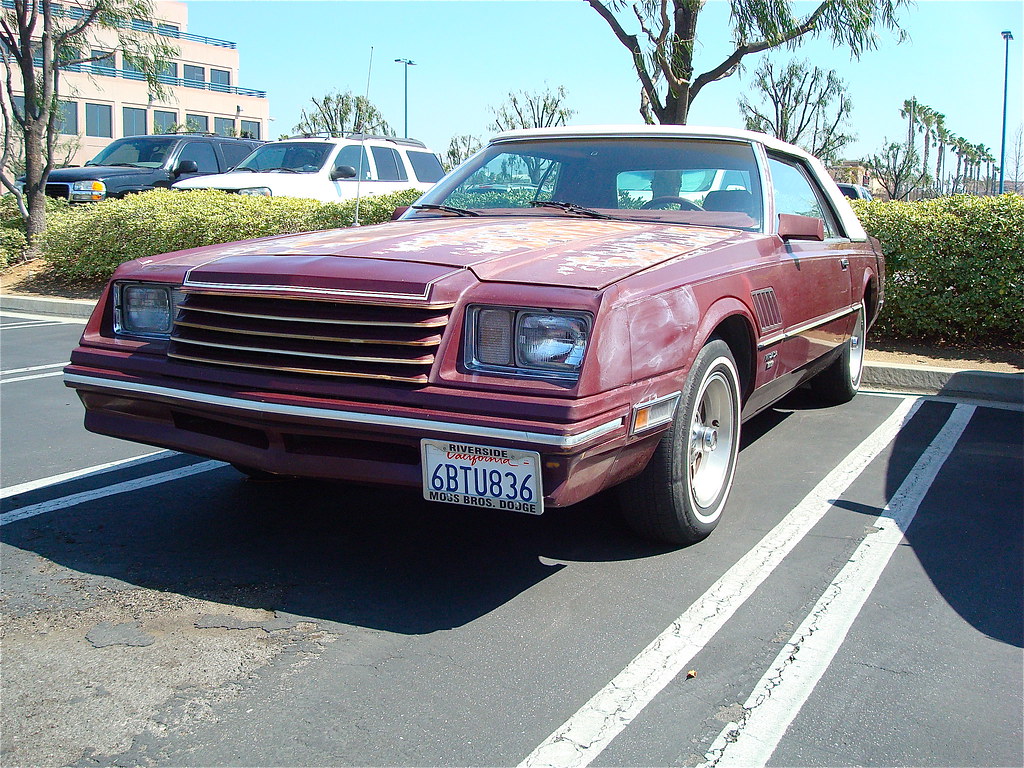
4. 1980 Dodge Mirada CMX: The Luxury Muscle Contradiction
The 1980 Dodge Mirada CMX attempted an ambitious fusion of muscle car aesthetics with luxury aspirations, a combination that ultimately proved contradictory and unconvincing. Its larger, more opulent styling suggested a powerful presence, but under the hood, the performance told a very different story. The 5.9L V8 engine, despite its considerable displacement, managed only 185 horsepower, a figure that was underwhelming for a vehicle aiming to embody both luxury and performance.
Such a modest power output, combined with the vehicle’s substantial curb weight, resulted in painfully slow acceleration. The Mirada CMX required more than 10 seconds to reach 60 mph, a pace that would certainly “embarrass a modern family sedan.” This performance deficit made it clear that the car delivered neither luxury nor muscle convincingly, failing to hit the mark on both fronts.
Furthermore, the suspension tuning, heavily biased towards comfort, actively eliminated any “sporting pretensions” the car might have theoretically possessed. The bold aesthetic, while distinctive, simply “couldn’t compensate for performance” that was so dramatically out of sync with its muscular appearance. The Mirada CMX stands as a prime example of an identity crisis, struggling to reconcile conflicting design philosophies in an era of challenging engineering mandates.
Car Model Information: 2021 RAM 2500 Big Horn
Caption: 1981 Dodge Mirada
Name: Dodge Mirada
Manufacturer: Chrysler Corporation
Assembly: Windsor, Ontario
ModelYears: 1980–1983,52,947 produced
Class: Mid-size
Layout: FR layout
Platform: Chrysler J platform
BodyStyle: coupe
Engine: ubl
Abbr: on (1981–83)
Transmission: TorqueFlite#A904,Automatic transmission
Wheelbase: 112.7 in
Length: 209.5 in
Width: 72.7 in
Height: 53.3 in
Weight: 3373 lb
Designer: Ernie Barry
Predecessor: Dodge Magnum
Successor: Dodge 600
Related: Dodge Aspen,Chrysler Cordoba#Second generation (1980–1983),Imperial (automobile)#Sixth generation (1981–1983)
Categories: All articles needing additional references, All articles with unsourced statements, Articles needing additional references from October 2018, Articles with short description, Articles with unsourced statements from November 2019
Summary: The Dodge Mirada is a mid-sized, rear-wheel drive coupe manufactured and marketed by Dodge for the model years 1980 to 1983, sharing the Chrysler J platform along with its badge engineered variants, the second generation Chrysler Cordoba and the Imperial. Production of the Mirada reached just under 53,000 units, staying relatively unchanged during its four-year run, with the exception of paint colors and engines. The Mirada was marketed as a sporty personal luxury car with limited advertising and marketing during a period when Chrysler was in deep financial difficulty.
Get more information about: Dodge Mirada
Buying a high-performing used car >>>
Brand: Dodge Model: Mirada CMX
Price: $33,564 Mileage: 45,952 mi.
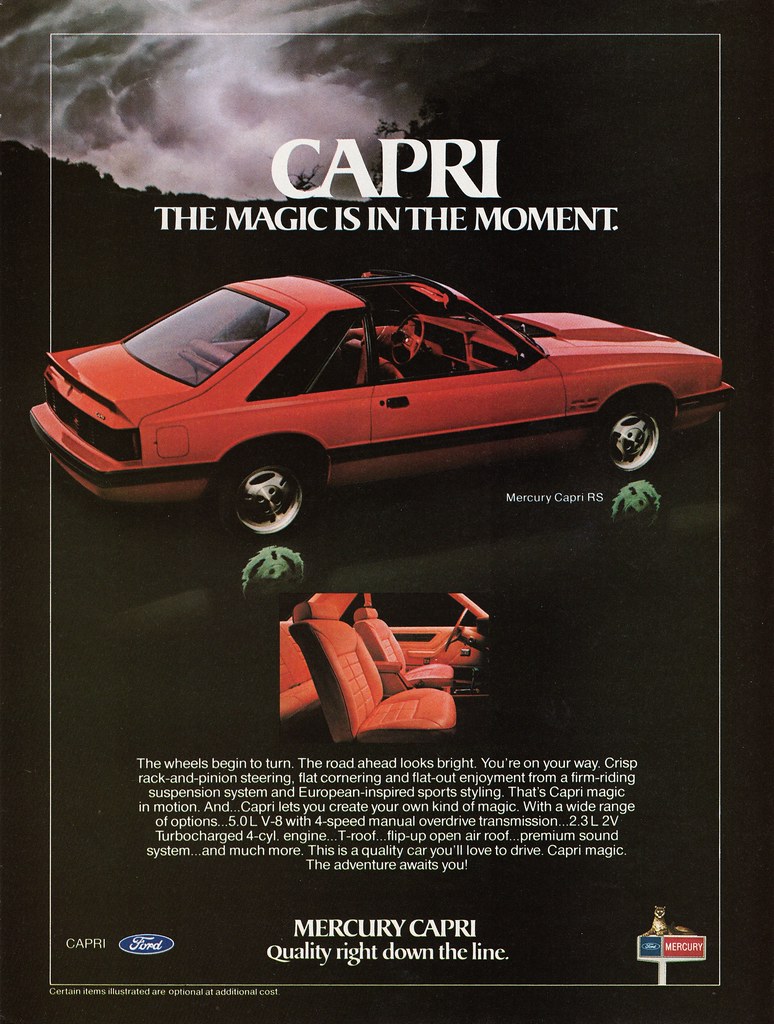
5. 1983 Mercury Capri RS: Fox Body Potential Lost in Identity
Sharing its fundamental architecture with the highly adaptable Fox Body Mustang platform, the 1983 Mercury Capri RS had the genetic potential for respectable performance. It came equipped with a 5.0L high-output V8 engine, which generated 175 horsepower and a healthy 270 lb-ft of torque. These numbers, while not earth-shattering, were certainly competitive for the period and hinted at a spirited driving experience.
Despite also featuring “decent handling updates” that improved its dynamic capabilities, the Capri RS was ultimately hampered by what the context describes as “middling acceleration of 8.5 seconds to 60 mph.” This performance, while not abysmal, left much to be desired for a car positioned as a performance-oriented variant. It struggled to stand out in a market gradually demanding more from its ‘sporty’ offerings.
More critically, the Capri RS suffered from a significant identity crisis. It “lacked any distinct identity that would justify choosing it over its Mustang sibling,” which often offered similar or superior performance with a more established brand cachet. This absence of a unique selling proposition relegated the Capri RS to the status of an “automotive footnote,” a car that could have been more, but never quite found its own voice or purpose amidst the challenges of the horsepower drought.
Car Model Information: 2023 Honda Accord EX
Caption: 1971 Capri
Name: Capri,Mercury Capri
Manufacturer: Ford Europe,Mercury (automobile),Ford Australia
Production: 1970–1977,1979–1986,1991–1994
Related: Ford Capri
Class: Sports car
Categories: 1970s cars, 1980s cars, 1990s cars, All articles needing additional references, All articles with a promotional tone
Summary: Capri (later Mercury Capri) is a nameplate marketed by the Lincoln-Mercury division of Ford Motor Company over three generations between 1970 and 1994.
From 1970 to 1978, the Capri was a sport compact marketed in North America by the Lincoln-Mercury division without any Ford or Mercury divisional branding; it was a captive import, manufactured by Ford of Europe and sold simply as the Capri.
From 1979 to 1986, the second generation Capri became part of the Mercury model line as a U.S. built pony car, a badge engineered variant of the contemporary Ford Mustang.
Ford Australia produced the third-generation Mercury Capri roadster from 1991 to 1994, which Ford marketed as the Ford Capri outside of North America.
In North America, the first and third generations of the Capri were marketed without a direct Ford-brand counterpart but were sold in other markets under the Ford brand.
The name derives from the Italian island of Capri, and has been used by all three Ford divisions. The 1952 Lincoln Capri marked the first use of the nameplate, serving as a trim level through 1959. From 1962 to 1964, Ford of Britain introduced a Ford Consul Capri two-door hardtop coupe. For 1966 and 1967, the Capri name was first used by Mercury to denote the standard trim of the Mercury Comet.
For 1968, Ford of Europe developed the Ford Capri two-door coupé as its European counterpart to the Mustang. Like the Mustang, the Capri was styled with a long hood and a short deck, with a fastback-style roofline.
Get more information about: Mercury Capri
Buying a high-performing used car >>>
Brand: Mercury Model: Capri RS
Price: $22,799 Mileage: 37,546 mi.
Read more about: Remember These? 12 Mind-Blowing Classic TV Car Ads That Vanished From Our Screens (But Live On In Our Hearts!)

6. 1981 Chevrolet Monte Carlo Turbo: A Cautionary Tale of Early Turbocharging
The 1981 Chevrolet Monte Carlo Turbo represented another attempt by American automakers to leverage forced induction to combat the era’s performance constraints. It employed a 3.8L turbocharged V6 engine, producing 170 horsepower and 250 lb-ft of torque. On paper, this was a respectable power output for a personal luxury coupe, promising a blend of comfort and spirited driving dynamics.
However, the nascent state of turbocharging technology during this period proved to be its Achilles’ heel. The turbo system was unfortunately “plagued by reliability issues,” leading to frequent mechanical problems and inconsistent performance. This undermined any advantage the turbo might have offered, turning what was intended as an innovative solution into a source of frustration for owners.
Compounding these reliability woes was the car’s disappointing acceleration, with a 0-60 mph time of 9.5 seconds. This figure “left muscle car enthusiasts cold,” as it failed to deliver the urgent, powerful acceleration expected from a ‘Turbo’ model. The 1981 Monte Carlo Turbo became a poignant “cautionary tale” rather than a success story, illustrating that good intentions and emerging technology often require more maturity before they can reliably deliver on their performance promises in mainstream applications.
Car Model Information: 2021 RAM 2500 Big Horn
Name: Chevrolet Monte Carlo
Manufacturer: Chevrolet
Production: 1969–1987,1994–2007
ModelYears: 1970–1988,1995–2007
Class: Personal luxury car
BodyStyle: coupé
Layout: FR layout
Caption: 2006 Chevrolet Monte Carlo LS
Categories: 1980s cars, 1990s cars, 2000s cars, All Wikipedia articles written in American English, All articles needing additional references
Summary: The Chevrolet Monte Carlo is a two-door coupe that was manufactured and marketed by the Chevrolet division of General Motors. Deriving its name from the city in Monaco, the Monte Carlo was marketed as the first personal luxury car of the Chevrolet brand. Introduced for the 1970 model year, the model line was produced across six generations through the 2007 model year, with a hiatus from 1989 until 1994. The Monte Carlo was a variant of the Pontiac Grand Prix throughout its production.
From 1970 until 1972, the Monte Carlo rode on the unique “A-Special” platform with the Grand Prix, shifting to the standard A-body intermediate chassis from the 1973 through 1977 model years. For 1978, the Monte Carlo line underwent downsizing, but was still considered a midsized coupe. The rear-wheel drive A-body platform of this generation of Monte Carlo was redesignated as the G-body when GM’s front-wheel drive A-body cars were introduced for the 1982 model year. After an abbreviated 1988 model year, the Monte Carlo was replaced by the two-door Chevrolet Lumina.
For the 1995 model year, the Monte Carlo was revived, replacing the two-door Lumina. It shared the front-wheel drive W-platform with the two-door Grand Prix, and was the largest coupe in the Chevrolet lineup. After the 2002 model year, the Grand Prix coupe was discontinued, the Monte Carlo became the largest two-door model produced by an American auto manufacturer.
In response to declining sales of the model line, Chevrolet discontinued the Monte Carlo after the 2007 model year. During much of its production, the Monte Carlo represented the Chevrolet brand in stock car racing. During the 1980s, the Monte Carlo SS was introduced, featuring aerodynamically enhanced styling; as part of its revival, the Monte Carlo again represented Chevrolet in stock car racing from 1995 through its discontinuation.
Get more information about: Chevrolet Monte Carlo
Buying a high-performing used car >>>
Brand: Chevrolet Model: Monte Carlo
Price: $33,564 Mileage: 45,952 mi.
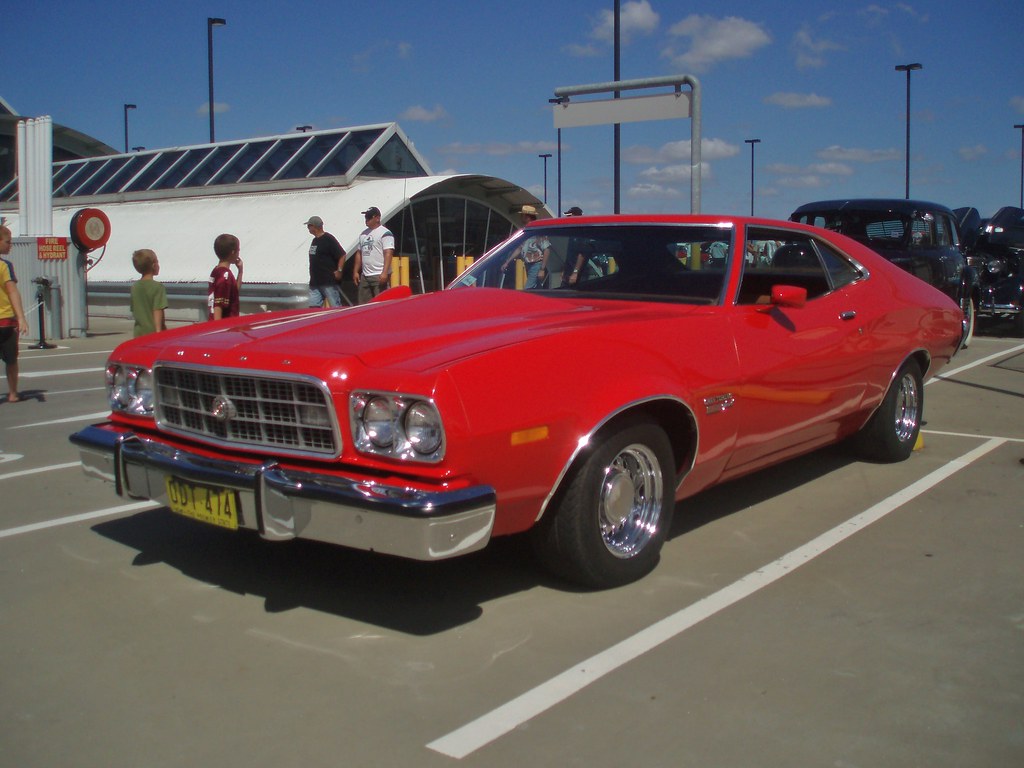
7. 1972 Gran Torino Sport: Style Over Speed in a Changing Era
The 1972 Gran Torino Sport certainly caught the eye with its quintessential classic muscle car looks, embodying the aggressive styling cues that defined the era. However, beneath its compelling exterior, the performance narrative told a different and often frustrating story. This car, despite its muscular appearance, struggled significantly when it came to delivering the speed and acceleration expected of a true muscle machine.
Its 0 to 60 mph time hovered around 7.7 seconds, a figure that was considered “much slower than many of its peers from the era.” This performance deficit can be attributed to several converging factors prevalent in the early 1970s. The model was heavily “affected by changing horsepower ratings,” which transitioned from gross to net measurements, often showing lower figures, and an “increased weight,” which further diminished its agility and raw speed.
Consequently, the Gran Torino Sport, despite its undeniably “stunning design,” became a car that simply “doesn’t quite deliver the thrills you might anticipate” from its imposing presence. It represented a shift where styling began to outweigh raw performance, a characteristic that would become increasingly common as manufacturers grappled with new regulations and economic pressures. For many, it was a beautiful shell lacking the powerful heart of its predecessors.
Having dissected the initial missteps that plagued some of America’s most revered nameplates, our journey into the horsepower drought continues. The challenges of the era were widespread, affecting a diverse range of vehicles from quintessential sports cars to luxury cruisers and even once-proud muscle machines. As we delve into seven more examples, it becomes increasingly clear that no badge, however prestigious, was immune to the crippling combination of regulatory mandates and economic pressures that reshaped the automotive landscape during the 1970s and early 1980s. This period demanded innovation, but often delivered compromise, leaving enthusiasts longing for the raw power of bygone years. The story of these cars isn’t just about their individual failings; it’s a testament to a pivotal moment in automotive history.
Car Model Information: 2021 Genesis GV80 2.5T
Aka: Ford Fairlane (Venezuela)
Name: Ford Torino
Caption: 1970 Ford Torino Cobra SportsRoof
Manufacturer: Ford Motor Company
Production: 1968–1976
Class: Mid-size car,muscle car
Layout: FR layout
Related: Mercury Montego
Assembly: ubl
Predecessor: Ford Fairlane (Americas)
Successor: Ford LTD II
Categories: 1960s cars, 1970s cars, All Wikipedia articles written in American English, All articles with vague or ambiguous time, Articles with short description
Summary: The Ford Torino is an automobile that was produced by Ford for the North American market between 1968 and 1976. It was a competitor in the intermediate market segment and essentially a twin to the Mercury Montego line.
Just as the Ford LTD had been the upscale version of the Ford Galaxie, the Torino was initially an upscale variation of the intermediate-sized Ford Fairlane. In the 1968 and 1969 model years, the intermediate Ford line consisted of lower-trim Fairlanes and its subseries, the upper-trim Torino models. In 1970, Torino became the primary name for Ford’s intermediate, and the Fairlane was now a subseries of the Torino. In 1971, the Fairlane name was dropped altogether, and all Ford intermediates were called Torino.
Most Torinos were conventional cars, and generally the most popular models were the four-door sedans and two-door hardtops. However, Ford produced some high-performance “muscle car” versions of the Torino by fitting them with large powerful engines, such as the 428 cu in (7.0 L) and 429 cu in (7.0 L) “Cobra-Jet” engines. Ford also chose the Torino as the base for its NASCAR entrants, and it has a successful racing heritage.
Get more information about: Ford Torino
Buying a high-performing used car >>>
Brand: Ford Model: Gran Torino Sport
Price: $34,319 Mileage: 36,145 mi.
Read more about: Rev Your Engines! The Reality Check on 13 Beloved Movie Cars That Just Can’t Exist as They Do On Screen
8. 1977-81 Corvette: The Icon’s Compromise
The Chevrolet Corvette, particularly the C3 generation, remains an enduring symbol of American sports car prowess. Its sleek, aerodynamic lines and aggressive stance captivated a generation, promising exhilaration and high performance. However, for models produced between 1977 and 1981, this promise was often overshadowed by a stark reality: the performance simply didn’t live up to the visual spectacle, a direct consequence of the era’s increasingly stringent emissions regulations.
During this difficult period, the Corvette’s engine options saw a significant decline in power output. The 1981 version, for instance, could only muster around 190 horsepower from its 5.7-liter V8 engine. When combined with the vehicle’s respectable curb weight of approximately 3,500 pounds, this modest power figure translated into acceleration times that left much to be desired, especially compared to its more potent predecessors and the expectations typically associated with the Corvette name.
While the 1977-81 Corvette still commanded attention with its bold style and undeniable presence, the driving experience often felt disconnected from its muscle car reputation. The performance numbers, while perhaps understandable given the prevailing conditions, were undoubtedly “surprising for a car with such a bold style.” It became a prime example of an automotive icon forced to compromise its core identity in the face of external pressures, prioritizing compliance over outright speed.
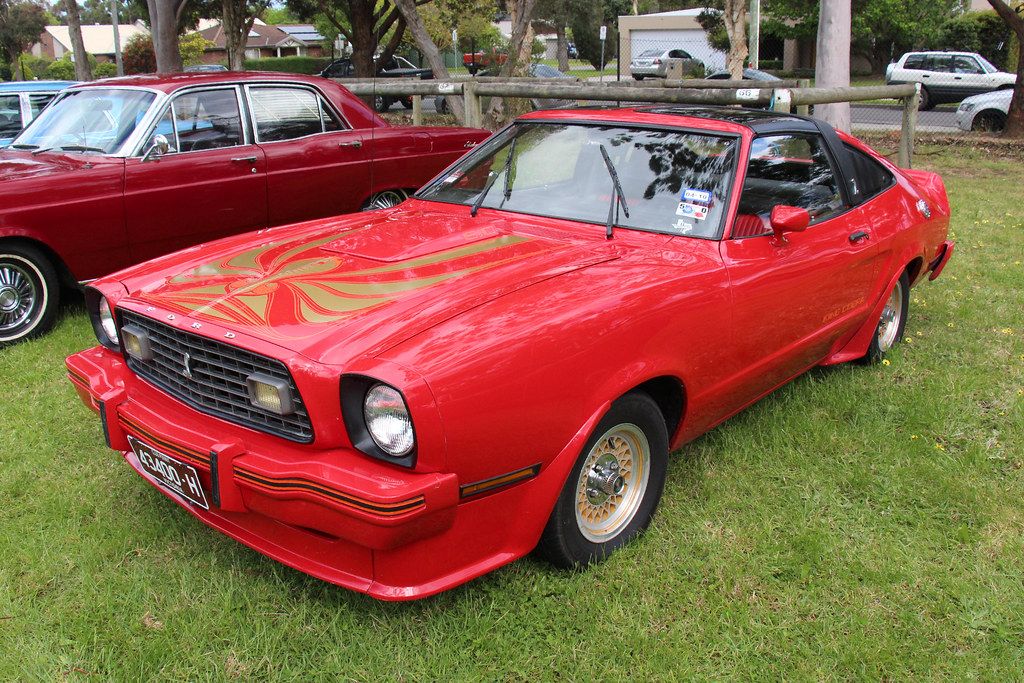
9. 1975 Ford Mustang II: A Sales Success, Performance Fiasco
The Ford Mustang II, introduced in the mid-1970s, remains one of the most polarizing entries in the storied Mustang lineage. While it achieved remarkable sales success, becoming “one of the best-selling Mustangs at the time,” its performance narrative tells a decidedly different story. Positioned as a smaller, more fuel-efficient response to the oil crisis, its design marked a significant departure from the original pony car ethos, a shift that alienated many traditional enthusiasts.
Under the hood, the performance deficits were glaring. The 1975 model, weighing around 3,000 pounds—heavier than earlier, more powerful Mustangs—was often equipped with a 2.8-liter V6 engine that produced a meager 105 horsepower. This powerplant, far from the thunderous V8s that defined the Mustang legend, delivered acceleration that was profoundly lacking, with a 0-60 mph time of “about 10 seconds.”
This sluggish performance left the Mustang II struggling to compete with its muscle car peers and even many contemporary family sedans. Despite its commercial triumph, driven by its timely appeal to fuel efficiency and a more compact size, the 1975 Mustang II stands as a testament to how “style can sometimes outweigh speed.” For those who cherished the Mustang legacy for its raw power, this iteration proved to be a surprising and often disappointing chapter, demonstrating that even a revered nameplate could fall victim to the era’s performance compromises.
Car Model Information: 2021 Genesis GV80 2.5T
Name: Second generation
Caption: Ford Mustang II coupe
Aka: Ford Mustang II , Ford T5 (in Germany)
Class: Pony car,Subcompact car
Production: 1973–1978
ModelYears: 1974–1978
Predecessor: Ford Mustang (first generation)
Successor: Ford Mustang (third generation)
Assembly: Unbulleted list
Layout: Front-engine, rear-wheel-drive layout
BodyStyle: coupé,hatchback
Related: Ford Pinto,Ford Pinto
Manufacturer: Ford Motor Company
Engine: ubl
Transmission: ubl
Wheelbase: cvt
Length: cvt
Width: cvt
Height: cvt
Designer: Buck Mook, Dick Nesbitt
Categories: All articles with dead external links, All articles with unsourced statements, Articles with dead external links from April 2024, Articles with permanently dead external links, Articles with short description
Summary: The second-generation Ford Mustang, marketed as the Ford Mustang II, is a two- or three-door, four-passenger, front-engine/rear-drive pony car manufactured and marketed by Ford from 1973 until 1978. Introduced in September 1973 for the 1974 model year, the Mustang II arrived roughly coincident with the oil embargo of 1973 and subsequent fuel shortages. Developed under Lee Iacocca, it was an “entirely new kind of pony car.” Ford “decided to call it Mustang II, since it was a new type of pony car designed for an era of high gas prices and fuel shortages.”
The Mustang II was 490 lb (222 kg) lighter and almost 19 in (483 mm) shorter than the 1973 Mustang, and derived from the subcompact Pinto platform. While sharing a limited number of driveline components with the Pinto, the Mustang II employed an exclusive subframe, isolating its front suspension and engine mount subframe. The steering used a rack-and-pinion design.
Named Motor Trend’s 1974 Car of the Year and reaching over 1.1 million sales over four years of production, the Mustang II is noted simultaneously for both its marketing prescience and strong sales – while criticized as having abandoned essential aspects of the Mustang heritage and described, in a retrospective after 40 years since its introduction, as embodying the Malaise era.
Get more information about: Ford Mustang (second generation)
Buying a high-performing used car >>>
Brand: Ford Model: Mustang II
Price: $34,319 Mileage: 36,145 mi.
Read more about: Engineering Flaws and Fateful Journeys: Unpacking the Most Dangerous Cars of All Time

10. 1976 Cadillac Eldorado: The Fall of a Gilded Giant
The Cadillac Eldorado, with its opulent styling and massive dimensions, represented the pinnacle of American automotive luxury and grandeur. In its prime, the Eldorado was synonymous with effortless power, courtesy of its colossal engines. Upon its initial release, the 500 cubic inch (8.2-liter) V8 in the Eldorado produced an impressive 405 horsepower, a formidable figure that solidified its status as a land yacht with serious grunt.
However, the onset of stringent emissions restrictions and a fundamental shift in how horsepower was measured delivered a truly “tragic story of horsepower loss” for this automotive titan. By 1976, the very same massive big-block V8 that once produced over 400 horsepower was detuned to an “almost unbelievably low 190 horsepower.” This drastic reduction represented a colossal blow to the Eldorado’s performance credentials.
The transformation meant that a vehicle designed for commanding presence and powerful acceleration suddenly found itself struggling to move its considerable mass with anything resembling authority. The 1976 Eldorado, despite retaining its luxurious appointments, became a poignant symbol of how regulatory changes could strip even the most powerful and prestigious American cars of their inherent performance. It highlighted the end of an era where displacement alone guaranteed prodigious power, forcing Cadillac and other manufacturers to fundamentally rethink their engineering approaches.
Car Model Information: 1976 Cadillac Eldorado Convertible
Caption: 1963 Cadillac Eldorado Convertible
Name: Cadillac Eldorado
Manufacturer: Cadillac
Production: 1952–2002
Layout: Front-engine, rear-wheel-drive layout
Aka: Cadillac Fleetwood Eldorado
Class: Personal luxury car
Successor: Cadillac CTS
Categories: 1960s cars, 1970s cars, 1980s cars, 1990s cars, 2000s cars
Summary: The Cadillac Eldorado is a luxury car manufactured and marketed by the Cadillac Motor Car Division of General Motors from 1952 until 2002, over twelve generations.
The Eldorado was at or near the top of the Cadillac product line. The original 1953 Eldorado convertible and the Eldorado Brougham models of 1957–1960 had distinct bodyshells and were the most expensive models offered by Cadillac during those years. The Eldorado was never less than second in price after the Cadillac Series 75 limousine until 1966. Beginning in 1967, the Eldorado retained its premium position in the Cadillac price structure, but was manufactured in high volumes on a unique, two-door personal luxury car platform.
The Eldorado carried the Fleetwood designation from 1965 through 1972, and was seen as a modern revival of the pre-war Cadillac V-12 and Cadillac V-16 roadsters and convertibles.
Get more information about: Cadillac Eldorado
Buying a high-performing used car >>>
Brand: Cadillac Model: Eldorado
Price: $28,499 Mileage: 31,898 mi.
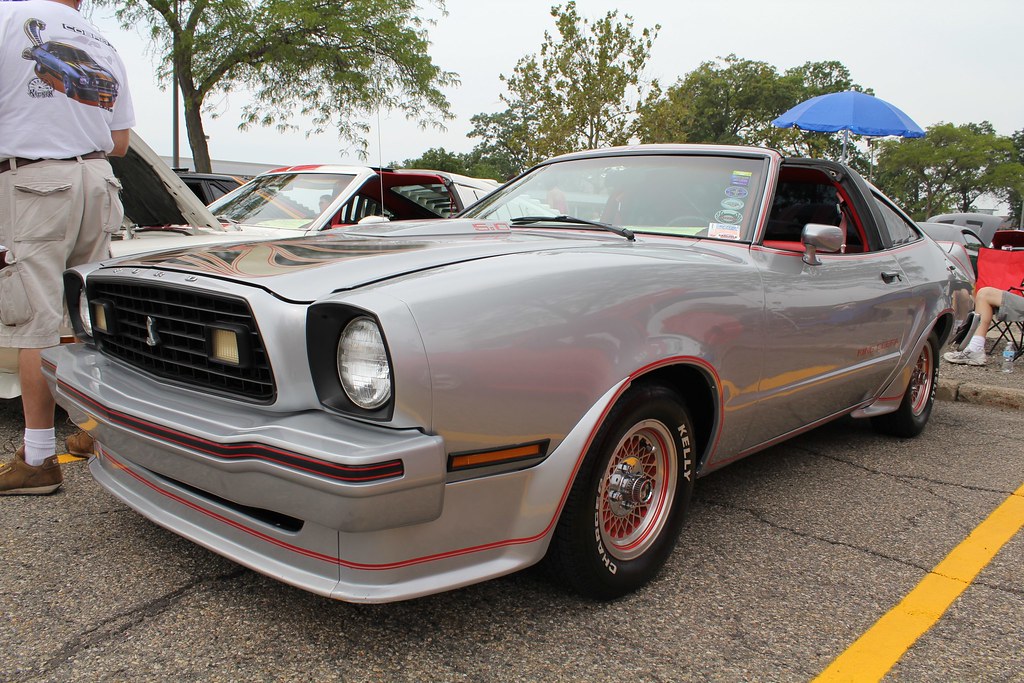
11. 1978 Ford Mustang King Cobra: An Ironic Crown
For automotive enthusiasts, the name ‘Cobra’ evokes images of raw power, aggressive performance, and the legendary touch of Carroll Shelby, who transformed Mustangs into fearsome track machines. It is precisely this potent heritage that makes the 1978 Ford Mustang King Cobra such an “insulting” and ironic entry in the annals of disappointing muscle cars. The audacious ‘King Cobra’ moniker promised dominance, yet delivered a stark reminder of the era’s performance drought.
Beneath its aggressive hood scoop and bold graphics, the 1978 King Cobra was powered by a 5.0L/302 small-block Ford V8. This engine, while iconic in other applications, was severely neutered by emissions controls, producing a paltry “only 139 horsepower.” This meager output was not only an affront to the ‘Cobra’ name but also laughably inadequate for a car attempting to project an image of high performance.
As the context wryly puts it, the name ‘Cobra’ in this instance almost “comes full circle into being ironic,” akin to calling a very large gentleman ‘Tiny.’ The 1978 Mustang King Cobra stands as a potent symbol of the profound disconnect between marketing bravado and actual on-road performance during this challenging period. It was a vehicle that visually screamed speed, but mechanically whispered, leaving enthusiasts with a taste of disappointment rather than exhilaration.
Car Model Information: 2021 RAM 2500 Big Horn
Name: Second generation
Caption: Ford Mustang II coupe
Aka: Ford Mustang II , Ford T5 (in Germany)
Class: Pony car,Subcompact car
Production: 1973–1978
ModelYears: 1974–1978
Predecessor: Ford Mustang (first generation)
Successor: Ford Mustang (third generation)
Assembly: Unbulleted list
Layout: Front-engine, rear-wheel-drive layout
BodyStyle: coupé,hatchback
Related: Ford Pinto,Ford Pinto
Manufacturer: Ford Motor Company
Engine: ubl
Transmission: ubl
Wheelbase: cvt
Length: cvt
Width: cvt
Height: cvt
Designer: Buck Mook, Dick Nesbitt
Categories: All articles with dead external links, All articles with unsourced statements, Articles with dead external links from April 2024, Articles with permanently dead external links, Articles with short description
Summary: The second-generation Ford Mustang, marketed as the Ford Mustang II, is a two- or three-door, four-passenger, front-engine/rear-drive pony car manufactured and marketed by Ford from 1973 until 1978. Introduced in September 1973 for the 1974 model year, the Mustang II arrived roughly coincident with the oil embargo of 1973 and subsequent fuel shortages. Developed under Lee Iacocca, it was an “entirely new kind of pony car.” Ford “decided to call it Mustang II, since it was a new type of pony car designed for an era of high gas prices and fuel shortages.”
The Mustang II was 490 lb (222 kg) lighter and almost 19 in (483 mm) shorter than the 1973 Mustang, and derived from the subcompact Pinto platform. While sharing a limited number of driveline components with the Pinto, the Mustang II employed an exclusive subframe, isolating its front suspension and engine mount subframe. The steering used a rack-and-pinion design.
Named Motor Trend’s 1974 Car of the Year and reaching over 1.1 million sales over four years of production, the Mustang II is noted simultaneously for both its marketing prescience and strong sales – while criticized as having abandoned essential aspects of the Mustang heritage and described, in a retrospective after 40 years since its introduction, as embodying the Malaise era.
Get more information about: Ford Mustang (second generation)
Buying a high-performing used car >>>
Brand: Ford Model: Mustang King Cobra
Price: $33,564 Mileage: 45,952 mi.
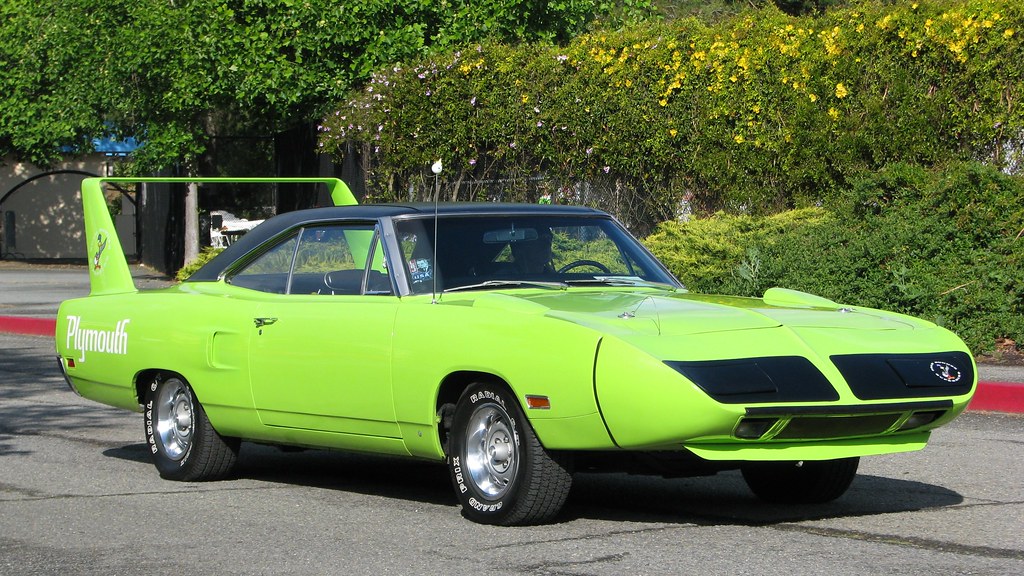
12. 1974 Plymouth Road Runner: The Myth of Speed Meets Reality
The Plymouth Road Runner is unequivocally one of the most celebrated names in muscle car history, conjuring images of raw, unadulterated speed and a no-nonsense approach to performance. However, by 1974, even this legendary badge could not escape the pervasive detuning trend gripping the automotive industry. The 1974 Road Runner marked a significant shift, signaling a compromise between its storied past and the new realities of emissions regulations.
This iteration of the Road Runner was equipped with a 383ci V8 engine, which by then produced approximately 240 horsepower. While this figure might seem adequate in isolation, it represented “a notable decrease compared to its predecessors” from the golden age of muscle. The combined impact of stricter emissions controls and the era’s growing emphasis on comfort over outright speed meant the vehicle’s performance suffered significantly.
Real-world quarter-mile times for the 1974 Road Runner hovered around the 15-second mark. This performance was described as “respectable for the era but not particularly thrilling,” especially when contrasted with the sub-14-second runs of earlier, more ferocious Road Runners. The 1974 model thus became a poignant example of an iconic muscle car forced to trade its legendary velocity for compliance, delivering a far cry from the neck-snapping acceleration its name once promised.
Car Model Information: 2021 RAM 2500 Big Horn
Name: Plymouth Road Runner
Assembly: Detroit,Michigan
Manufacturer: Plymouth (automobile)
Class: Mid-size car
Production: 1968–1980
Related: unbulleted list
Layout: FR layout
Categories: 1970s cars, 1980s cars, All articles needing additional references, All articles with peacock terms, All articles with unsourced statements
Summary: The Plymouth Road Runner is a muscle car introduced by Chrysler in the United States for the 1968 model year and marketed under its Plymouth brand. Initially based on the Belvedere, the brand’s basic mid-size model, the Road Runner combined a powerful engine with a spartan trim level and a price that undercut increasingly upscale and expensive muscle cars such as the Pontiac GTO and Plymouth’s own GTX. It was initially a sales success.
The Road Runner was built in three generations on the mid-size B platform. Like most muscle cars, its performance and sales declined in the 1970s due to an increasing focus on fuel economy and the adoption of more stringent U.S. emission standards. The nameplate became to a trim package for the compact Plymouth Volaré for model year 1976—no longer offering any special performance capability—and was discontinued in 1980.
Get more information about: Plymouth Road Runner
Buying a high-performing used car >>>
Brand: Plymouth Model: Road Runner
Price: $33,564 Mileage: 45,952 mi.
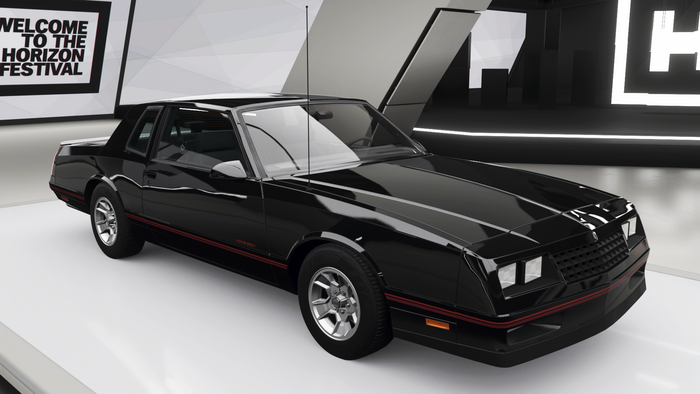
13. 1973 Chevrolet Monte Carlo: A Powerless Grandeur
The Chevrolet Monte Carlo, particularly in its early generations, cultivated an image of personal luxury combined with a hint of performance. It was a car designed for cruising in style, yet it also carried the expectation of respectable V8 power, being a “staple of luxury and performance for Chevrolet for many years.” However, the 1973 Monte Carlo vividly illustrates how even these well-established nameplates succumbed to the horsepower drought, delivering performance that felt profoundly underwhelming.
Under the hood, the 1973 Monte Carlo frequently featured the classic Chevrolet 5.7-liter V8, often referred to as a “small-block” or “350.” Despite its considerable displacement and historical significance, this V8 engine in the 1973 model produced “only 145 horsepower.” For a car of its size and aspirational market positioning, such a modest output was, as the context suggests, an “excellent name choice for it would be ‘disappointing.'”
This power figure was a far cry from the robust performance associated with V8s of earlier decades and left drivers with a sensation of sluggishness rather than spirited acceleration. The 1973 Chevrolet Monte Carlo thus serves as a clear indicator of the systemic power reduction that affected even mainstream, mass-produced vehicles during this challenging period, underscoring the widespread impact of regulatory and economic pressures on American automotive engineering.
Car Model Information: 2023 Honda Accord EX
Name: Chevrolet Monte Carlo
Manufacturer: Chevrolet
Production: 1969–1987,1994–2007
ModelYears: 1970–1988,1995–2007
Class: Personal luxury car
BodyStyle: coupé
Layout: FR layout
Caption: 2006 Chevrolet Monte Carlo LS
Categories: 1980s cars, 1990s cars, 2000s cars, All Wikipedia articles written in American English, All articles needing additional references
Summary: The Chevrolet Monte Carlo is a two-door coupe that was manufactured and marketed by the Chevrolet division of General Motors. Deriving its name from the city in Monaco, the Monte Carlo was marketed as the first personal luxury car of the Chevrolet brand. Introduced for the 1970 model year, the model line was produced across six generations through the 2007 model year, with a hiatus from 1989 until 1994. The Monte Carlo was a variant of the Pontiac Grand Prix throughout its production.
From 1970 until 1972, the Monte Carlo rode on the unique “A-Special” platform with the Grand Prix, shifting to the standard A-body intermediate chassis from the 1973 through 1977 model years. For 1978, the Monte Carlo line underwent downsizing, but was still considered a midsized coupe. The rear-wheel drive A-body platform of this generation of Monte Carlo was redesignated as the G-body when GM’s front-wheel drive A-body cars were introduced for the 1982 model year. After an abbreviated 1988 model year, the Monte Carlo was replaced by the two-door Chevrolet Lumina.
For the 1995 model year, the Monte Carlo was revived, replacing the two-door Lumina. It shared the front-wheel drive W-platform with the two-door Grand Prix, and was the largest coupe in the Chevrolet lineup. After the 2002 model year, the Grand Prix coupe was discontinued, the Monte Carlo became the largest two-door model produced by an American auto manufacturer.
In response to declining sales of the model line, Chevrolet discontinued the Monte Carlo after the 2007 model year. During much of its production, the Monte Carlo represented the Chevrolet brand in stock car racing. During the 1980s, the Monte Carlo SS was introduced, featuring aerodynamically enhanced styling; as part of its revival, the Monte Carlo again represented Chevrolet in stock car racing from 1995 through its discontinuation.
Get more information about: Chevrolet Monte Carlo
Buying a high-performing used car >>>
Brand: Chevrolet Model: Monte Carlo
Price: $22,799 Mileage: 37,546 mi.
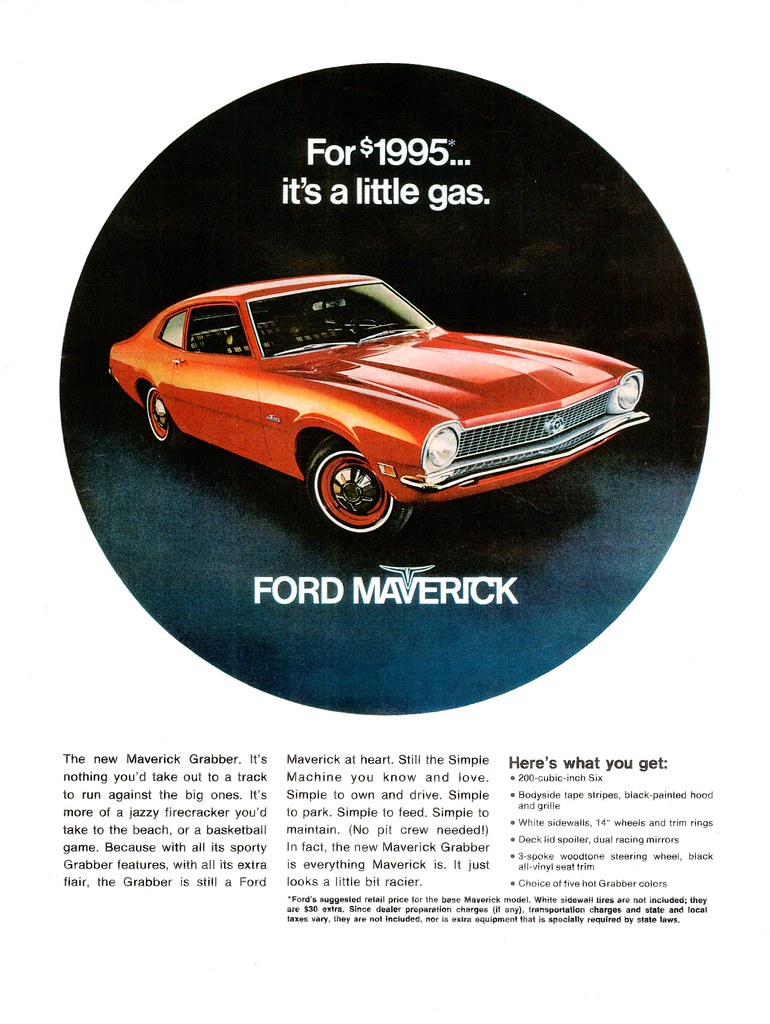
14. 1975 Ford Maverick Grabber: Styling Deceived, Power Declined
The Ford Maverick, initially conceived as a compact sedan, offered a surprising variant in the form of the ‘Grabber.’ This model attempted to infuse the everyday compact with aggressive, sporty aesthetics, boasting “pretty decent muscle car styling” and “attractive body lines.” The visual cues strongly suggested a performance-oriented machine, building expectations for a spirited driving experience that, unfortunately, the powertrain simply couldn’t fulfill.
Despite its muscular appearance, the 1975 Ford Maverick Grabber housed a version of Ford’s iconic 5.0-liter small-block V8. Yet, under the suffocating grip of emissions controls, this engine could only churn out “only 129 horsepower.” Such a meager output for a V8, especially one in a car draped in ‘Grabber’ performance attire, was an “even more of a letdown” than its compact origins might suggest.
This profound disconnect between its aggressive styling and its actual performance made the Maverick Grabber a vivid example of superficial muscle. Its “passable styling makes the power output even more of a letdown,” highlighting how manufacturers resorted to visual bravado when genuine power was constrained. The 1975 Ford Maverick Grabber serves as a reminder that during the era of the horsepower drought, even smaller, more accessible cars designed to look the part often fell short when it came to delivering the thrilling performance their appearance promised.
The legacy of these ‘speed traps’—iconic classics with profoundly disappointing horsepower—serves as a compelling historical record of a tumultuous period for American automotive engineering. Choked by the confluence of stringent emissions regulations, global fuel crises, and the necessity for rapid engineering adjustments, the once-unrivaled thunder of Detroit muscle dwindled to a wheeze. These vehicles, despite their revered badges and aggressive styling, stand as stark reminders of an era where compromise often superseded performance, leaving a generation of enthusiasts yearning for the power that had seemingly vanished overnight.
Yet, this challenging chapter ultimately paved the way for remarkable advancements. The lessons learned from the horsepower drought of the 1970s and early 1980s spurred engineers to innovate, leading to the sophisticated forced induction and advanced fuel injection systems that define modern automotive performance. Today, we are fortunate to live in an age where turbocharged four-cylinder engines effortlessly produce double the horsepower of many of these ‘ghosts of disappointment’s past,’ all while achieving vastly superior fuel economy. The horsepower wars, once a casualty of regulation, are now back in full swing, albeit with a renewed focus on efficiency and technological brilliance. What a time to be alive for car enthusiasts!