Muscle cars often conjure images of roaring engines and sleek designs, iconic beasts like the Dodge Charger, Plymouth Barracuda, and Chevrolet Chevelle that dominate our collective automotive memory. These machines from the heyday of the muscle car era are etched into history, celebrated for their raw power and undeniable cool points. However, beneath the gleaming chrome and thunderous exhaust notes of these legends, there lies a vast, shadowed landscape of forgotten machines – cars that once flexed their automotive brawn but have since faded into obscurity, largely unmissed by the modern enthusiast.
It’s easy to wax lyrical about the undisputed kings of the asphalt, but what about the unsung players that never quite made it to the Hall of Fame? Many factors contributed to their quiet disappearance: perhaps an identity crisis, a styling misstep, a marketing blunder, or simply being overshadowed by more charismatic rivals. Whatever the reason, these vehicles, despite their initial promise or unique attributes, failed to capture the enduring appeal that defined their more celebrated brethren. They are the background figures, the footnotes in a thrilling saga, often disappearing before their story was truly told.
In this deep dive, we’re pulling back the curtain on some of these fascinating failures and near-misses. We’re not here to celebrate their triumphant return to glory, but rather to understand why they slipped through the cracks of automotive history. Join us as we explore 14 muscle cars that, for various reasons, have been largely forgotten and are no longer as coveted as they once were. These are the models that once roared but now merely whisper in the annals of time, serving as compelling reminders that not every powerful machine earns a permanent spot in our hearts.

1. AMC Javelin (1968-1974)
The AMC Javelin, with its distinct design and Trans-Am racing success, certainly had a unique appeal in its time. It was American Motors Corporation’s spirited challenger in the pony car segment, aiming squarely at the likes of the Mustang and Camaro, cars that would go on to become automotive legends. The Javelin’s aggressive stance and sporty lines suggested a formidable contender, one that could hold its own both on the street and on the track with genuine capability.
Despite its inherent potential and notable achievements in competitive racing, the Javelin never managed to achieve the widespread popularity of its more mainstream rivals. Production numbers were comparatively limited, a factor which, while making them somewhat rare today, actually contributed significantly to its eventual obscurity during its original run. It struggled immensely to break through the deeply entrenched dominance of the ‘Big Three’ automakers, especially when it came to brand recognition and powerful, far-reaching marketing campaigns.
Furthermore, the overarching decline of the entire AMC brand, as American Motors Corporation faced increasing financial difficulties and ultimately ceased to exist as an independent entity, only hastened the Javelin’s fade from memory. As the company struggled, so too did the visibility and legacy of its performance cars. This meant less advertising, fewer dealer networks, and a general loss of public consciousness for the brand’s offerings.
Today, the AMC Javelin is often overshadowed by more iconic models, becoming a curious footnote rather than a celebrated chapter in muscle car history. It remains a fascinating piece of automotive Americana for a dedicated few, but certainly a car few actively miss compared to its more famous peers who commanded the lion’s share of public attention and adoration.

2. Buick GSX (1970-1972)
The Buick GSX truly packed a formidable punch, particularly when equipped with its fearsome Stage 1 455 engine. This powerhouse was capable of delivering staggering torque figures and immensely impressive straight-line speed, making it a genuine contender in the muscle car arena. This was Buick’s serious and quite audacious entry into the muscle car wars, an ambitious attempt to inject some high-octane excitement and a performance edge into a brand more commonly associated with comfortable, luxurious cruisers and sedans.
Visually, the GSX was striking and demanded attention. It was often adorned with bold, contrasting spoilers, prominent hood scoops, and distinctive graphics that unequivocally screamed performance. However, the GSX found itself in an unusual and somewhat awkward position within Buick’s overall established brand image. Buick’s long-standing reputation as a luxury marque often clashed quite sharply with the raw, rebellious, and sometimes unrefined image of the traditional muscle car.
This internal brand conflict created a peculiar identity crisis for the GSX, making it seem a little out of place in the performance pantheon. It struggled to clearly define its identity against competitors that were overtly born and bred for pure, unadulterated speed and aggressive, no-holds-barred aesthetics. It was, in essence, a muscle car wrapped in a comparatively genteel package, and for many hardcore enthusiasts, this blend simply didn’t resonate with their vision of what a muscle car should be.
As a direct result of these market dynamics, the Buick GSX never quite captured the same widespread attention or gained the lasting, iconic appeal that many of its contemporaries enjoy to this day. It was undeniably powerful, yes, but its perceived incongruity with the Buick brand meant it didn’t connect as deeply with the core muscle car audience. Today, the GSX remains a lesser-known player in the muscle car world, appreciated by a dedicated niche of enthusiasts but certainly not a vehicle missed by the broader automotive community, which typically gravitates towards the more widely recognized names from that exhilarating era.
3. Chevrolet Chevelle Malibu SS (1964-1967)
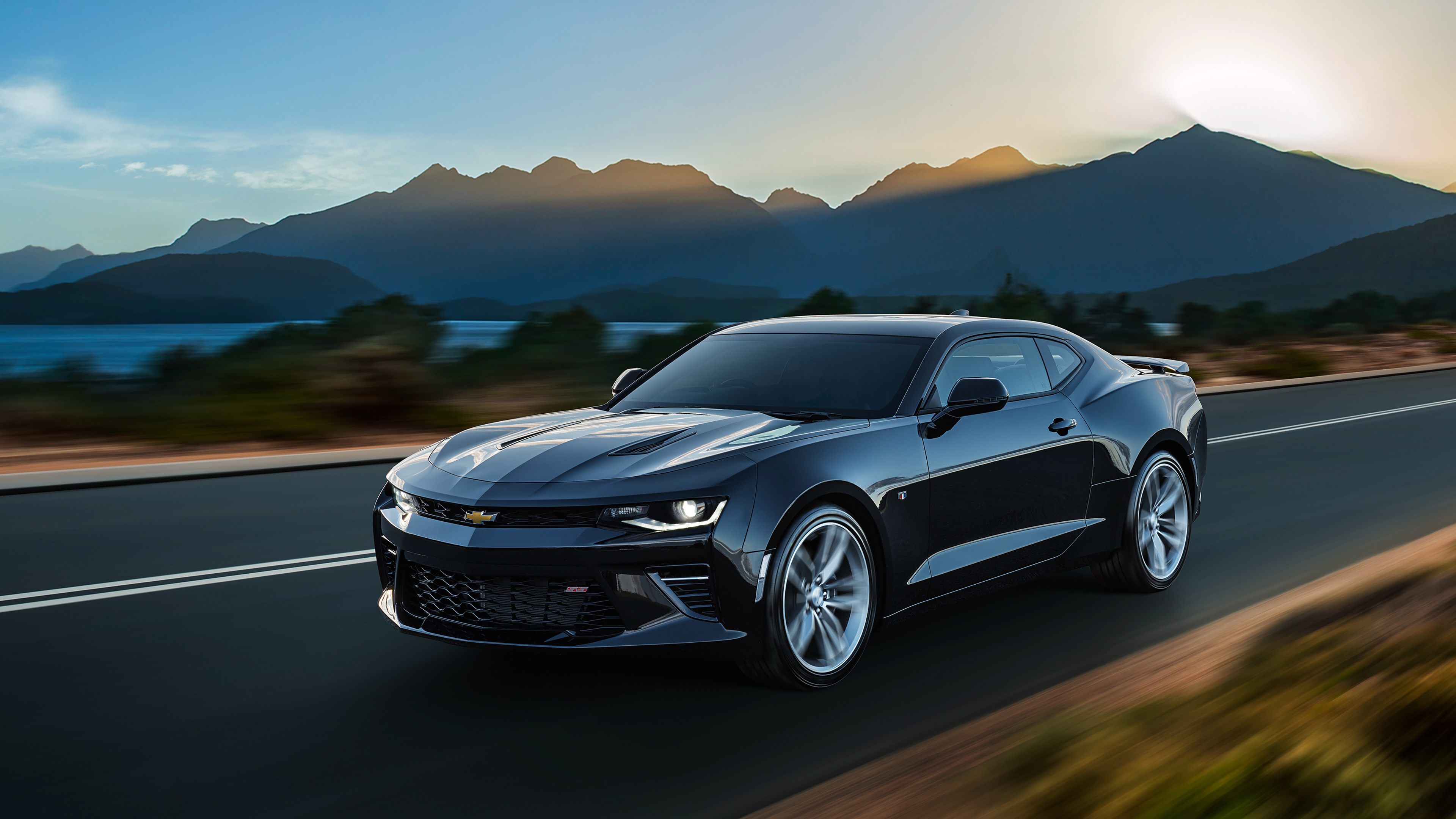
The early Chevrolet Chevelle Malibu SS models represented a crucial stepping stone in the formidable evolution of the Chevelle lineup, offering a decent and capable blend of performance and everyday usability. These initial iterations laid the foundational groundwork for what would soon become one of the most recognizable and beloved muscle car names in automotive history. They provided a respectable dose of power for their era, clearly signaling Chevrolet’s determined intent to compete vigorously in the burgeoning and highly competitive performance market.
However, one of the primary and most significant reasons these early models ultimately faded from popular memory is their distinct lack of the truly aggressive styling that later muscle cars, and especially the subsequent, more potent Chevelle generations, would so fully and successfully embrace. The 1964-1967 Malibu SS featured comparatively subdued aesthetics, presenting a more reserved appearance compared to the bolder, more muscular, and overtly menacing designs that would come to define the muscle car’s absolute peak years. It was undoubtedly a handsome car, but it simply did not possess the immediate visual aggression that truly captivated buyers seeking an overt statement of raw power and unbridled speed.
As the dynamic Chevelle lineup rapidly evolved, these foundational early versions quickly became overshadowed by the significantly more powerful and undeniably visually striking 1968-1972 models. These later iterations showcased a far more muscular presence, with designs that commanded attention and performance figures that left no doubt about their intentions. Enthusiasts, naturally drawn to the latest and greatest, began to overwhelmingly overlook the early Malibu SS in favor of these more muscular, overtly aggressive, and undeniably more exciting versions that followed.
Consequently, these important but understated foundational models have largely faded into the background of muscle car lore, becoming a historical footnote rather than a celebrated icon that stirs widespread nostalgia. They represent a curious point in time, a car that, while good, was simply destined to be eclipsed. Easily forgotten amidst the glory and sheer dominance of their successors, these are certainly not the Chevelles that most enthusiasts pine for or even remember when discussing the true titans of the muscle car era.
Car Model Information: 2024 Kia Telluride SX Prestige X-Pro
Name: Chevrolet Chevelle
Caption: 1970 Chevrolet Chevelle SS 396 Sport Coupe
Manufacturer: Chevrolet
Production: 1963–1977
ModelYears: 1964–1977
Class: Mid-size
Platform: GM A platform (RWD)
Layout: FR layout
Successor: Chevrolet Malibu
Categories: 1970s cars, All articles needing additional references, All articles that may contain original research, All articles with specifically marked weasel-worded phrases, All articles with unsourced statements
Summary: The Chevrolet Chevelle is a mid-sized automobile that was produced by the Chevrolet division of General Motors (GM) in three generations for the 1964 to 1977 model years. Part of the GM A-body platform, the Chevelle was one of Chevrolet’s most successful nameplates. Body styles included coupes, sedans, convertibles, and station wagons. The “Super Sport” versions were produced through the 1973 model year and Lagunas from 1973 through to 1976.
After a four-year absence, the El Camino was reintroduced as part of the new Chevelle lineup in 1964.
From 1964 to 1969, GM of Canada sold a modified version of the Chevelle that included a Pontiac-style grille, and a LeMans instrument panel, marketed as the Beaumont.
The Malibu was the top-of-the-line model to 1972, and completely replaced the Chevelle nameplate starting with the redesigned, and downsized 1978 model year.
Get more information about: Chevrolet Chevelle
Buying a high-performing used car >>>
Brand: Chevrolet Model: Chevelle Malibu SS
Price: $41,500 Mileage: 25,564 mi.
Read more about: The Untamed Roads: Iconic Machines That Defined the 60s and 70s Automotive Golden Era
4. Ford Torino GT (1968-1971)
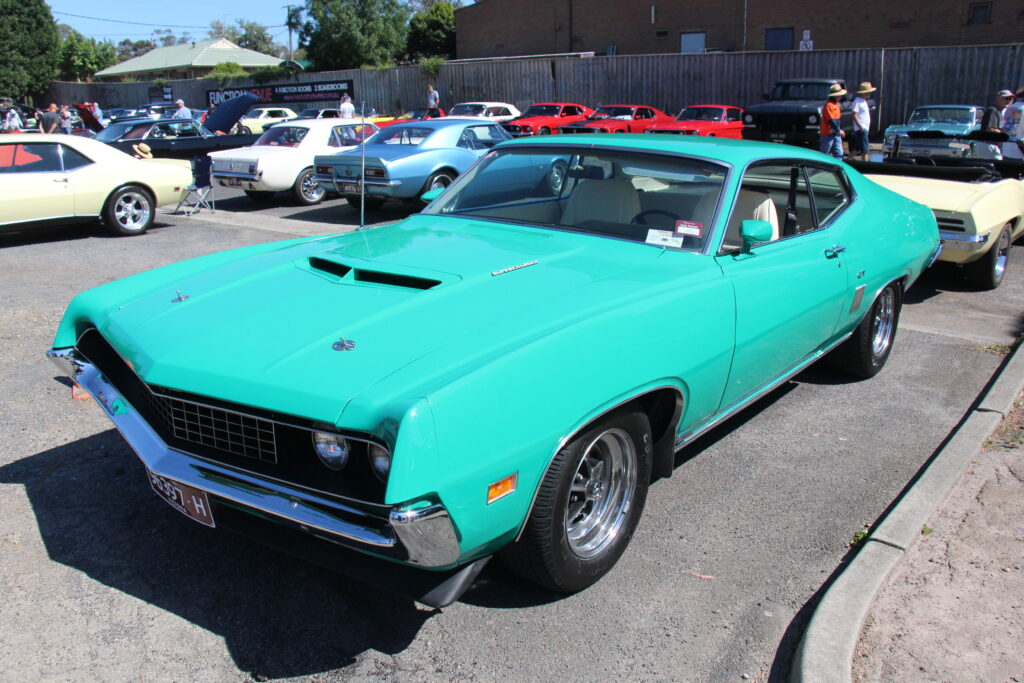
The Ford Torino GT certainly had its brief but notable moment in the sun, particularly gaining significant recognition on the NASCAR tracks where its sleek and aerodynamic body proved quite effective in competitive racing. It was Ford’s intermediate offering, deliberately designed to be larger and more comfortable than the wildly popular Mustang, yet still thoroughly imbued with a compelling sporting spirit. The Torino GT represented an attempt to cleverly blend robust performance with a more spacious, accommodating, and slightly more luxurious package, aiming to appeal to a slightly different segment of the ever-expanding performance car market.
Despite its impressive racing pedigree and the convenient availability of potent engine options, the Torino GT never quite reached the same stratospheric level of popularity or achieved the enduring iconic status as its smaller, more focused, and already legendary stablemate, the Mustang. The Mustang had, by this point, already captured the hearts and imaginations of an entire generation, effectively defining an entire genre of performance cars. The Torino GT, while undeniably capable and well-engineered, often found itself languishing in the Mustang’s considerable and overshadowing presence, struggling significantly to carve out its own distinct and memorable identity.
Its design, while undeniably sporty and aesthetically pleasing in its own right, didn’t quite resonate with the deeply entrenched hardcore muscle car crowd. These purists often favored raw, unadulterated power and aggressive, stripped-down aesthetics over any hint of added comfort or luxury. For them, a muscle car was about unapologetic performance, not compromise. Over time, as other prominent Ford models took the spotlight and the dynamic muscle car landscape began to shift, the Torino GT’s broader market appeal began to dwindle noticeably.
Today, the Ford Torino GT is frequently considered a largely forgotten chapter in Ford’s rich and storied muscle car history. It’s a car that, while important in its specific historical context and for its racing endeavors, few modern enthusiasts actively seek out, restore, or reminisce about when discussing the truly legendary greats of the era. Its tale is one of potential unfulfilled, forever cast in the shadow of a bigger star.
Car Model Information: 2024 Kia Telluride SX Prestige X-Pro
Aka: Ford Fairlane (Venezuela)
Name: Ford Torino
Caption: 1970 Ford Torino Cobra SportsRoof
Manufacturer: Ford Motor Company
Production: 1968–1976
Class: Mid-size car,muscle car
Layout: FR layout
Related: Mercury Montego
Assembly: ubl
Predecessor: Ford Fairlane (Americas)
Successor: Ford LTD II
Categories: 1960s cars, 1970s cars, All Wikipedia articles written in American English, All articles with vague or ambiguous time, Articles with short description
Summary: The Ford Torino is an automobile that was produced by Ford for the North American market between 1968 and 1976. It was a competitor in the intermediate market segment and essentially a twin to the Mercury Montego line.
Just as the Ford LTD had been the upscale version of the Ford Galaxie, the Torino was initially an upscale variation of the intermediate-sized Ford Fairlane. In the 1968 and 1969 model years, the intermediate Ford line consisted of lower-trim Fairlanes and its subseries, the upper-trim Torino models. In 1970, Torino became the primary name for Ford’s intermediate, and the Fairlane was now a subseries of the Torino. In 1971, the Fairlane name was dropped altogether, and all Ford intermediates were called Torino.
Most Torinos were conventional cars, and generally the most popular models were the four-door sedans and two-door hardtops. However, Ford produced some high-performance “muscle car” versions of the Torino by fitting them with large powerful engines, such as the 428 cu in (7.0 L) and 429 cu in (7.0 L) “Cobra-Jet” engines. Ford also chose the Torino as the base for its NASCAR entrants, and it has a successful racing heritage.
Get more information about: Ford Torino
Buying a high-performing used car >>>
Brand: Ford Model: Torino GT
Price: $41,500 Mileage: 25,564 mi.
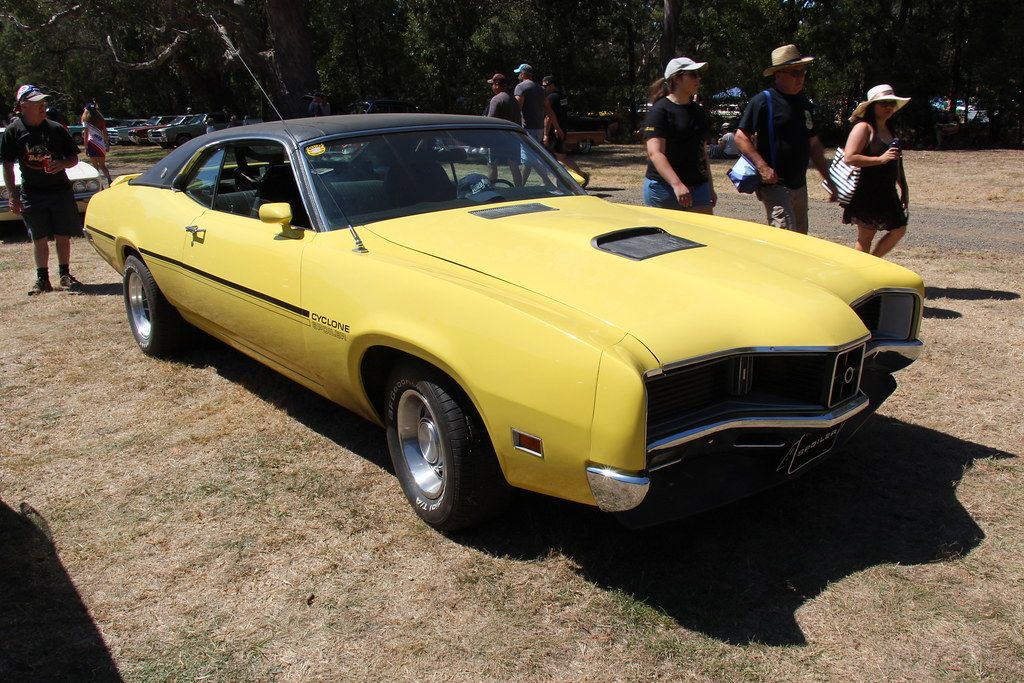
5. Mercury Cyclone Spoiler (1969-1971)
The Mercury Cyclone Spoiler was undeniably a significant force on the track, demonstrating remarkable potential and considerable prowess in competitive racing environments during its brief tenure. As a high-performance-oriented variant of Mercury’s intermediate platform, it brilliantly showcased what could be achieved when Mercury engineers pushed the very boundaries of their street-legal offerings. With its distinctive aerodynamic enhancements, like its elongated nose cone, and its formidable, powerful engines, the Cyclone Spoiler was unequivocally built for speed and looked every bit the part of a serious high-performance machine.
However, despite its impressive on-track capabilities and menacing appearance, the Cyclone Spoiler struggled considerably to gain meaningful traction in the all-important showroom. Mercury, positioned as a mid-tier brand under the sprawling Ford umbrella, simply didn’t possess the same extensive marketing push, the deeply established performance image, or the vast dealer network that its primary rivals, including Ford itself, so readily enjoyed. This significant disadvantage meant the Cyclone Spoiler was often left languishing in the shadows, fighting an uphill battle for attention in a crowded and fiercely competitive market without the crucial benefit of a strong, universally recognized performance brand identity.
Although it possessed undeniable performance potential and was a genuine, legitimate performer, the Mercury Cyclone Spoiler never quite managed to capture the public’s imagination in a widespread way that would secure its lasting legacy in the automotive world. It was a victim of circumstance, unable to compete with the marketing might and brand loyalty commanded by its rivals. Its relatively muted public reception and distinct lack of widespread acclaim have unfortunately led to its current relative obscurity in muscle car history, making it a topic for only the most dedicated aficionados.
It remains a car known mostly by a select group of dedicated enthusiasts and automotive historians, a testament to what truly could have been under different circumstances. Ultimately, however, it is a vehicle that most modern car lovers don’t actively remember or particularly mourn the passing of, signifying its failure to achieve lasting cultural impact. Its story is a classic example of a good car lost in the shuffle of a highly competitive market dominated by larger, better-resourced players.
Car Model Information: 2024 Kia Telluride SX Prestige X-Pro
Name: Mercury Cyclone Spoiler II
Manufacturer: Mercury (division)
Aka: Ford Torino Talladega
Production: 1969
ModelYears: 1969
Class: Race car
BodyStyle: fastback
Layout: FR layout
Designer: FoMoCo
Categories: All articles needing additional references, All articles with unsourced statements, Articles needing additional references from July 2025, Articles with short description, Articles with unsourced statements from April 2025
Summary: The Mercury Cyclone Spoiler II is a muscle car that was produced by Mercury in early 1969. The Mercury Cyclone Spoiler II was a special, more aerodynamic version of the Mercury Cyclone. It was produced specifically to compete against the Dodge Charger Daytona and Plymouth Superbird produced by Chrysler, and the nearly identical Ford Torino Talladega, in NASCAR stock car racing, and was sold to the public only because homologation rules required a minimum number of cars (500 in 1969) be produced and made available for sale to the public. A total of 503 cars were built in both Yarborough (285) and Gurney (215) versions, a during the first few weeks of 1969.
Get more information about: Mercury Cyclone Spoiler II
Buying a high-performing used car >>>
Brand: Mercury Model: Cyclone Spoiler
Price: $41,500 Mileage: 25,564 mi.

6. Oldsmobile 442 (1964-1972)
The Oldsmobile 442 was, by almost all accounts, a remarkably well-engineered and genuinely capable muscle car, offering a compelling blend of robust performance and a touch of sophistication within the extensive General Motors lineup. Its intriguing name, originally referring to a specific combination of a four-barrel carburetor, a four-speed manual transmission, and dual exhausts, eloquently evolved to represent a comprehensive performance package that consistently delivered genuine thrills and impressive road presence. Oldsmobile engineers invested considerable effort and technical prowess into making the 442 a potent and credible competitor, meticulously equipping it with powerful, high-output engines and incredibly robust chassis components designed for demanding driving.
Yet, despite its inherent quality, advanced engineering, and undeniable performance credentials, the Oldsmobile 442 never quite achieved the same universal level of fame or the iconic status that its more overtly celebrated GM counterparts, such as the legendary Pontiac GTO or the pervasive Chevrolet Chevelle SS, so effortlessly garnered. A significant part of this struggle stemmed directly from Oldsmobile’s well-established and somewhat conservative brand image. Often perceived as a more mature, dignified, or even luxury-oriented marque, Oldsmobile’s association with the raw, rebellious, and youth-driven spirit of the muscle car era was, at best, tenuous and, at worst, contradictory. This made it considerably harder for the 442 to truly stand out in a crowded market that celebrated overt aggression and youthful exuberance.
While the 442 offered a refined muscle car experience, this very refinement could be seen as a drawback by purists. It lacked the raw, unadulterated edge that many muscle car buyers craved, those who sought a vehicle that was loud, proud, and unapologetically aggressive. The 442, with its slightly more upscale leanings, didn’t always scream ‘street brawler’ in the same way a GTO or Chevelle did, causing it to appeal to a slightly different, and perhaps smaller, segment of the market. This nuance contributed to its comparatively lower public profile.
Over time, the 442 became distinctly less celebrated, especially when directly compared to its flashier, more heavily marketed, and overtly aggressive GM siblings. Its understated elegance and sophisticated approach, while appealing to a discerning few, simply didn’t resonate with the broader, more boisterous muscle car audience who clamored for bolder visual statements and unequivocally aggressive aesthetics. The 442 was a strong contender, but it didn’t quite fit the prevailing narrative.
Today, the Oldsmobile 442 is often regretfully overlooked by many enthusiasts. It remains a demonstrably competent performer, a testament to solid engineering, yet it has been largely relegated to the background while other GM muscle cars continue to dominate the discourse and command higher prices and greater recognition. This serves as a poignant reminder that even a truly great and capable car can be largely forgotten if it doesn’t align perfectly with the popular mold or fails to generate sufficient brand excitement within its competitive landscape.

7. Plymouth Road Runner Superbird (1970)
The Plymouth Road Runner Superbird, with its absolutely unmistakable towering rear wing and incredibly distinctive aerodynamic nose cone, was an absolute spectacle designed for one singular, overriding purpose: NASCAR domination. This wasn’t merely a high-performance vehicle; it was, in its purest form, a homologation special, a street-legal version painstakingly created purely to allow Plymouth to legally compete on the high-speed oval tracks of professional racing. Its utterly extreme and radical design, born directly from the urgent and critical need for aerodynamic advantage in blistering high-speed competition, made it one of the most visually dramatic and audacious cars of its entire era.
However, this very extremism in design was, paradoxically, a double-edged sword when it came to achieving widespread mainstream appeal among regular car buyers. Produced in incredibly limited numbers to meticulously meet NASCAR’s strict homologation rules, the Superbird was fundamentally more of a niche novelty item than a practical, everyday muscle car that could blend into suburban life. Its radical styling, while undeniably effective on the demanding race track and a marvel of engineering, did not universally resonate with the general public who were looking for something a bit more conventional. Many found its enormous, almost comical wing and elongated, almost cartoonish nose to be far too outlandish and impractical for regular street use, bordering on the theatrical rather than the truly functional or aesthetically pleasing for daily driving.
The Superbird’s specialized nature and its clear focus on racing performance meant it was never truly intended for broad consumer appeal. It was a specific tool for a specific job, and that job was winning races, not cruising boulevards. This highly focused design, coupled with its limited availability, created a situation where the car remained largely a curiosity for most consumers, rather than a desirable purchase. Its performance was undeniably stellar, but its character was too singular for the masses.
Consequently, while the Plymouth Superbird is now a highly coveted and immensely valuable niche collector’s item, especially within the Mopar community, at the precise time of its original release, its extreme design and specialized nature severely limited its broad market appeal. It was, quite literally, a car built for racing, not for regular commutes or family road trips. As a direct result, the Superbird quickly disappeared from the market after its single year of production, leaving behind a unique, albeit polarizing, legacy.
Ultimately, while appreciated by a select few and revered in collector circles today, it rapidly faded from the collective automotive consciousness as a mainstream muscle car icon. Its story is a vivid testament to a racing dream that was perhaps too wild, too unconventional, and too specialized for the average consumer, making it a car that few beyond the dedicated Mopar faithful actively remember or truly miss for its original market presence.
Car Model Information: 2022 Volkswagen Tiguan 2.0T SE
Name: Plymouth Superbird
Manufacturer: Plymouth (automobile)
Wheelbase: 115.8 in
Abbr: on
Length: Convert
Width: 76.4 in
Height: 61.4 in
Weight: Convert
Production: 1970
Assembly: Detroit
Class: muscle car,race car
BodyStyle: coupe
Platform: Chrysler B platform
Layout: FR layout
Engine: cvt,Chrysler Hemi engine,V8 engine,cvt,Chrysler RB engine#440,V8 engine
Related: Plymouth Road Runner,Dodge Charger Daytona
Transmission: Automatic transmission,TorqueFlite
Designer: Gary Romberg
Categories: 1970s cars, All articles with unsourced statements, Articles with short description, Articles with unsourced statements from March 2010, Commons category link is on Wikidata
Summary: The Plymouth Superbird is a highly modified, short-lived version of the Plymouth Road Runner with applied graphic images as well as a distinctive horn sound, both referencing the popular Looney Tunes cartoon character Road Runner. It was the factory’s follow-up stock car racing design, for the 1970 season, to the Dodge Charger Daytona of 1969, and incorporated many engineering changes and modifications (both minor and major) garnered from the Daytona’s season in competition.
The car’s primary rivals were the Ford Torino Talladega and Mercury Cyclone, a direct response to the Mopar aero car. It has also been speculated that a motivating factor in the production of the car was to lure Richard Petty back to Plymouth. Both of the Mopar aero cars famously featured a protruding, aerodynamic nosecone, a high-mounted rear wing and, unique to the Superbird, a horn mimicking the Road Runner’s signature “beep, beep.”
Superbirds equipped with the top-of-the-line 426 cu in (7.0 L) Hemi engine with a pair of four barrel Carter AFB carburetors (2x4bbl) producing 425 hp (317 kW) could accelerate from 0 to 60 mph (97 km/h) in 5.5 seconds.
Get more information about: Plymouth Superbird
Buying a high-performing used car >>>
Brand: Plymouth Model: Road Runner Superbird
Price: $19,595 Mileage: 63,937 mi.
Read more about: Unleashing American Thunder: The 13 Most Iconic Muscle Cars Ever Built for Speed Enthusiasts

8. Pontiac GTO Judge (1969-1971)
The Pontiac GTO Judge roared onto the scene as Pontiac’s bold statement, an attempt to inject youthful exuberance into the already iconic GTO lineup. With its vibrant Carousel Red paint, eye-catching ‘The Judge’ decals, and an imposing rear spoiler, it was designed to be impossible to ignore. This was Pontiac trying to out-muscle and out-flash its competition, aiming squarely at the hearts of performance-hungry enthusiasts who craved not just speed, but a distinct persona.
However, beneath the audacious styling and aggressive marketing, a critical flaw began to emerge: the Judge’s performance was on a noticeable decline as the early 1970s progressed. While initial models packed a formidable punch, tightening emission regulations choked the raw power that defined the muscle car genre. Horsepower figures diminished, taking a significant chunk of the Judge’s intrinsic appeal with them, making the over-the-top styling feel almost like an overcompensation for fading prowess under the hood.
This wasn’t just a minor setback; for a car marketed so heavily on its raw aggression and street dominance, a dip in performance was a critical blow to its credibility. The visually striking package, sadly, couldn’t quite deliver the same unbridled punch as its earlier, less regulated ancestors. It was a powerful exclamation point at the end of a golden age, but one whose thunder was progressively muted.
As the glorious muscle car era began its inevitable wane, accelerated by rising insurance costs, fuel crises, and stringent environmental mandates, the Pontiac GTO Judge struggled to maintain relevance. Its bold aesthetics, once a beacon of rebellious spirit, now seemed a little out of step with the changing automotive landscape. While original GTOs are celebrated legends, “The Judge” variant is often less remembered by the broader enthusiast community, serving as a compelling example of a car caught in the changing currents of the automotive world.
Car Model Information: 2024 Kia Telluride SX Prestige X-Pro
Name: Pontiac GTO
Caption: 2005 Pontiac GTO
Manufacturer: Pontiac (automobile),Holden
Class: Mid-size car,Compact car,Mid-size car
Production: 1963–1974,2003–2006
Predecessor: Pontiac Tempest
Layout: Front-engine, rear-wheel-drive layout
ModelYears: 1964-1974 2004-2006
Categories: 1970s cars, 2000s cars, All articles with unsourced statements, Articles with short description, Articles with unsourced statements from October 2008
Summary: The Pontiac GTO is a front-engine, rear-drive, two-door, and four-passenger automobile manufactured and marketed by the Pontiac division of General Motors over four generations from 1963 until 1974 in the United States — with a fifth generation made by GM’s Australian subsidiary, Holden, for the 2004 through 2006 model years.
The first generation of the GTO is credited with popularizing the muscle car market segment in the 1960s. Some consider the Pontiac GTO to have started the trend with all four domestic automakers offering a variety of competing models.
For the 1964 and 1965 model years, the GTO was an optional package on the intermediate-sized Pontiac LeMans. The 1964 GTO vehicle identification number (VIN) started with 22, while the 1965 GTO VIN began with 237. The GTO was designated as a separate Pontiac model from 1966 through 1971 (VIN 242…). It became an optional package again for the 1972 and 1973 intermediate LeMans. For 1974, the GTO was an optional trim package on the compact-sized Ventura.
The GTO model was revived for the 2004 through 2006 model years as a captive import for Pontiac, a left-hand drive version of the Holden Monaro, itself a coupé variant of the Holden Commodore.
Get more information about: Pontiac GTO
Buying a high-performing used car >>>
Brand: Pontiac Model: GTO Judge
Price: $41,500 Mileage: 25,564 mi.

9. Chrysler 300 Hurst (1970)
The Chrysler 300 Hurst was a truly distinctive collaboration between Chrysler and legendary shifter manufacturer Hurst Performance, an interesting paradox: a muscle car that boldly embraced luxury. This wasn’t your typical stripped-down, lightweight brawler; instead, it was a full-sized, opulent cruiser that still managed to pack a serious performance punch. Its eye-catching gold and white paint scheme, a signature Hurst touch, immediately set it apart, signaling a blend of sophisticated comfort and underlying brute force.
Underneath its imposing hood resided the massive 440 cubic-inch TNT V8 engine, factory-rated at a robust 375 horsepower, giving the 300 Hurst the kind of straight-line acceleration that could surprise many a lighter competitor. It aimed to offer the best of both worlds: the plush interiors and smooth ride expected of a high-end Chrysler, fused with the undeniable power characteristic of the muscle car ethos. You could cruise in style, but certainly light up the tires when provoked.
However, it was precisely this blend of power and luxury, particularly its sheer physical size and unwavering focus on comfort, that alienated a significant portion of the core muscle car enthusiast base. Purists believed muscle cars should be lean, mean, and built for speed above all else. The 300 Hurst, with its substantial dimensions and sophisticated demeanor, seemed somewhat out of step with this aggressive, no-frills philosophy, appearing more like a gentleman’s express in an era of street fighters.
While undeniably powerful and visually striking, the 300 Hurst’s concept didn’t quite align with the raw, rebellious image that dominated the market. Its hefty price tag and larger-than-life presence further limited its appeal. Today, the Chrysler 300 Hurst has largely become a forgotten relic, often overshadowed by Chrysler’s more iconic and performance-focused models. It’s a compelling reminder that even a powerful, impressive car can fade if its identity clashes with prevailing market expectations, a powerful car that few actively miss.
Car Model Information: 2024 Kia Telluride SX Prestige X-Pro
Name: Chrysler 300 letter series
Caption: 1964 Chrysler 300-K Coupe
Class: Personal luxury car,Muscle car,Grand tourer
Manufacturer: Chrysler Corporation
Production: 1955–1965,1970
Assembly: Detroit,Michigan
Layout: Front-engine, rear-wheel-drive layout
Predecessor: Chrysler Saratoga
Successor: Chrysler 300 non-letter series
Categories: 1950s cars, 1960s cars, All Wikipedia articles written in American English, All articles containing potentially dated statements, All articles with unsourced statements
Summary: The Chrysler 300 “letter series” are high-performance personal luxury cars that were built by Chrysler in the U.S. from 1955 to 1965 and were a sub-model from the Chrysler New Yorker. After the initial year, which was named C-300 for its standard 300 hp (220 kW) 331 cu in (5.4 L) FirePower V8, the 1956 cars were designated 300B. Successive model years were given the next letter of the alphabet as a suffix (skipping “i”), reaching the 300L by 1965, after which the model sequence was discontinued while the “300” remained. At its introduction it was advertised as “America’s Most Powerful Car”.
The 300 “letter series” cars were among the vehicles built by Chrysler after World War II that focused on performance, and thus can be considered the beginning of the muscle car, though full-sized and more expensive. Chrysler had a long history of producing race car products going back to the Chrysler Six that was entered in the 1925 24 Hours of Le Mans, 1928 24 Hours of Le Mans, 1929 24 Hours of Le Mans, and the Chrysler Imperial Eight roadster in the 1931 24 Hours of Le Mans. The 1955 C-300 and the 1956 300B were raced with very little modification at NASCAR races to include Watkins Glen International where it won races multiple times.
The automaker reintroduced the 300 designations again for performance-luxury sedans in 1999, using the 300M nameplate from 1999 to 2004, and expanding the 300 series with a reintroduction of a new Hemi-engineered V8 installed in the 300C, the top model of a new Chrysler 300 line, a new rear-wheel drive car launched in 2004 for the 2005 model year.
Get more information about: Chrysler 300 letter series
Buying a high-performing used car >>>
Brand: Chrysler Model: 300 Hurst
Price: $41,500 Mileage: 25,564 mi.
Read more about: Unleash the Beasts: 14 Legendary American Cars That Roared Through the 1960s, Forging an Unforgettable Automotive Decade
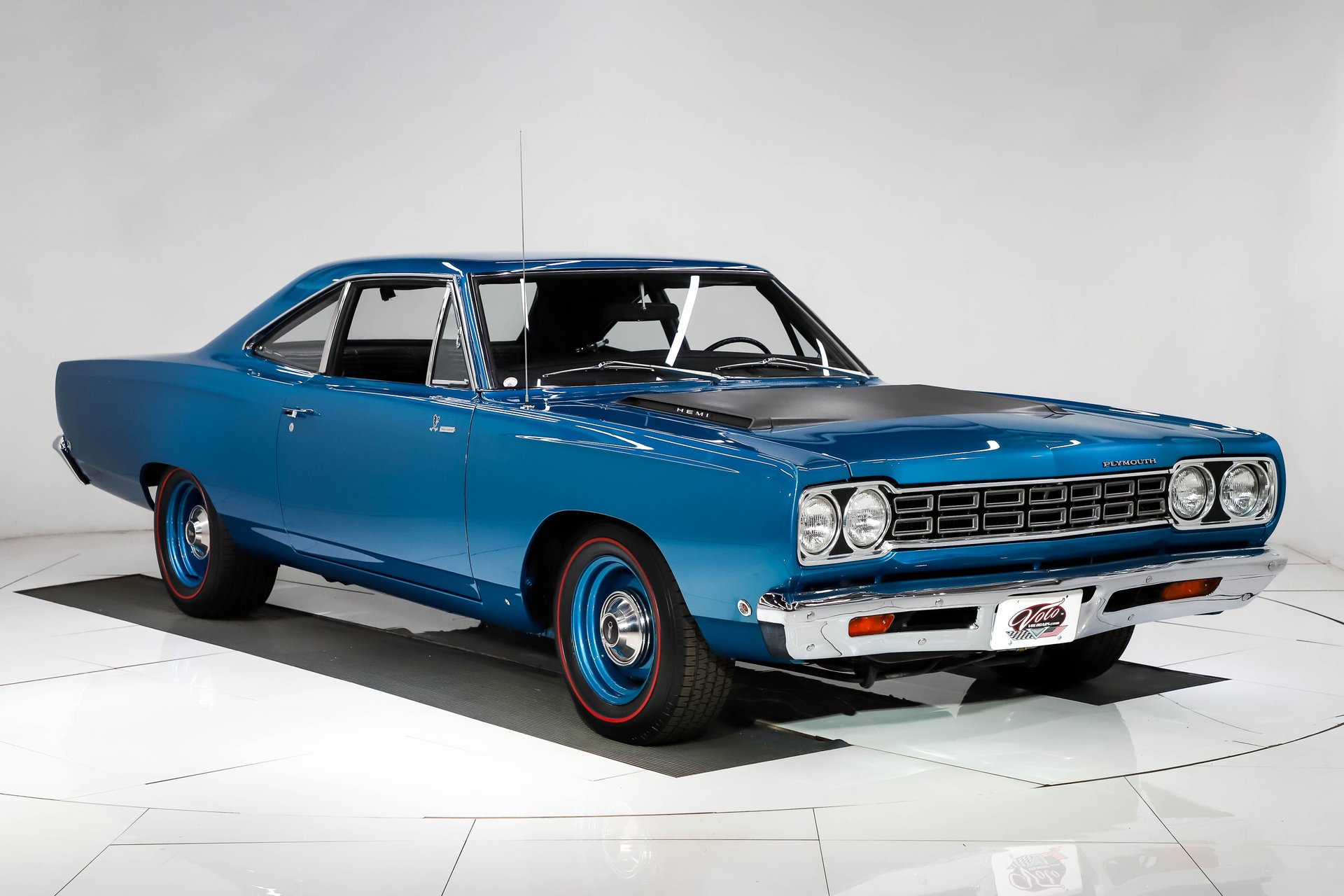
10. Plymouth GTX (1967-1971)
The Plymouth GTX carved out a unique identity for itself as the “gentleman’s muscle car,” a proposition that sought to marry brute force with a touch of sophistication. Positioned above the more raw and raucous Road Runner in Plymouth’s lineup, the GTX offered a compelling blend of high-performance capabilities and upscale appointments. It was designed for buyers who wanted blistering speed and impressive power, but also appreciated a more refined driving experience and a higher level of interior comfort and exterior finish.
Under its hood, the GTX typically housed formidable engines like the potent 440 cubic-inch Super Commando V8 or, for the truly audacious, the legendary 426 Hemi. These powerplants ensured the “gentleman” could still dominate the drag strip or conquer the open road with unquestionable authority. The GTX was undeniably quick, boasting performance figures that rivaled the best of its era, all while offering a quieter cabin and a more composed ride than some of its bare-bones counterparts.
However, this unique combination of power and luxury, while appealing on paper, came with a significantly higher price point. This proved to be a critical hurdle for its widespread adoption, as the typical muscle car buyer was primarily driven by raw horsepower-per-dollar value, prioritizing aggressive performance and bold styling over creature comforts. For them, refinement was often seen as an unnecessary embellishment, a dollar not spent on more speed or a cooler look.
As the market became increasingly saturated with more affordable, yet equally potent and overtly aggressive models like its stablemate, the Road Runner, the GTX slowly but steadily began to fall out of favor. It struggled to justify its premium cost to an audience that largely viewed refinement as a concession rather than a desirable feature. Today, the Plymouth GTX is often overshadowed, fading into the background of muscle car conversations, a powerful yet largely forgotten testament to Plymouth’s attempt at a more refined muscle car experience.
Car Model Information: 1967 Plymouth GTX Hemi
Name: Plymouth GTX
Manufacturer: Plymouth (automobile)
Production: 1967–1971,44,178 units
Class: Muscle car
Assembly: Detroit,Michigan
Layout: FR layout
Platform: Chrysler B platform
Caption: 1970 Plymouth GTX
Categories: 1970s cars, All articles needing additional references, Articles needing additional references from February 2010, Articles with short description, Cars discontinued in 1971
Summary: The Plymouth GTX is an automobile manufactured by Chrysler and marketed under its Plymouth division from 1967 to 1971. Introduced as the Belvedere GTX, it was positioned as a mid-sized upscale-trimmed performance muscle car through the 1971 model year.
Get more information about: Plymouth GTX
Buying a high-performing used car >>>
Brand: Plymouth Model: GTX
Price: $113,000 Mileage: 66,594 mi.

11. Ford Ranchero GT (1968-1969)
The Ford Ranchero GT represented a fascinating, albeit ultimately niche, attempt by Ford to merge two seemingly disparate automotive concepts: the practicality of a pickup truck with the exhilarating performance of a muscle car. This hybrid concept, part car and part utility vehicle, offered a unique proposition to buyers desiring both cargo-hauling capability and tire-shredding power. In its GT guise, the Ranchero showcased sporty styling cues, including bold stripes, special wheels, and performance badging, attempting to signal its dual-purpose nature.
During its prime in the late 1960s, the Ranchero GT could be equipped with formidable engines, including the impressive 428 Cobra Jet V8, which transformed this “gentleman’s pickup” into a genuine street machine. This meant that while you could haul your gear, you could also leave most other cars in your dust off the line. It was an intriguing blend, offering a level of versatility not found in traditional muscle car coupes or sedans, and certainly not in the more utilitarian pickups of the era.
However, it was precisely this “hybrid” concept that ultimately prevented the Ranchero GT from resonating with a wider audience. Traditional muscle car buyers typically wanted pure, unadulterated performance without the perceived compromises of a utility bed. Conversely, pickup truck buyers often prioritized ruggedness and maximum hauling capacity, for which the Ranchero, with its car-based chassis, was not ideally suited. It existed in an automotive no-man’s-land, unable to fully satisfy either demographic.
Consequently, the Ford Ranchero GT has largely been relegated to a footnote in the expansive history of muscle cars. It remains a curious piece of Ford’s past, admired by collectors of unique vehicles, but easily overshadowed by the more traditional and unequivocally performance-oriented muscle cars that came to define the era. It’s a compelling example of an innovative concept that, despite its inherent merits, simply failed to capture the broader public’s imagination, becoming a car few actively miss today.
Car Model Information: 2024 Kia Telluride SX Prestige X-Pro
Name: Ford Ranchero
Aka: Ford Falcon Ranchero , Ford Fairlane Ranchero , Meteor Ranchero
Caption: 1957 Ford Ranchero
Manufacturer: Ford Motor Company
Class: Full-size Ford
Production: 1957–1979
BodyStyle: coupe utility
Related: Ford Fairlane (North American),Ford Falcon (North American),Ford Galaxie,Ford Torino,Ford LTD II,Ford Durango
Layout: FR layout
Categories: All articles with unsourced statements, Articles with short description, Articles with unsourced statements from October 2025, CS1 Spanish-language sources (es), Commons category link from Wikidata
Summary: The Ford Ranchero is a coupe utility that was produced by Ford between 1957 and 1979. Unlike a standard pickup truck, the Ranchero was adapted from a two-door station wagon platform that integrated the cab and cargo bed into the body. A total of 508,355 units were produced during the model’s production run. Over its lifespan it was variously derived from full-sized, compact, and intermediate automobiles sold by Ford for the North American market.
During the 1970s, the Ranchero name was used in the South African market for a rebadged Australian Ford Falcon utility. Shipped from Australia in complete knock down (CKD) form, these vehicles were assembled in South Africa at Ford’s plant in Port Elizabeth. In Argentina, a utility version of the locally produced Ford Falcon was also called Ranchero.
The original Ranchero sold well enough to spawn a competitor from General Motors in 1959, the Chevrolet El Camino.
Get more information about: Ford Ranchero
Buying a high-performing used car >>>
Brand: Ford Model: Ranchero GT
Price: $41,500 Mileage: 25,564 mi.
12. Dodge Coronet R/T (1967-1970)
The Dodge Coronet R/T was undeniably a solid performer, a legitimate big-block bruiser designed to hold its own in the fiercely competitive muscle car wars of the late 1960s. Equipped with powerful engine options like the 440 Magnum or the legendary 426 Hemi, the Coronet R/T delivered raw, unadulterated power that translated into impressive straight-line acceleration and a commanding road presence. It was a serious piece of machinery, a testament to Dodge’s commitment to high-performance vehicles, and absolutely capable of delivering exhilarating thrills.
However, despite its formidable capabilities, the Coronet R/T found itself in an unfortunate predicament: it consistently played second fiddle to its flashier, more iconic Dodge stablemates, namely the immensely popular Charger and the equally revered Super Bee. These two models, with their more aggressive styling and powerful marketing campaigns, simply captured the public’s imagination and attention more effectively, leaving the Coronet R/T in their considerable shadows.
A significant contributing factor to its fading popularity was its comparatively conservative styling. While not unattractive, the Coronet R/T lacked the overtly aggressive, flamboyant lines and dramatic visual impact that defined its more famous brethren. Its appearance was more understated, less visually “exciting” to buyers who were looking for a car that made an unequivocal statement of raw power and rebellious spirit. In a market where aesthetics were almost as crucial as horsepower, the Coronet R/T’s subdued looks were a distinct disadvantage.
As the dynamic muscle car era surged forward, the Coronet R/T, with its quieter demeanor, quietly slipped into obscurity. It struggled to stand out in a crowded field of increasingly audacious designs and ever-escalating horsepower figures. Today, the Dodge Coronet R/T remains one of the less celebrated and often forgotten models of its time, appreciated by Mopar enthusiasts for its big-block performance but lacking the iconic status of the Charger or Super Bee.
Car Model Information: 2024 Kia Telluride SX Prestige X-Pro
Name: Dodge Coronet
Caption: 1967 Dodge Coronet R/T
Manufacturer: Dodge
Production: 1949–1959,1965–1976
Class: Full-size
Predecessor: Dodge Custom
Successor: Dodge Dart
Layout: FR layout
Categories: 1950s cars, 1970s cars, All articles with dead external links, All articles with unsourced statements, Articles with dead external links from June 2016
Summary: The Dodge Coronet is an automobile that was marketed by Dodge in seven generations, and shared nameplates with the same bodyshell with varying levels of equipment installed. Introduced as a full-size car in 1949, it was the division’s highest trim line and moved to the lowest level starting in 1955 through 1959. The name was reintroduced on intermediate-sized models from the 1965 until 1976 model years. Muscle car versions were available starting in 1965 with the 383 and 426 wedge cu in (7.0 L) Chrysler RB engine, followed in 1966 by the powerful 426 cu in (7.0 L) Chrysler Hemi. Other performance models included the “Superbee”, and featured, the 383 cu in (6.3 L) Magnum, among other engine options. The nameplate “coronet” is a type of crown worn by royalty.
In the 1980s, the Coronet was used on Dodge models marketed in Colombia.
Get more information about: Dodge Coronet
Buying a high-performing used car >>>
Brand: Dodge Model: Coronet R/T
Price: $41,500 Mileage: 25,564 mi.
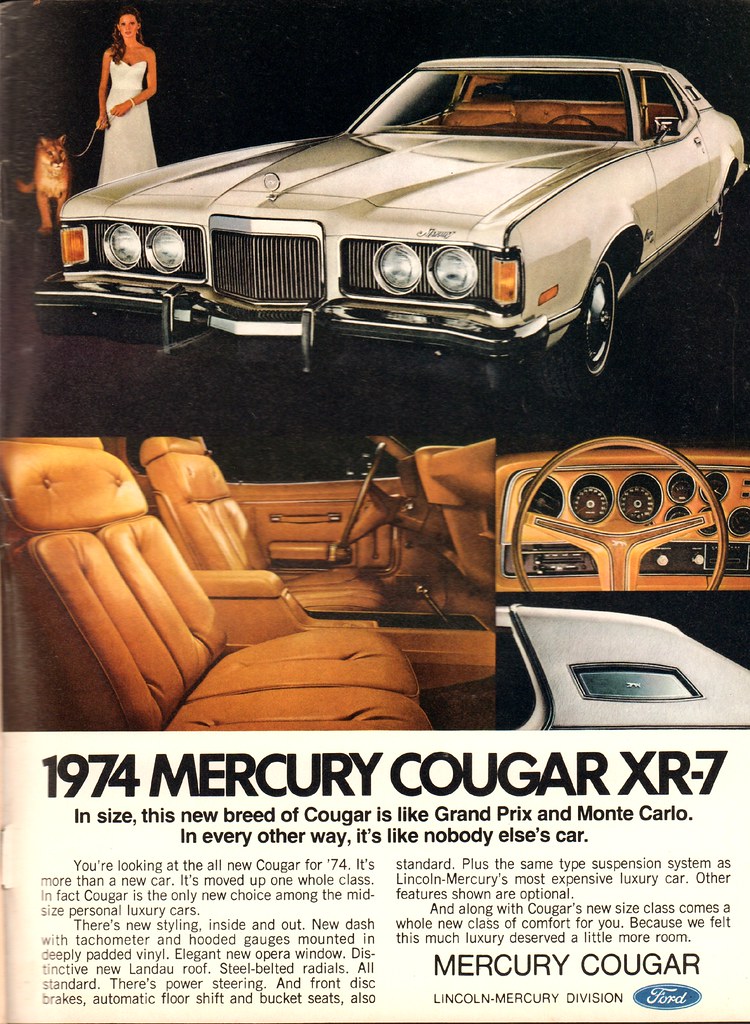
13. Mercury Cougar XR-7 (1967-1970)
The Mercury Cougar XR-7 presented a fascinating divergence from the traditional muscle car formula, offering a more refined and luxurious interpretation of the genre. Positioned as Mercury’s upscale pony car, it aimed to blend the raw power and sporty appeal of a muscle car with the sophisticated comfort and stylistic elegance typically associated with personal luxury coupes. This meant a distinct emphasis on a well-appointed interior, often featuring leather upholstery, woodgrain accents, and a comprehensive array of gauges, setting it apart from its more spartan performance-oriented peers.
Under the hood, the Cougar XR-7 could be optioned with powerful V8 engines, including the 390 cubic-inch unit and later the formidable 428 Cobra Jet. These engines ensured that despite its luxurious leanings, the XR-7 could still deliver impressive acceleration and a genuinely exhilarating driving experience. It was capable of holding its own against many a muscle car on the street, proving that refinement didn’t necessarily mean sacrificing performance. It offered a compelling blend for those who wanted to go fast, but do so in comfort and style.
However, this very emphasis on comfort, luxury, and distinctive style over raw, unadulterated performance proved to be its Achilles’ heel in the eyes of the traditional muscle car audience. Purists and hardcore enthusiasts largely prioritized aggressive aesthetics, a visceral driving experience, and the highest possible horsepower-to-dollar ratio. For them, the Cougar XR-7’s sophisticated demeanor and slightly softer ride were perceived as concessions, rather than enhancements, diminishing its appeal as a true street brawler.
As the muscle car landscape evolved, favoring increasingly aggressive and overtly powerful models, the Mercury Cougar XR-7 found itself overshadowed by its more focused Ford stablemate, the iconic Mustang. While the Cougar carved out a niche, it struggled to capture the widespread, passionate following that defined the Mustang’s legacy. It stands as a testament to Mercury’s vision of a more refined muscle car, a car that, despite its merits, ultimately slipped through the cracks of popular memory.
Car Model Information: 2024 Kia Telluride SX Prestige X-Pro
Name: Mercury Cougar
Caption: 1969 Mercury Cougar (first generation)
Manufacturer: Mercury (automobile)
Layout: Front-engine, rear-wheel-drive layout
ModelYears: 1967–1997,1999–2002
Class: Pony car,Personal luxury car,Mid-size car,Sport compact
Categories: 1960s cars, 1970s cars, 1980s cars, 1990s cars, 2000s cars
Summary: The Mercury Cougar is a series of automobiles that was sold by Mercury from 1967 to 2002. The model line is a diverse series of vehicles; though the Cougar nameplate is most commonly associated with two-door coupes, at various stages in its production, the model also was offered as a convertible and a hatchback. During its production as the mid-size Mercury line, the Cougar was also offered as a four-door sedan and five-door station wagon.
In production for 34 years across eight generations (skipping the 1998 model year), the Cougar is second only to the Grand Marquis (36 years) in the Mercury line for production longevity. 2,972,784 examples were produced, making it the highest-selling Mercury vehicle. During the 1970s and 1980s, the marketing of the Mercury division was closely associated with the Cougar, with promotional materials advertising Mercury dealers as “The Sign of the Cat” with big cats atop Lincoln-Mercury dealer signs. Cat-related nameplates were adopted by other Mercury lines, including the Bobcat and Lynx.
During its production, the Cougar was assembled at the Dearborn Assembly Plant (part of the Ford River Rouge Complex) in Dearborn, Michigan from 1967 until 1973, San Jose Assembly (Milpitas, California) from 1968 into early 1969, Lorain Assembly (Lorain, Ohio) from 1974 until 1997, and at Flat Rock Assembly (Flat Rock, Michigan) from 1999 through 2002.
Get more information about: Mercury Cougar
Buying a high-performing used car >>>
Brand: Mercury Model: Cougar XR-7
Price: $41,500 Mileage: 25,564 mi.

14. Pontiac Firebird Esprit (1970-1981)
The Pontiac Firebird Esprit, launched in 1970, represented a markedly different philosophy within the celebrated Firebird lineup, intentionally diverging from the raw, performance-first mandate of its siblings, the Trans Am and Formula models. Where those variants were engineered for blistering speed and aggressive handling, the Esprit was consciously designed with luxury, comfort, and sophisticated style at its core. It aimed to appeal to a driver who appreciated the Firebird’s iconic pony car shape but desired a more relaxed, upscale, and daily-drivable experience.
This shift in focus manifested in several key areas. The Esprit typically featured softer suspension settings, providing a more compliant and comfortable ride quality compared to the firm, track-oriented setups of the Trans Am. Its styling, while still retaining the Firebird’s unmistakable lines, was less adorned with aggressive spoilers, scoops, and graphics, opting instead for a cleaner, more understated aesthetic. The interior often boasted plush upholstery, more sound deadening, and a greater emphasis on creature comforts.
However, it was precisely this deliberate emphasis on luxury and refinement over raw performance that rendered the Esprit less appealing to the traditional muscle car enthusiast. The core audience for a Firebird typically sought out the visceral thrills, the ear-splitting exhaust notes, and the neck-snapping acceleration offered by the Trans Am or Formula. The Esprit, with its milder engines, softer ride, and less aggressive visual package, simply didn’t deliver the kind of adrenaline-fueled experience that defined the muscle car genre.
As a result, the Firebird Esprit was largely overlooked and underappreciated, perpetually living in the shadow of its more powerful and iconic siblings. It struggled to gain traction with a market segment that expected performance first and foremost from a car bearing the Firebird name. Today, it remains a relatively uncelebrated and often forgotten variant of the revered Firebird lineup, a compelling reminder that even within a successful model range, a variant deviating too far from the core expectation can fade from collective memory.
Car Model Information: 2022 Volkswagen Tiguan 2.0T SE
Name: Pontiac Firebird
Caption: The second, third, and fourth generations of,the Pontiac Firebird Trans Am
Manufacturer: Pontiac (automobile)
Production: February 23, 1967 – August 30, 2002
ModelYears: 1967 – 2002
Class: Pony car,Muscle car
Platform: GM F platform
Related: Chevrolet Camaro
Layout: Front engine, rear-wheel-drive layout
Categories: 1970s cars, 1980s cars, 1990s cars, 2000s cars, All articles with dead external links
Summary: The Pontiac Firebird is an American automobile built and produced by Pontiac from the 1967 to 2002 model years. Designed as a pony car to compete with the Ford Mustang, it was introduced on February 23, 1967, five months after GM’s Chevrolet division’s platform-sharing Camaro. This also coincided with the release of the 1967 Mercury Cougar, Ford’s upscale, platform-sharing version of the Mustang.
The name “Firebird” was also previously used by GM for the General Motors Firebird series of concept cars in the 1950s.
Get more information about: Pontiac Firebird
Buying a high-performing used car >>>
Brand: Pontiac Model: Firebird Esprit
Price: $19,595 Mileage: 63,937 mi.
Read more about: Beyond the Auction Block: Unearthing 14 Surprisingly Affordable Classic Cars for Enthusiasts Today
And there you have it – a deeper look into the automotive graveyard where some truly intriguing, if ultimately forgotten, muscle cars reside. Each with its own unique story of ambition and compromise, these machines serve as powerful reminders that not every roaring V8 earns a permanent spot in the pantheon of legends. While iconic names dominate our memory, it’s in the tales of these unsung heroes that we find a richer understanding of this exhilarating era. Spare a thought for these overlooked beasts; their stories are undeniably worth telling.