Andy Samuel Griffith, an American icon, crafted a career that spanned an incredible seven decades, leaving an indelible mark across music, television, and film. Born in Mount Airy, North Carolina, Griffith captivated audiences with his distinctive Southern drawl and a unique ability to portray characters with a folksy, friendly personality, often underpinned by a gruff yet warm voice that became his trademark. His versatile talents saw him succeed as an actor, comedian, television producer, singer, and writer.
From his humble beginnings to the beloved streets of Mayberry and the courtrooms of Atlanta, Griffith’s journey is a testament to his talent and genuine connection with the American public. His ability to blend humor with dramatic depth, crafting relatable and profoundly human characters, allowed him to transcend generations and mediums. This article will delve into the factual milestones and defining moments of a life lived in the spotlight, exploring the significant achievements and personal influences that shaped Andy Griffith’s extraordinary path.
Join us as we explore the early chapters of Andy Griffith’s life and career, tracing his evolution from a shy student finding his voice through laughter to a burgeoning star on the national stage. We will uncover the foundational experiences that honed his craft, from his musical education and comedic monologues to his pivotal dramatic roles, illuminating the dedication and talent that paved the way for his enduring legacy as an American entertainment legend.

1. **Early Life and Education**Andy Samuel Griffith was born on June 1, 1926, in Mount Airy, North Carolina, the only child of Carl Lee and Geneva Griffith. His early years were marked by modest circumstances; as an infant, he lived with relatives and, lacking a crib, slept in dresser drawers for months until his parents could afford a home in Mount Airy’s “blue-collar” south side. Growing up, Griffith was acutely aware of being from what many considered the “wrong side of the tracks,” initially a shy student who found his voice and confidence by making his peers laugh.
His interest in the arts blossomed at Mount Airy High School, particularly his love for music, especially swing. A significant mentor was Ed Mickey, a minister at Grace Moravian Church, who taught Griffith to sing and play the trombone, nurturing his talent until his 1944 graduation. A notable early experience was performing in Paul Green’s “The Lost Colony,” a play still performed today, where he eventually landed the role of Sir Walter Raleigh after several years in various parts.
Griffith pursued higher education at the University of North Carolina (UNC) in Chapel Hill, initially studying to be a Moravian preacher before changing his major to music. He graduated with a Bachelor of Music degree in 1949. At UNC, he was actively involved with the Carolina Playmakers and served as president of the Phi Mu Alpha Sinfonia chapter, America’s oldest fraternity for men in music. He also performed in several student operettas, including “The Chimes of Normandy,” “The Gondoliers,” “The Mikado,” and “H.M.S. Pinafore.” Following graduation, he spent a few years teaching music and drama at Goldsboro High School, where he also began to write, further developing his creative skills.
Read more about: Mind Blown! 15 Unrecognizable Childhoods That Prove Growing Up Has Changed Everything
2. **Early Comedy Career**Andy Griffith’s initial foray into the entertainment world was as a monologist, adopting the persona of “Deacon Andy Griffith,” an affable country parson. In this character, he delivered long, humorous stories, most notably “What It Was, Was Football,” where he comically attempted to understand the intricacies of a football game, narrated in a distinctive rural dialect. This unique brand of humor quickly captured attention and set the stage for his national recognition.
The monologue was first released as a single in 1953 on Colonial Records, gaining sufficient popularity for the larger Capitol Records to acquire and reissue the master recording in December of that year. This reissue propelled “What It Was, Was Football” to national success, peaking at number nine on the charts in 1954, marking Griffith’s breakthrough in comedy. The B-side of the single featured the deacon offering his rural interpretation of Shakespeare’s “Romeo and Juliet.”
Capitalizing on this newfound popularity, Griffith made numerous appearances on television variety shows. During these appearances, he would entertain audiences with either his famous football monologue or his unique take on Shakespeare, further cementing his reputation as a versatile and engaging comedic performer. These early successes as a monologist were foundational to his career, demonstrating his innate ability to connect with a broad audience through humor and storytelling.
Read more about: Jennifer Lawrence’s Indie Renaissance: Unpacking the Buzz, Star Power, and Premiere Impact of ‘Die, My Love’
3. **Breakthrough on Broadway: *No Time for Sergeants***Andy Griffith’s talent for embodying authentic “country boy” characters found a powerful platform in Ira Levin’s “No Time for Sergeants.” His journey with this narrative began in March 1955, when he starred in a one-hour teleplay on “The United States Steel Hour.” This early television role showcased his portrayal of a country boy navigating the complexities of the United States Air Force, a performance that resonated strongly with viewers.
The teleplay’s success led to a significant Broadway adaptation, where Griffith reprised and expanded his role in October 1955. His performance on the New York stage was a critical triumph, earning him a Tony Award nomination in 1956 for “Distinguished Supporting or Featured Dramatic Actor.” Though he did not win the Tony, he was honored with the 1956 Theatre World Award, a prestigious recognition for debut roles on Broadway, solidifying his status as a formidable stage presence.
Critics were quick to praise his authentic portrayal. Brooks Atkinson of The New York Times lauded his natural charm, stating, “Mr. Griffith does not have to condescend to Will Stockdale,” his character in the play. Atkinson further noted, “All he has to do is walk on the stage and look the audience straight in the face. If the armed forces cannot cope with Will Stockdale, neither can the audience resist Andy Griffith.” This endorsement underscored the genuine and irresistible appeal that Griffith brought to his performances, a quality that would define his career.
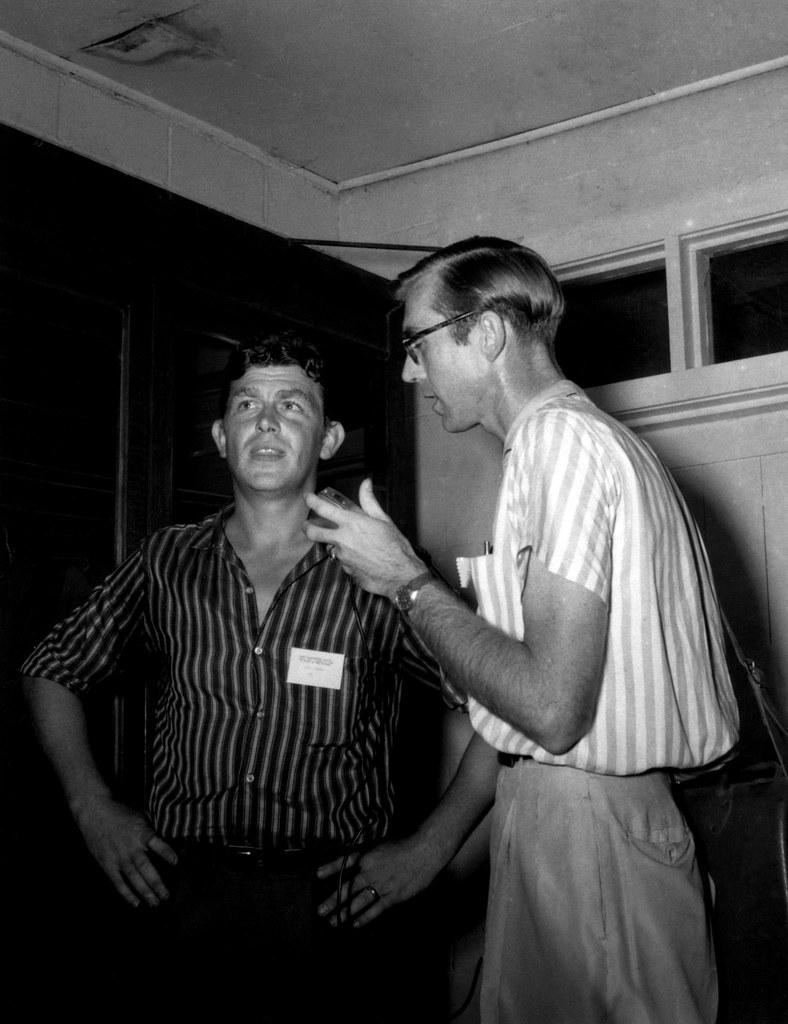
4. **Dramatic Film Debut: *A Face in the Crowd***In a remarkable shift from his comedic and folksy roles, Andy Griffith made a powerful dramatic film debut in 1957, starring in Elia Kazan’s “A Face in the Crowd.” This film presented audiences with a starkly different side of Griffith’s acting prowess, challenging pre-conceived notions and showcasing his profound versatility beyond lighthearted entertainment. It remains a crucial entry in his filmography, highlighting his depth as a performer.
In the film, Griffith portrayed a manipulative and power-hungry “country boy” named Lonesome Rhodes, a drifter who rises to become a popular television host. Rhodes then exploits his show as a conduit to gain significant political influence. This complex and demanding role required Griffith to delve into themes of ambition, corruption, and the darker aspects of celebrity, a stark contrast to the geniality that would later characterize his most famous television persona.
“A Face in the Crowd” was directed by the acclaimed Elia Kazan and written by Budd Schulberg, ensuring a production of considerable artistic merit. Griffith starred alongside a distinguished cast including Patricia Neal, Walter Matthau, Tony Franciosa, and Lee Remick, who made her own film debut in the movie. The film’s prescient themes regarding media power and political manipulation have ensured its enduring relevance, gaining, as Griffith himself noted in a 2005 DVD interview, even greater popularity in later decades than at its initial release.
Read more about: The Strategic Imperative: Unpacking the Forces Behind HBO’s Pivotal Channel Shifts and Programming Discontinuations
5. **The Genesis of *The Andy Griffith Show***Before he became a household name as Sheriff Andy Taylor, Andy Griffith had already garnered television experience, notably starring in the 1955 one-hour teleplay of “No Time for Sergeants” on “The United States Steel Hour.” This early exposure allowed him to build a connection with national audiences and demonstrated his capabilities on the small screen, laying essential groundwork for his future in television.
A pivotal moment for his career arrived in 1960, when Griffith appeared in an episode of the popular sitcom “Make Room for Daddy,” starring Danny Thomas. In this specific episode, Griffith portrayed a county sheriff who also served as a justice of the peace and the editor of the local newspaper. The plot featured Thomas’s character being stopped for a traffic violation in a charming small town, providing the perfect vehicle to introduce Griffith’s unique character.
This “Make Room for Daddy” episode was ingeniously conceived as a “backdoor pilot” for what would ultimately become “The Andy Griffith Show.” It successfully introduced the character of Andy Taylor and the potential setting of a tranquil, endearing small town, allowing both network executives and audiences to gauge the appeal of such a concept. The positive reception confirmed the viability of a series centered around Griffith’s warm and wise persona.
Both “Make Room for Daddy” and the burgeoning concept for “The Andy Griffith Show” were under the production guidance of Sheldon Leonard, a keen observer of talent who recognized Griffith’s unique appeal. Leonard’s strategic decision to present Griffith in this manner proved instrumental in greenlighting the new series, effectively planting the seeds for the beloved fictional community of Mayberry and its iconic inhabitants, leading to one of television’s most cherished and enduring programs.
Read more about: The Undying Echo: Why the Much-Maligned Sitcom Laugh Track Is Quietly Reclaiming Its Place on Television
6. **The Phenomenon of *The Andy Griffith Show***”The Andy Griffith Show” swiftly captivated CBS audiences upon its September 1960 premiere, establishing itself as a beloved staple of American television. Andy Griffith starred as Sheriff Andy Taylor, a wise widower who balanced law enforcement with sagely advice in the fictional, idyllic town of Mayberry, North Carolina. The show’s exterior scenes, which vividly depicted small-town life, were filmed at Forty Acres in Culver City, California, while indoor segments were brought to life at Desilu Studios.
A defining characteristic for the series’ first five seasons was the dynamic partnership between Griffith and his close friend, Don Knotts. Knotts delivered an indelible performance as Deputy Barney Fife, Sheriff Taylor’s best friend and comedic foil. While their relationship was initially presented with Fife calling Taylor “Cousin Andy” and Taylor reciprocating with “Cousin Barney” in the premiere, this familial connection was later subtly dropped, evolving into a deep friendship rooted in their shared boyhood. The show also introduced the talented child actor Ron Howard, then known as Ronny Howard, in the role of Opie Taylor, Sheriff Taylor’s only son, whose authentic father-son dynamic became a central emotional anchor.
“The Andy Griffith Show” was an immediate hit upon its debut, quickly securing its place as a prime-time favorite and a cultural phenomenon. Despite his profound influence on the show’s narrative and tone, Andy Griffith never received a formal writing credit. However, his extensive involvement in shaping the series meant he meticulously worked on the development of every script, ensuring the show’s distinctive blend of humor, moral lessons, and nuanced character dynamics remained consistent, contributing significantly to its lasting quality and universal appeal.
While Andy Griffith himself was notably never nominated for an Emmy Award during the show’s successful run, his co-stars received significant acclaim. Don Knotts was frequently honored with multiple Emmy Awards for his brilliant comedic portrayal of Deputy Fife, a testament to his exceptional talent. Similarly, Frances Bavier, who brought the beloved character of Aunt Bee to life, earned an Emmy in 1967, underscoring the remarkable ensemble performances that solidified “The Andy Griffith Show” as a true television classic.
Read more about: Beyond the Redline: A MotorTrend Exploration of Earth’s Ultimate Speed Machines and Natural Wonders

7. **Post-*The Andy Griffith Show* Television Ventures and *Matlock***After “The Andy Griffith Show” concluded in 1968, Andy Griffith sought new creative avenues, establishing his production company, Andy Griffith Enterprises, in 1972. The years immediately following the show saw him star in various television ventures that, while varied, did not achieve the same iconic status, including “Headmaster” (1970), “The New Andy Griffith Show” (1971), “Adams of Eagle Lake” (1975), “Salvage 1” (1979), and “The Yeagers” (1980). This period marked his ambition beyond the beloved Sheriff Taylor role.
A significant personal and professional challenge arose in 1983 when Griffith was diagnosed with Guillain–Barré syndrome, which caused leg paralysis and seven months of being unable to walk. His resilience led to recovery and a powerful return to television in 1986 as the title character, Ben Matlock, in the legal drama “Matlock,” broadcast on NBC and ABC. Matlock was a sagacious country lawyer in Atlanta, known for his Southern drawl and his uncanny ability to always win cases.
“Matlock” not only brought Griffith back to prominence but also provided a platform for actors like Nancy Stafford (1987-1992) and Clarence Gilyard, Jr. (1989-1993). The series became a ratings powerhouse on Tuesday nights. Although the show itself received four Emmy Award nominations, Griffith was never personally nominated for an Emmy for this role, but he did earn a well-deserved People’s Choice Award in 1987.

8. **Diverse Film Roles and Television Films**Throughout the 1970s and 80s, Andy Griffith frequently starred in television films, showcasing a wide array of dramatic roles. He appeared in “The Strangers in 7A” (1972), “Go Ask Alice” (1973), “Winter Kill” (1974), and notably “Pray for the Wildcats” (1974), marking his first villainous role since “A Face in the Crowd.” He played another villain in “Savages” (1974) and took on The Father in a 1976 PBS adaptation of “Six Characters in Search of an Author.” His performance in “Murder in Texas” (1981) earned his only Primetime Emmy Award nomination, and he gained acclaim as a homicidal villain in “Murder in Coweta County” (1983), co-starring Johnny Cash. Griffith also participated in miniseries like “From Here to Eternity” (1979) and “Washington: Behind Closed Doors” (1977), portraying a former president loosely based on Lyndon B. Johnson.
Many of these TV movies aimed to launch new series, though most proved unsuccessful. “Winter Kill” led to the short-lived “Adams of Eagle Lake,” and two NBC films in 1977, “The Girl in the Empty Grave” and “Deadly Game,” aimed to establish a new series with Griffith as Police Chief Abel Marsh, despite strong ratings. His feature film ventures, “Hearts of the West” (1975) and “Rustlers’ Rhapsody” (1985), were not commercial successes.
Later TV movies like “Crime of Innocence” (1985), “Under the Influence” (1986), and “Gramps” (1995) showcased his darker dramatic range. His last feature film role was a leading part in “Play the Game” (2009) as a widowed grandfather, which notably featured Ron Howard’s real-life father and brother, bringing his career full circle.
Read more about: Mind Blown! 15 Unrecognizable Childhoods That Prove Growing Up Has Changed Everything

9. **Singing and Recording Career**Beyond his acclaimed acting, Andy Griffith possessed a deep love for music, a passion that frequently intertwined with his performing roles, notably in “A Face in the Crowd” and across numerous episodes of “The Andy Griffith Show” and “Matlock.” His recording career began with comedic monologues in the 1950s, like “What It Was, Was Football,” which reached number nine on the charts in 1954. During “The Andy Griffith Show’s” run, he released an album of country and gospel tunes, including his rendition of the show’s theme, “The Fishin’ Hole.”
In later years, Griffith found profound success in gospel music, recording a series of well-received albums of classic Christian hymns for Sparrow Records. His most commercially successful release, “I Love to Tell the Story: 25 Timeless Hymns” (1996), achieved platinum certification from the RIAA and won the Grammy Award for Best Southern, Country or Bluegrass Gospel Album at the 1997 Grammy Awards.
He also received other Grammy nominations for “Hamlet” (1960) and “Just As I Am” (1999). His musical influence was also showcased through a memorable appearance in country singer Brad Paisley’s music video for “Waitin’ on a Woman” in 2008, connecting him with new generations of fans through his musical talents.
Read more about: Global Titans: An In-Depth Look at the World’s Most Influential Personalities of Late 2025

10. **Notable Collaborations: Don Knotts and Ron Howard**Andy Griffith’s career was significantly enriched by his enduring collaborations and deep friendships, most notably with Don Knotts and Ron Howard. His friendship with Don Knotts blossomed in 1955 when they co-starred in “No Time for Sergeants” on Broadway. Knotts joined “The Andy Griffith Show” as Deputy Barney Fife, Sheriff Taylor’s best friend and comedic foil, earning multiple Emmy Awards. He remained a regular for five seasons, later making guest appearances and recurring roles on “Matlock” from 1988 to 1992. Griffith fondly remarked, “The five years we worked together were the best five years of my life,” a bond that lasted until Knotts’s death in 2006.
Similarly, Griffith’s relationship with Ron Howard began in 1960 with the “Make Room for Daddy” pilot episode. For eight seasons, they portrayed the heartwarming father-son dynamic of Sheriff Andy Taylor and Opie Taylor, a central emotional core of the beloved series. Their collaborations continued in “Mayberry R.F.D.,” “Gomer Pyle U.S.M.C.,” the reunion special “Return to Mayberry” (1986), and CBS specials in 1993 and 2003. Griffith also made a comedy cameo on an “Saturday Night Live” episode hosted by Howard in 1982.
Following Griffith’s death, Howard shared a profound reflection on his mentor, noting, “His love of creating, the joy he took in it… was inspiring to grow up around. The spirit he created on the set of The Andy Griffith Show was joyful and professional all at once… He was a great influence on me.” Howard also recalled Griffith’s early encouragement of his scriptwriting, underscoring their deep and supportive mentorship.
11. **Political Activities and Public Endorsements**Andy Griffith leveraged his iconic status and connection with the American public for significant political activities, particularly in North Carolina. In 2000, Griffith appeared in a last-minute commercial endorsing Democratic candidate Mike Easley for governor, an endorsement widely credited with stopping Easley’s falling poll numbers in a tight race. Easley’s victory was dubbed the “Mayberry Miracle,” and Griffith later spoke at his 2001 inauguration.
His political engagement extended to national campaigns. In October 2008, Griffith appeared with Ron Howard in a “Funny or Die” video endorsing Barack Obama’s presidential campaign. That same year, he recorded a commercial for Democratic candidate Bev Perdue for North Carolina governor and spoke at her 2009 inauguration.
Despite actively endorsing candidates, Griffith maintained a selective approach to direct political involvement, notably declining an offer in 1989 to run against Republican Senator Jesse Helms. He also starred in advertisements about Medicare in July 2010, utilizing his trusted image to engage the public on social issues.
Read more about: Behind the Spotlight: 14 Stars We’ve Adored Who Committed Shameful Acts That Still Make Us Cringe

12. **Personal Life and Relationships**Andy Griffith’s personal life included several significant relationships. His first marriage was to Barbara Bray Edwards on August 22, 1949, and they adopted two children before divorcing in 1972. He then married Greek actress Solica Cassuto from 1973 to 1981. His third and final marriage was to Cindi Knight, whom he met in 1983 while she was a cast member of “The Lost Colony.” They married on April 12, 1983, and remained together until his death in 2012. He cherished his three granddaughters.
An aspect of Griffith’s personal life that later came to light was an affair during “The Andy Griffith Show” with Aneta Corsaut, who played Helen Crump. The 2015 book “Andy & Don: The Making of a Friendship and a Classic American TV Show” revealed this ongoing relationship was an “open secret” among the cast and crew.
In a curious event, Griffith was involved in a name dispute in 2006 when William Harold Fenrick legally changed his name to Andrew Jackson Griffith to run for sheriff. Actor Griffith filed a lawsuit, but a US District Court Judge ruled that using the name for elective office was “fundamental First Amendment protected speech” and did not violate trademark law.
Read more about: Unseen Architects: 14 Vital Collaborators Every Director Works With to Forge Cinematic Magic

13. **Health, Final Years, and Enduring Legacy**Andy Griffith’s later years were marked by significant health challenges. In April 1983, he was diagnosed with Guillain–Barré syndrome, causing leg paralysis for seven months. He underwent quadruple heart-bypass surgery in May 2000 and hip surgery in September 2007 after a fall, showcasing his resilience.
Andy Griffith passed away peacefully on July 3, 2012, at his Roanoke Island home in Manteo, North Carolina, at 86, from a heart attack suffered the previous day. Hypertension, coronary artery disease, and hyperlipidemia were listed as underlying health conditions. In accordance with prior arrangements, he was privately buried on the island within five hours of his death.
His legacy endures through numerous awards and honors. He was inducted into the Television Hall of Fame (1991), received a star on the Hollywood Walk of Fame, and was bestowed the Presidential Medal of Freedom in 2005. Further tributes include the Andy Griffith Museum in Mount Airy, the Andy Griffith Parkway, statues of him and Ron Howard in Raleigh and Mount Airy, a signature model guitar, and inductions into the Country Gospel Music Hall of Fame (1999) and North Carolina Music Hall of Fame (2010), recognizing his diverse talents and lasting impact. His legacy is one of warmth, wisdom, and an unforgettable ability to connect with the heart of America.
Read more about: The Unseen Archives: Decoding Hollywood’s Most Mysterious & Legendary Unreleased Movies and TV Shows
From the quiet, unassuming streets of Mount Airy to the bustling stages of Broadway and the enduring glow of the small screen, Andy Griffith carved out a monumental career defined by authenticity, versatility, and an unwavering commitment to his craft. He gifted America with characters that resonated deeply, portraying folksy wisdom and genuine human spirit with a rare blend of humor and heart. His impact, woven into the fabric of television history and popular culture, extends far beyond mere entertainment; it represents a cherished ideal of community, integrity, and the timeless appeal of a truly great storyteller. Andy Griffith’s indelible mark will continue to inspire and entertain for generations to come, a testament to a life richly lived and a legacy profoundly felt.